Gabriel García Márquez
Gabriel José de la Concordia García Márquez was born on March 6, 1927, in Aracataca, a small town in the Caribbean coastal region of Colombia, the eldest of eleven children. He was raised for the first eight years of his life primarily by his maternal grandparents in a large house that was itself a kind of novel: his grandmother told stories of ghosts and the supernatural with the matter-of-fact tone of someone reporting the weather, while his grandfather, a retired colonel who had fought in the Thousand Days War, provided an inexhaustible supply of historical narrative and moral authority. This double inheritance — the magical domestic world of his grandmother and the historical world of his grandfather — became the essential imaginative DNA of his fiction.
García Márquez studied law at the National University of Colombia and the University of Cartagena before abandoning legal studies for journalism, working as a reporter and columnist for Colombian newspapers throughout the 1950s while beginning to publish fiction. His early stories and his novella Leaf Storm (1955) introduced the fictional town of Macondo, clearly modeled on Aracataca, that would become the setting for his masterwork. Years of financial struggle, political exile, and creative incubation preceded the composition of his greatest novel, which he began writing in January 1965. The story goes that he was driving to Acapulco with his family when the opening lines came to him fully formed; he turned the car around, drove back to Mexico City, and spent the next eighteen months writing without pause, while his wife handled the family’s debts.
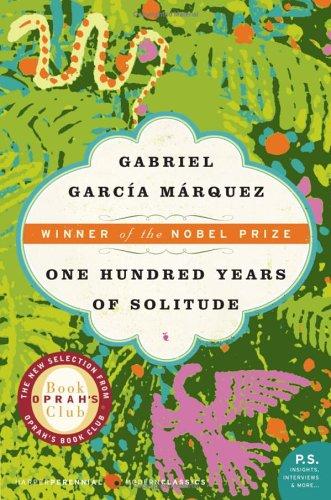
One Hundred Years of Solitude, published in 1967, is one of the most celebrated novels of the twentieth century. It traces six generations of the Buendía family in the mythical town of Macondo from its founding to its apocalyptic destruction, weaving together the personal and the historical, the natural and the supernatural, with seamless fluency. The novel invented a new mode — magical realism, in which the miraculous is rendered in the same matter-of-fact prose as the mundane — that proved extraordinarily influential on world literature. It sold more than fifty million copies, was translated into over forty languages, and is frequently cited as the greatest novel in the Spanish language.
García Márquez’s prose style is one of the wonders of world literature: its long, hypnotic sentences carry the reader forward on a current of accumulated detail that is simultaneously specific and mythic. He writes with an authority that permits him to move between the historical and the fantastical without breaking stride, and his narrative voice — that of a storyteller who has heard everything and is surprised by nothing — lends his most extraordinary inventions an air of absolute conviction.
Gabriel García Márquez received the Nobel Prize in Literature in 1982. He died on April 17, 2014, in Mexico City. His influence on world literature, particularly on the fiction of Latin America and the Caribbean but extending far beyond, has been as enormous as the river of his imagination. One Hundred Years of Solitude permanently expanded the possibilities of the novel and established García Márquez as one of the indispensable writers of the modern era.