G.W.F. Hegel
Georg Wilhelm Friedrich Hegel (1770–1831) was born in Stuttgart, in the Duchy of Württemberg, the son of a minor civil servant. A precocious student who was educated at the Tübingen Stift — a Protestant seminary where his dormitory-mates included Friedrich Schelling and Friedrich Hölderlin — Hegel came of age intellectually during the revolutionary decades at the end of the eighteenth century. The French Revolution, Kant’s critical philosophy, and the dawning of German Romanticism all left their mark on the young Hegel, who worked as a tutor and journalist before securing an academic position at Jena in 1801, just in time to witness Napoleon riding through the city after the Battle of Jena. He famously described Napoleon as the “World-Soul on horseback” — a phrase that captures his characteristic tendency to identify historical events as the unfolding of reason itself.
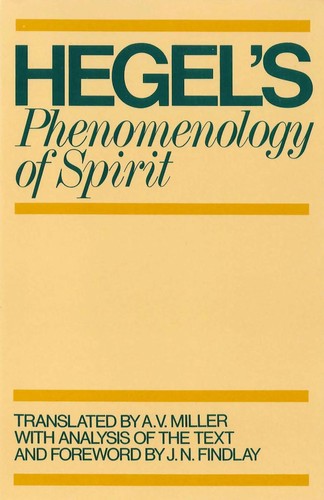
The Phenomenology of Spirit, published in 1807 under almost farcical conditions — Hegel sent pages to the printer while Napoleon’s cannons boomed outside Jena — is his first and in many ways most extraordinary philosophical achievement. The book traces the development of consciousness from its most elementary form — simple sensory awareness — through a dialectical progression of increasingly complex shapes of experience, culture, and thought, until it reaches Absolute Knowing, the form of consciousness that understands itself as identical with the structure of reality. Along the way Hegel analyzes the master-slave dialectic, Stoicism and Skepticism, the Enlightenment, the French Revolution, and the conflict between individual moral conviction and social ethical life — each moment shown to contain its own internal contradiction, which drives the dialectic forward.
Hegel’s method — the dialectic, in which every position generates its own negation and the two are reconciled at a higher level — became one of the most influential (and disputed) intellectual frameworks in modern thought. His later works developed his system across logic, philosophy of nature, and philosophy of mind. The Science of Logic (1816) gave the dialectic its most rigorous technical elaboration. The Philosophy of Right (1820) applied it to law, morality, and the state, producing both a defence of constitutional monarchy and the foundations of what would become left and right Hegelianism.
Hegel’s death from cholera in 1831 at the height of his influence left a philosophical vacuum that his followers immediately divided to fill. Left Hegelians, including the young Karl Marx and Ludwig Feuerbach, took the dialectic in a materialist, revolutionary direction. Right Hegelians defended the established religious and political order. Marx, famously, claimed to turn Hegel’s idealism “right-side up” by grounding the dialectic in material economic conditions rather than the development of Spirit — making Hegel indirectly one of the most consequential thinkers of the modern era.
The Phenomenology of Spirit, reviewed on WritersReview.com, is notoriously difficult — Hegel’s prose is dense, his argument cumulative, and his vocabulary technical in ways that require sustained effort. But the rewards are commensurate with the demands. The book is one of the most ambitious attempts in any literature to understand what it means for a self-conscious being to exist in a world with other self-conscious beings — and its insights into recognition, alienation, and the social constitution of selfhood retain a freshness that belies their age.