David Szalay
David Szalay is a British-Canadian author whose fiction examines the modern male experience with a clinical precision and emotional honesty that has earned him comparisons to the great realists of European literature. Born in 1974 in Montreal, Quebec, to Hungarian parents, Szalay grew up in Britain and was educated at Oxford. He has lived in various European cities, including London and Budapest, and his transatlantic, trans-European biography is reflected in fiction that treats the idea of rootedness with skepticism and tends to locate its characters in the middle distances—in airports, rented rooms, unfamiliar cities, the placeless spaces of contemporary life.
His early novels—London and the South-East (2008) and The Innocent (2009)—established his gift for economical prose and his interest in masculinity under pressure: the compromises men make, the self-deceptions they sustain, the gap between the life they imagined and the life they have. Spring (2011) continued in this vein with a love story set against the backdrop of the financial crisis, praised for its lack of sentimentality and its fidelity to psychological truth.
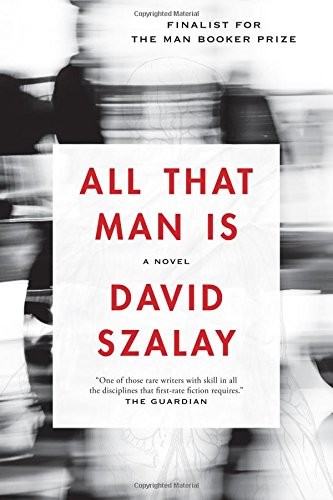
All That Man Is (2016), featured on WritersReview, is Szalay’s most celebrated and formally distinctive work. The novel—or perhaps more accurately, the novel-in-stories—presents nine men at different stages of life, from a seventeen-year-old backpacking through Europe to a seventy-three-year-old property developer facing his mortality, each portrait capturing a particular inflection of masculine experience in contemporary Europe. The book is structured to feel like watching a man’s life accelerate, each section moving further into middle and old age, each encounter with women, work, desire, and disappointment revealing something new about what it means to be alive in this particular moment in history. It was shortlisted for the Man Booker Prize and won the Gordon Burn Prize, and was recognized as one of the most formally inventive and emotionally unsparing works of literary fiction in years.
Szalay’s style is spare and observational, deeply influenced by the European modernist tradition but without its difficulty—his sentences are clean, his psychology acute, his refusal to console the reader absolute. He is interested in men not as heroes or villains but as specimens: flawed, self-justifying, often lonely, sometimes capable of kindness, always subject to time.
His subsequent novel, Turbulence (2019), applied a similar mosaic structure to a global network of characters connected by a single flight route, demonstrating that his formal concerns extend beyond any single gender or nationality. Szalay is regarded as one of the most distinctive voices in contemporary European fiction in English, a writer whose minimalism is hard-won and whose silences carry real weight.