Daniel Kahneman
Daniel Kahneman was born on March 5, 1934, in Tel Aviv, then part of British Mandatory Palestine, to Lithuanian Jewish parents. He spent part of his childhood in France during the Nazi occupation, an experience of hiding and fear that gave him an early, visceral understanding of the irrationality and contingency that shape human experience. He earned his bachelor’s degree in psychology and mathematics from the Hebrew University of Jerusalem in 1954 and served in the Israel Defense Forces as a psychologist before completing his PhD in psychology at the University of California, Berkeley, in 1961.
Kahneman joined the faculty of Hebrew University and began a decades-long collaboration with fellow psychologist Amos Tversky that would fundamentally transform the understanding of human judgment and decision-making. Their research challenged the prevailing assumption in economics and decision theory that people are rational actors who consistently maximize utility. Through a series of elegant experiments, they demonstrated that human thinking is systematically biased in ways that are predictable and repeatable—that people rely on mental shortcuts called heuristics that produce reliable errors rather than rational calculations.
Their work on prospect theory, which describes how people actually evaluate gains and losses (asymmetrically, with losses feeling roughly twice as powerful as equivalent gains), earned Kahneman the Nobel Prize in Economic Sciences in 2002—awarded to him alone as Tversky had died in 1996. The prize recognized decades of research that had spawned an entirely new field, behavioral economics, and reshaped thinking in finance, public policy, medicine, law, and organizational behavior.
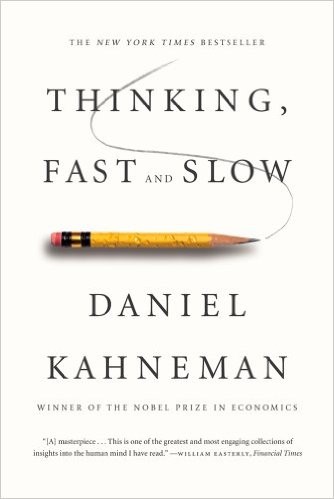
His book Thinking, Fast and Slow, published in 2011, synthesized a lifetime of research into a framework accessible to general readers. The book introduced the now-famous System 1 and System 2 framework: System 1 is fast, automatic, intuitive, and prone to bias; System 2 is slow, deliberate, and effortful. By explaining the specific ways that cognitive biases—anchoring, availability, overconfidence, the planning fallacy—arise from the tension between these two systems, the book gave readers both a vocabulary and a practical lens for examining their own reasoning. It sold millions of copies worldwide and was widely regarded as one of the most important popular science books of its era.
Daniel Kahneman continued to produce influential research into the psychology of wellbeing, experience, and memory, including his distinction between the experiencing self and the remembering self—a finding with profound implications for how we evaluate the quality of our lives. He died on March 27, 2024, in New York City, at age 90, leaving behind a body of work that transformed not just academic psychology but the practical understanding of how human minds navigate an uncertain world.