Andrew Sean Greer
Andrew Sean Greer was born on November 22, 1970, in Washington, D.C., and grew up in the suburbs of Maryland. He studied writing at Brown University, where he earned his undergraduate degree, and completed a master of fine arts degree at the University of Montana. He has lived in various cities over his career — New York, San Francisco, Rome, Paris — and the international literary life of an American writer abroad provides the background for his most celebrated novel. He has taught creative writing at numerous institutions, including the Iowa Writers’ Workshop and Harvard University, and is a respected presence in American literary culture as both a writer and a member of a network of authors that includes his close friends and champions in the literary community.
Greer published his first novel, The Path of Minor Planets, in 2001, and it was followed by The Confessions of Max Tivoli (2004), a novel narrated by a man who ages backwards, and The Story of a Marriage (2008), which became a finalist for the San Francisco Chronicle’s Best Books of the Year. These works established him as a writer of formal ingenuity, historical sensibility, and emotional generosity. His stories have been published in leading literary magazines, and his writing has been recognized with fellowships from the National Endowment for the Arts and the Guggenheim Foundation.
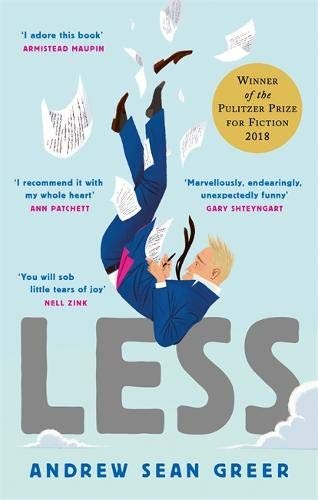
Less (2017), winner of the Pulitzer Prize for Fiction, is his most celebrated and widely read novel. A comic novel — rare in the contemporary American literary landscape — it follows Arthur Less, a middle-aged, moderately successful American novelist who, in order to avoid attending the wedding of his former lover, strings together a series of literary invitations into a circumnavigation of the globe: a literary prize in Mexico, a conference in Italy, a magazine assignment in Germany, a teaching stint in Japan, and a reading in India. Less is a man of gentle confusion and pervasive embarrassment, and the novel treats his mishaps with both tender comedy and genuine philosophical weight. The narrative frame — Less narrated by the lover he has left behind — gives the novel a structural elegance that only fully reveals itself in its final pages.
Greer’s prose is witty, warm, and quietly lyrical, possessed of a light touch with serious material that recalls the comic tradition of Waugh and Wodehouse while remaining distinctively American. He writes about gay male experience, aging, failure, and love without sentimentality and without the earnestness that occasionally weights contemporary fiction on these subjects. Less is funny in the sustained, structural way that only the best comic novels manage — not joke-by-joke but through the accumulation of situation and character — and it is also genuinely moving.
The Pulitzer Prize for Less was greeted with widespread pleasure by the literary community, partly because the novel is a comedy — a genre usually passed over by prize committees — and partly because its author’s evident delight in the pleasures of fiction felt like a rebuke to the grimmer modes of contemporary literary seriousness. Greer’s subsequent novel, Less Is Lost (2022), returned to Arthur Less for a road trip across America, confirming that the character had taken on a life beyond a single book. He remains one of the most warmly regarded figures in contemporary American letters.