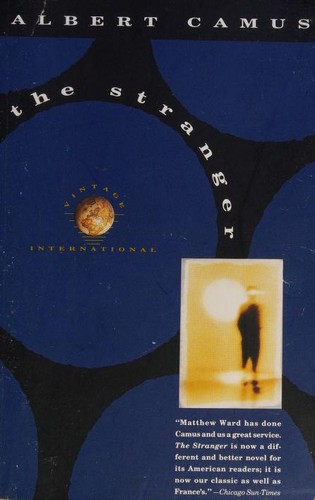
Albert Camus
Albert Camus was born on November 7, 1913, in Mondovi (now Dréan), in French Algeria, into a working-class family of French and Spanish descent. His father, Lucien, was an agricultural laborer who was killed at the Battle of the Marne in 1914, leaving his family destitute. Camus grew up in the Belcourt district of Algiers with his deaf, nearly illiterate mother, his uncle, and his grandmother — a childhood of poverty that gave him a visceral sympathy with the dispossessed and a lifelong identification with those at the margins of society. He was fortunate in his teacher: Louis Germain, his elementary school instructor, recognized Camus’s exceptional intelligence and recommended him for a scholarship to the lycée, an intervention that changed the course of his life. (Camus dedicated his Nobel Prize acceptance speech to Germain.) He went on to study philosophy at the University of Algiers, where his career was interrupted by a severe bout of tuberculosis — a disease that would recur throughout his life and that gave him a constant, lived awareness of mortality and of the body’s frailty.
Camus established himself simultaneously as a journalist, playwright, and fiction writer in Algeria before World War II. During the German occupation of France, he became editor of the clandestine Resistance newspaper Combat, a role that placed him at the center of French intellectual and political life after the Liberation. He was closely associated with the existentialist circle around Jean-Paul Sartre, though he increasingly distinguished his own philosophy of absurdism — the irreducible conflict between the human hunger for meaning and the universe’s utter indifference — from existentialism’s ethical commitments. His philosophical essays The Myth of Sisyphus (1942) and The Rebel (1951) articulated a moral and philosophical position that put him at odds with Sartre and much of the French intellectual left.
The Stranger (L’Étranger, 1942) is Camus’s most celebrated work of fiction and one of the defining novels of the twentieth century. Narrated by Meursault, a French Algerian who kills an Arab man on a sun-drenched beach and is subsequently tried and condemned to death — officially for murder, but effectively for his failure to perform socially required emotions at his mother’s funeral — the novel is both a philosophical demonstration of absurdist detachment and a searing critique of bourgeois social conventions that value emotional performance over authentic experience. Meursault’s famous first sentence — “Mother died today. Or maybe yesterday; I can’t be sure” — is among the most celebrated opening lines in world literature.
Camus’s style in The Stranger — spare, flat, deceptively simple, recording surfaces and sensations without interpretation — was a deliberate philosophical choice as well as a literary one, enacting Meursault’s radical refusal of inherited meaning. His subsequent novels, The Plague (1947) — an allegorical account of a bubonic plague epidemic in Oran, widely read as a parable of the Nazi Occupation — and The Fall (1956), moved toward greater complexity and moral ambiguity while maintaining his clarity of style and thought.
Camus was awarded the Nobel Prize in Literature in 1957, at the age of forty-three — the second-youngest laureate in the Prize’s history — for writing “which with clear-sighted earnestness illuminates the problems of the human conscience in our times.” He died on January 4, 1960, in a car accident near Sens, France, aged forty-six. An unfinished autobiographical novel, The First Man, was found in the wreckage and published posthumously in 1994. His death was mourned as one of the great premature losses of twentieth-century literature, and his work remains indispensable — as philosophy, as history, and as literature of the first order.