
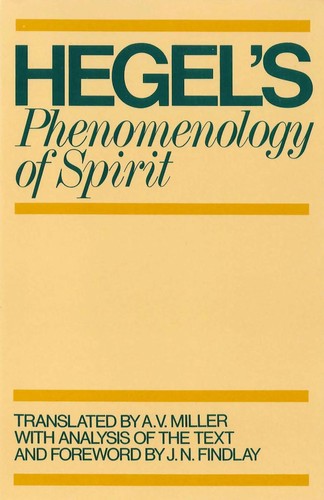
Phenomenology of Spirit
Oxford University Press · 1977 · 631 pages
ISBN: 9780198245971
Review Editor
Owen Strand
G.W.F. Hegel’s Phenomenology of Spirit, published in 1807, is the most ambitious philosophical work ever written. Hegel proposes nothing less than to trace the development of consciousness from its most naive, immediate form – simple sense-perception – through all the stations of its alienation and self-recognition, to the standpoint of absolute knowledge in which the opposition between subject and object, mind and world, is finally overcome. The journey takes consciousness through epistemology, psychology, moral philosophy, political philosophy, religion, and art, showing how each form of knowing breaks down through its own inner contradictions and generates a higher form. Whether or not one finds the destination convincing, the journey is the most sustained exercise in philosophical ambition in the Western tradition.
The Dialectical Method
Hegel’s method is dialectical. A position – a claim about what is real or what can be known – generates its own negation through internal contradiction. The contradiction is not resolved by abandoning both positions but by a higher synthesis that preserves what was true in both while showing how they belong together at a deeper level. This preservation-through-negation Hegel calls Aufhebung (sublation) – a German word that simultaneously means to cancel, preserve, and elevate.
The dialectic is not a mechanical formula but the logical structure of thought’s own self-development. Thought moves from immediacy to mediation, from abstract to concrete, from simple to complex – and each stage is richer than the last because it contains the negated earlier stages within itself. The final stage – absolute knowledge – is not the annihilation of all the earlier shapes of consciousness but their full, unified comprehension.
Sense-Certainty and Its Failure
The book opens with what seems like the most secure possible form of knowledge: the immediate certainty of what I am directly perceiving right now – this tree, this now, this here. Hegel’s analysis of sense-certainty is one of the most brilliant arguments in the book: the language we use to express this immediate certainty (this, here, now) turns out to be entirely universal – “this” and “now” can refer to anything and apply always. The immediate particular the senses grasp cannot be captured in the universal terms thought requires. Knowledge cannot be simply immediate; it requires mediation and the activity of consciousness in structuring what is given.
This failure launches the entire development of the book. Each subsequent form of consciousness – perception, understanding, self-consciousness, reason, spirit – represents an attempt to overcome the contradictions that brought down its predecessor, and each generates new contradictions of its own.
The Master-Slave Dialectic
The most famous passage in the Phenomenology is the analysis of self-consciousness in Chapter 4, particularly the master-slave dialectic. Two self-consciousnesses encounter each other, each needing the other’s recognition to be genuinely a self. They struggle for recognition to the death. One yields – becomes the slave – while the other, risking death, becomes the master. The master achieves recognition, but it is immediately revealed as empty: recognition from a slave is not the recognition of another free consciousness but the recognition of a thing.
The slave, working on objects at the master’s command, discovers something the master cannot: through labor, transforming the world through thought and hand, the slave finds their own consciousness reflected in the objects they produce. Work is the medium through which self-consciousness becomes genuinely real and concrete. Hegel’s inversion of the apparent power relation has been enormously influential – on Marx’s analysis of labor, on Kojeve’s existentialist reading, on feminist theory and postcolonial thought.
The Unhappy Consciousness
Following the master-slave dialectic, Hegel traces the development of self-consciousness through Stoicism (which finds freedom in pure thought, regardless of external circumstances), Skepticism (which destroys all determinate content), and the Unhappy Consciousness – his analysis of medieval Christian religiosity. The Unhappy Consciousness is divided against itself: it seeks an unchangeable, transcendent God but finds only its own finite, changing self in the world. This division – the consciousness that seeks its essential self in a beyond it cannot reach – is one of Hegel’s most psychologically acute analyses and one of the most searching philosophical accounts of religious alienation.
Spirit and History
The central chapters on Spirit (Geist) contain Hegel’s compressed history of modern European consciousness – Greek ethical life, Roman legal universalism, the Enlightenment’s struggle with faith, the French Revolution, and its aftermath in the Terror. The analysis of the Terror is extraordinary: Hegel argues that the abstract universalism of the Revolution – its reduction of all particular social bonds to abstract freedom – necessarily generates pure terror, since any particular individual can be accused of being an obstacle to abstract freedom. The horror of the Revolutionary tribunals is the dialectical consequence of abstract freedom’s attempt to realize itself.
Verdict: The Work That History Has Not Finished With
The Phenomenology of Spirit is a work readers either find transformative or impenetrable. Its difficulty is genuine – not just linguistic but substantive. Hegel is trying to show how apparently distinct philosophical problems (epistemology, ethics, politics, religion) are moments in a single developmental whole, and holding that whole in view requires sustained effort. The reward is a philosophical vision of unusual depth and scope.
Its influence has been enormous: Marx’s historical materialism is a materialist inversion of Hegel’s dialectical idealism; Kierkegaard defined his project against Hegel; Sartre’s phenomenology bears Hegelian marks; and the contemporary philosophy of recognition (Honneth, Taylor) is directly Hegelian. The Phenomenology is not a book that can be definitively mastered – readers return to it at different stages of their philosophical development and find different things. That inexhaustibility is the mark of a genuinely great work.
Frequently Asked Questions
What is the Phenomenology of Spirit about?
Hegel traces the development of consciousness from its most basic form (immediate sense-perception) through increasingly complex and self-aware forms – self-consciousness, reason, spirit, religion – to the standpoint of absolute knowledge, in which mind fully comprehends itself and its relation to the world. Each form of consciousness fails through internal contradiction and generates a higher form that preserves and overcomes it.
What is the Hegelian dialectic?
The dialectical method traces how a position generates its own negation through internal contradiction, and how both are preserved in a higher synthesis (Aufhebung – sublation). It is not a three-step formula (thesis-antithesis-synthesis) – this formulation was imposed on Hegel by later interpreters – but the logical structure of thought’s own self-development: from abstract immediacy to rich, mediated concreteness.
What is the master-slave dialectic?
Two self-consciousnesses struggle for recognition. One risks death (becoming master), the other yields (becoming slave). The master’s victory proves hollow: recognition from a slave is not genuine recognition. The slave, through labor, achieves genuine self-knowledge that the master cannot. This dialectical reversal has been enormously influential on theories of labor, recognition, and social identity.
What does Geist mean in Hegel’s philosophy?
Geist (usually translated “Spirit” or “Mind”) is Hegel’s term for the self-developing whole of rational thought that actualizes itself through history, culture, and human minds. It is neither a supernatural entity nor simply individual human consciousness but the intersubjective, historical medium through which mind comes to full self-knowledge.
What is Aufhebung in Hegel?
Aufhebung (sublation) is a German word Hegel exploits for its triple meaning: to cancel, to preserve, and to elevate. When a position is sublated in the dialectical movement, it is cancelled as inadequate, preserved as a moment of truth within a higher synthesis, and elevated to a richer, more adequate form.
Why is the Phenomenology of Spirit so difficult?
Hegel wrote it in extraordinary haste; his sentences are dense with presupposed philosophical context; his method requires holding multiple levels of argument in view simultaneously; and he is genuinely trying to express ideas that cannot be stated simply. Readers approaching it for the first time benefit from a good secondary introduction – Robert Pippin’s or Terry Pinkard’s is recommended – before tackling the text directly.
What is the Unhappy Consciousness?
The Unhappy Consciousness is Hegel’s analysis of a form of self-consciousness divided against itself – seeking its essential, unchangeable self in a transcendent God while finding only its finite, contingent self in the world. He associates it with medieval Christian religiosity. It cannot achieve the unity it seeks because it projects its own essential self onto a transcendent beyond it cannot reach.
Which translation of Phenomenology of Spirit should I read?
A.V. Miller’s Oxford translation (Clarendon Press, 1977) is the standard English version and widely used in philosophy courses. Terry Pinkard’s Cambridge translation (2018) is more recent, more readable, and philosophically sophisticated, with excellent notes. For first-time readers, Pinkard’s translation paired with his or Robert Stern’s commentary is the recommended approach.
Book Details
- Title
- Phenomenology of Spirit
- Author
- G.W.F. Hegel
- Genre
- Philosophy
- Publisher
- Oxford University Press
- Year Published
- 1977
- Pages
- 631
- ISBN
- 9780198245971
- WritersReview Rating
- 5.0 / 5