
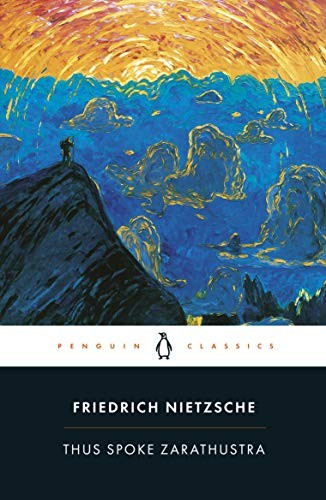
Thus Spoke Zarathustra
Penguin Classics · 1969 · 342 pages
ISBN: 9780140441185
Review Editor
Owen Strand
Friedrich Nietzsche called Thus Spoke Zarathustra his greatest gift to humanity. Written in four parts between 1883 and 1885, it is unlike anything else in the philosophical canon – a philosophical poem, a prose epic, a parody of biblical narrative, and a sustained provocation that has been misread more comprehensively than any philosophical work of the last two centuries. Its central ideas – the Uebermensch, eternal recurrence, the will to power, the death of God – have penetrated general culture so deeply that most people who invoke them have never read the book they come from. Reading it closely is both stranger and more rewarding than the popular versions suggest.
The Prophet Who Cannot Reach His People
The book follows Zarathustra, the ancient Persian prophet (chosen as a figure who once invented the morality Nietzsche is attacking, and who must therefore undo it), as he descends from a decade of solitary mountain contemplation to teach humanity his new wisdom. The structure is quasi-biblical: speeches, parables, encounters with various allegorical figures, a Last Supper of sorts, and a recurring failure. Zarathustra cannot get his message across. The people listen to him as entertainment, misunderstand him profoundly, and he repeatedly retreats back to his cave and his animals.
This structure is deliberate. Nietzsche is not just articulating new ideas; he is dramatizing the difficulty of communicating genuinely new values in a culture defined by old ones. The higher men whom Zarathustra eventually gathers cannot hold fast to his teaching – they fall back into conventional comfort at the first opportunity.
The Death of God and Its Consequences
“God is dead. God remains dead. And we have killed him.” This statement is not a metaphysical claim about divine existence but a cultural and historical one: the Christian God – the ultimate source of value, purpose, and moral authority in Western civilization – no longer functions as a genuinely operative belief. The edifice of Christian morality is crumbling, and nothing has yet emerged to replace it.
For Nietzsche, this is simultaneously catastrophic and liberating. Catastrophic: without the transcendent grounding that Christianity provided, Western culture faces the threat of nihilism – the conviction that nothing matters. Liberating: the death of the highest value is also the opening for the creation of new values. The Uebermensch is Nietzsche’s response to the nihilistic vacuum – not a divine replacement but a human ideal of self-overcoming and creative value-making.
The Uebermensch
Nietzsche’s Uebermensch (overman or superhuman) has nothing to do with racial superiority or the Nazi appropriation that Nietzsche’s sister helped engineer after his death. The Uebermensch is a philosophical ideal: the human being who has fully overcome nihilism, taken responsibility for creating their own values, and affirmed life completely – including its suffering – without recourse to otherworldly consolation.
Zarathustra introduces the Uebermensch by way of three metamorphoses: the spirit first becomes a camel (bearing the weight of existing values), then a lion (denying old values, saying the great “No”), then finally a child (the innocence of a new beginning, the capacity to create new values from a position of strength rather than resentment). The child-state is the Uebermensch’s essential condition – freedom from the reactive psychology that Nietzsche associates with conventional morality.
Eternal Recurrence
The most philosophically demanding idea in the book is eternal recurrence: the thought that every moment of your life has recurred infinitely and will recur infinitely – that the universe, lacking any direction or purpose, endlessly repeats the same configurations of matter and energy. This is not presented as a cosmological theory Nietzsche believed literally but as the most demanding possible test of one’s relationship to life: if you had to live this life over and over forever, would you want it?
The thought of eternal recurrence is the ultimate dissolution of the desire for otherworldly consolation. There is no escape from this life into a better one after death; there is only this life, repeated. The person capable of affirming eternal recurrence has achieved the complete affirmation of existence – the yes-saying to life in all its pain and joy – that Nietzsche considers the highest human achievement.
The Will to Power
The will to power in Zarathustra is not the crude desire for domination over others – that, for Nietzsche, is a sign of weakness rather than strength. Will to power is the fundamental drive toward self-overcoming, growth, and the expansion of one’s capacities. It is present in every living thing and expressed most fully not in conquest of others but in self-mastery and creative achievement.
The problem with conventional morality, for Nietzsche, is that it channels this drive into self-negation rather than self-development. The slave revolt in morality converts the powerless person’s resentment of the powerful into a moral system that declares weakness a virtue. Zarathustra’s alternative ethics values the strong, creative, self-overcoming individual over the resentful herd.
Verdict: The Book That Demands a Reader
Thus Spoke Zarathustra is a genuinely difficult book – not because of technical vocabulary or complex arguments but because its meaning is deliberately indirect, compressed in parable and symbol, and designed to provoke the reader into active interpretation rather than passive reception. Nietzsche explicitly did not want easy readers; he wanted readers willing to engage seriously with uncomfortable ideas.
What the book offers is extraordinary: a vision of human existence that takes suffering and death seriously without retreating into consolation, a critique of conventional morality that identifies its psychological roots in resentment, and an ideal of self-overcoming and creative value-making that remains genuinely provocative. Read with appropriate critical distance, Zarathustra remains one of the most challenging and vital works in the Western philosophical tradition.
Frequently Asked Questions
Who is Zarathustra in Nietzsche’s book?
Zarathustra is a fictional prophet loosely based on the historical Zoroaster, the ancient Persian religious figure. Nietzsche chose him precisely because the historical Zoroaster invented the moral dualism that Nietzsche is attacking – making him the appropriate figure to undo it. The character in the book is Nietzsche’s mouthpiece for his philosophical ideas, presented through a quasi-biblical narrative.
What is the Uebermensch?
The Uebermensch (overman or superhuman) is Nietzsche’s ideal of the human being who has overcome nihilism, taken full responsibility for creating their own values, and achieved a complete affirmation of life. It has nothing to do with racial superiority – Nietzsche explicitly despised nationalism and anti-Semitism. The Uebermensch is a philosophical ideal of self-overcoming and creative excellence.
What is eternal recurrence?
Eternal recurrence is the thought that every moment of your life recurs infinitely – the universe endlessly repeats the same configurations. Nietzsche uses it as the ultimate test of one’s affirmation of life: if you had to live your life over and over forever, would you want it? The person who can genuinely will the eternal recurrence of their life has achieved the complete life-affirmation Nietzsche considers the highest human achievement.
What did Nietzsche mean by the death of God?
“God is dead” is not a metaphysical claim but a cultural one: the Christian God no longer functions as a genuinely operative source of value and meaning in Western civilization. The edifice of Christian morality is crumbling without its transcendent foundation. This opens the possibility for nihilism but also for the creative revaluation of values that Nietzsche sees as the essential task of the coming era.
Did the Nazis misuse Nietzsche?
Profoundly so. Nietzsche’s sister Elisabeth Forster-Nietzsche selectively edited and distorted his unpublished notes to support nationalist and proto-fascist ideology. Nietzsche himself explicitly condemned German nationalism and anti-Semitism throughout his published work. The scholarly consensus is that his genuine philosophy is incompatible with National Socialism.
What is the will to power in Zarathustra?
The will to power is the fundamental drive toward self-overcoming, growth, and the expansion of one’s capacities. It is not primarily about domination over others but about self-mastery and creative achievement. It is present in every living thing but expressed most fully in the artist, the philosopher, and the self-overcoming individual who continuously pushes beyond their previous limits.
Is Thus Spoke Zarathustra a novel or a philosophy book?
It is both and neither. Nietzsche wrote it as a philosophical prose poem – a work with narrative elements, a recurring protagonist, and a quasi-biblical structure, but with no traditional argument. Ideas are expressed through parable, aphorism, and dramatic episode rather than systematic reasoning. This makes it unlike any other work of philosophy and demands a different kind of reading.
Which translation of Thus Spoke Zarathustra should I read?
R.J. Hollingdale’s Penguin translation is widely praised for its literary quality and accuracy. Walter Kaufmann’s Viking translation remains a scholarly standard with extensive commentary. Graham Parkes’s Oxford translation is more recent and philosophically precise. Hollingdale’s is probably the best starting point for most readers.
Book Details
- Title
- Thus Spoke Zarathustra
- Author
- Friedrich Nietzsche
- Genre
- Philosophy
- Publisher
- Penguin Classics
- Year Published
- 1969
- Pages
- 342
- ISBN
- 9780140441185
- WritersReview Rating
- 5.0 / 5