
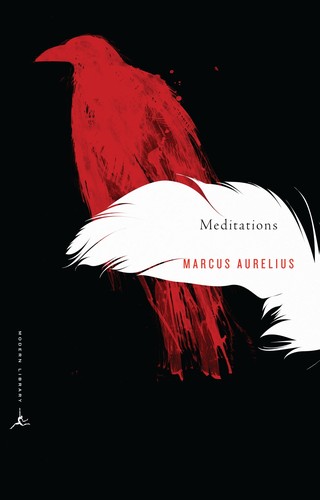
Meditations
Modern Library · 2002 · 254 pages
ISBN: 9780812968255
Review Editor
Owen Strand
Marcus Aurelius’s Meditations is the most intimate document in ancient philosophy. Written in Greek sometime between 161 and 180 CE, during campaigns on the Danube frontier and in the relative quiet of the imperial palace, it was never intended for publication. The Roman emperor was writing to himself – reminding himself of philosophical principles he knew but kept forgetting to apply, arguing with himself about what really matters, working through his own resistance to accepting what he had decided to believe. This is not a finished philosophical treatise but a private workbook, and that is exactly what makes it extraordinary.
A Stoic Emperor on the Frontier
Marcus Aurelius ruled the Roman Empire at its greatest extent, from 161 to 180 CE. He was by most accounts an effective and humane emperor, known for his legal reforms and his personal moderation. He was also constantly at war – the Marcomannic Wars on the northern frontier occupied much of his reign – and he found time amid military campaigns to compose the philosophical notes that became the Meditations. These are not the reflections of a man of leisure but of someone trying to hold onto philosophical composure under enormous pressure.
His primary philosophical influence is Stoicism, the school founded by Zeno of Citium in Athens around 300 BCE. He was particularly influenced by Epictetus, the former slave whose Discourses and Enchiridion Marcus knew well. But the Meditations is not a summary of Stoic doctrine; it is Stoic practice. Marcus is not explaining Stoicism to anyone – he is trying to live it.
The Central Stoic Distinction
The most important idea in the Meditations – and in Stoicism generally – is the distinction between what is up to us and what is not. What is genuinely in our power is our own will, our judgments, our desires, our responses to events. What is not in our power is everything external: other people’s actions, our reputation, our health, our wealth, our death. The Stoic task is to care intensely about the former and regard the latter with indifference.
This is not apathy. Marcus cares deeply about performing his duty as emperor, about treating others well, about acting justly. But he works to detach himself from outcomes he cannot control. The equanimity he seeks is not the absence of engagement but the presence of a stable inner life that external events cannot destabilize.
The Practice of Impermanence
A recurring theme throughout the Meditations is the brevity and transience of everything. Marcus returns obsessively to the image of the river of time carrying all things away – the great and the trivial alike, emperors and slaves, triumphs and disasters. Alexander the Great and his mule-driver ended in the same place. Everything that seems permanent is passing; everything that seems important is, from the perspective of the cosmos, negligible.
This might seem a depressing philosophy, but Marcus uses it differently. The impermanence of things is not a cause for despair but for present engagement. If everything passes, what matters is acting well now, treating the person in front of you well now, performing your duty now. The anxiety about future outcomes that paralyzes action is dissolved by the recognition that the outcome, whatever it is, will itself pass.
Self-Examination Without Self-Hatred
One of the most striking aspects of the Meditations is its tone of patient self-examination without self-laceration. Marcus is relentlessly honest about his failures and shortcomings – his temper, his impatience, his susceptibility to flattery, his difficulty maintaining philosophical composure under irritation. But he does not punish himself for these failures; he simply notes them and reminds himself what to do instead.
This quality distinguishes the Meditations from many self-help or spiritual texts that alternate between grandiose aspiration and crushing guilt. Marcus has a stable sense of what the good person does and simply keeps returning to it, without drama. When he fails, he begins again. This equanimity about one’s own imperfections is itself a form of Stoic virtue.
On Death, Reason, and the Whole
Marcus’s Stoicism includes a cosmology: the idea that the universe is governed by a rational principle (the Logos) and that each rational being participates in this cosmic reason. To live according to reason is not merely a personal achievement but a participation in the rational order of the whole. Death is simply the dissolution of one’s particular combination of matter and spirit back into the whole.
What is remarkable is how little Marcus depends on this cosmological framework for his practical conclusions. Whether or not the universe is providentially ordered, the response is the same: do your duty, act justly, treat others well, accept what you cannot change, and maintain your inner freedom. The Stoic ethical core survives intact even for readers who find the metaphysics unconvincing.
Verdict: The Most Direct of Ancient Guides
The Meditations is the most immediately useful of ancient philosophical texts precisely because it makes no claims to completeness or system. It is one intelligent, morally serious person talking to himself about how to live, and the problems he wrestles with – irritation at difficult people, anxiety about what others think, distraction by trivial concerns, difficulty maintaining composure under stress – are the problems every reader recognizes.
For contemporary readers, the Meditations speaks with particular directness to the experience of holding significant responsibility while remaining uncertain about ultimate questions. Marcus does not pretend to have solved the deep problems of philosophy; he has simply decided what to do in the meantime. The combination of philosophical seriousness, practical clarity, and honest self-examination makes the Meditations one of the great books of the Western tradition.
Frequently Asked Questions
What is the Meditations about?
The Meditations is Marcus Aurelius’s private philosophical journal – 12 books of notes and reminders to himself about how to live according to Stoic principles. Topics include the distinction between what is in our control and what is not, the impermanence of all things, the importance of doing one’s duty, how to treat difficult people, and how to maintain equanimity in the face of death and uncertainty.
Was the Meditations written for publication?
No. Marcus appears to have written these notes purely for his own benefit – as exercises in philosophical self-examination and reminders of principles he needed to keep in mind. The text was preserved after his death and eventually published, but it has the character of a private workbook rather than a polished treatise.
What is Stoicism?
Stoicism is a school of philosophy founded in Athens around 300 BCE. Its core ethical claim is that virtue – excellence of character – is the only true good, and that everything external (health, wealth, reputation, pleasure) is indifferent in the sense that it neither contributes to nor detracts from genuine flourishing. The Stoic task is to cultivate inner freedom by aligning one’s will with reason and accepting what cannot be changed.
What is the most important Stoic idea in the Meditations?
The distinction between what is up to us and what is not – between the inner life (judgments, desires, responses) which we genuinely control, and external circumstances (other people’s actions, outcomes, health, reputation) which we do not. Marcus works constantly to care intensely about the former and accept the latter with equanimity.
How does Marcus Aurelius deal with difficult people?
By reminding himself that difficult people act from ignorance – they do not know what is genuinely good and bad – and that getting angry at them is as irrational as being angry at a stone for being hard. He also reminds himself that he shares a rational nature with every person he encounters and that the appropriate response is patience and correction, not vengeance or withdrawal.
Is the Meditations a religious text?
Not in a conventional sense, but it has religious dimensions. Marcus’s Stoicism includes a cosmology in which a rational principle governs the universe and each rational being participates in it. The ethical core of the Meditations, however, does not depend on resolving cosmological questions about providence or the existence of gods.
Which translation of Meditations should I read?
Gregory Hays’s Modern Library translation (2002) is widely considered the best contemporary version – direct, clear, and accurate without being overly colloquial. Robin Waterfield’s Oxford translation (2021) is also excellent. Hays’s version, combined with his excellent introduction, is the best starting point for most readers.
How does the Meditations relate to modern Stoicism?
The contemporary Stoicism revival – visible in books like Ryan Holiday’s The Obstacle Is the Way – draws extensively on the Meditations alongside Epictetus and Seneca. Marcus’s emphasis on the dichotomy of control, the practice of negative visualization, and daily self-examination has translated well into modern contexts. The original text remains far richer than any of its popular adaptations.
Book Details
- Title
- Meditations
- Author
- Marcus Aurelius
- Genre
- Philosophy
- Publisher
- Modern Library
- Year Published
- 2002
- Pages
- 254
- ISBN
- 9780812968255
- WritersReview Rating
- 5.0 / 5