James Watson
James Watson was born in 1928 in Chicago, Illinois, the son of a businessman who instilled in him a fascination with birds and natural history. A child prodigy, Watson entered the University of Chicago at fifteen under the university’s early admissions program and graduated at nineteen with a degree in zoology. A reading of Erwin Schrödinger’s What Is Life? — a physicist’s speculation about the molecular basis of heredity — redirected his interests toward genetics, and he completed his PhD at Indiana University under Salvador Luria, one of the founders of molecular biology, in 1950. He was twenty-two.
In 1951 Watson arrived at the Cavendish Laboratory in Cambridge, where he met Francis Crick. The two men shared an intense belief that the structure of DNA — deoxyribonucleic acid, which experiments had shown to be the carrier of genetic information — was the most important unsolved problem in biology. Working with model-building, crystallographic data (including the famous “Photo 51” taken by Rosalind Franklin and Raymond Gosling at King’s College London), and the chemical constraints of base pairing, Watson and Crick proposed their double helix model in April 1953. The paper published in Nature — one page, modest in tone, revolutionary in implication — ended with the remarkable understatement: “It has not escaped our notice that the specific pairing we have postulated immediately suggests a possible copying mechanism for the genetic material.”
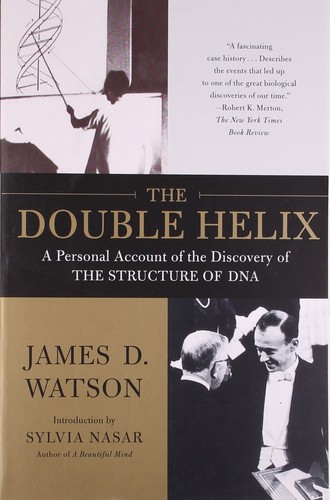
The Double Helix, published in 1968, is Watson’s personal account of the discovery — and it is one of the most unusual books in the history of science writing. Candid, gossipy, at times deliberately provocative, it presented science not as a noble cooperative enterprise but as a competitive, ego-driven race in which personality, ambition, and luck mattered as much as experimental skill. Watson’s portrayal of Rosalind Franklin — referred to throughout as “Rosy,” disparaged for her appearance and manner — generated immediate and lasting controversy. Subsequent scholarship, including Brenda Maddox’s biography Rosalind Franklin: The Dark Lady of DNA, has argued that Watson and Crick’s use of Franklin’s crystallographic data without her knowledge or credit was a significant ethical failure.
The controversy surrounding Watson deepened considerably in later years. In 2007, he made public statements claiming that African populations had lower average intelligence than other populations — claims that were scientifically unsupported and widely condemned. He was subsequently stripped of his honorary titles at Cold Spring Harbor Laboratory, where he had served as director, president, and chancellor for decades. In 2019, the laboratory severed all ties with him, citing these statements. Watson’s scientific legacy — the double helix remains arguably the most important discovery in twentieth-century biology — exists in permanent tension with the documented failures of his judgment and character.
The Double Helix, reviewed on WritersReview.com, endures as an important historical document regardless of its ethical complications. It captures the excitement and competitive intensity of a scientific breakthrough at close range, and its honesty about the sociology of science — the ambitions, rivalries, and serendipities that shape discovery — is genuinely illuminating. Watson and Crick received the Nobel Prize in Physiology or Medicine in 1962, along with Maurice Wilkins. Rosalind Franklin, who died of cancer in 1958 at thirty-seven, was ineligible for the Nobel Prize, which is not awarded posthumously.