
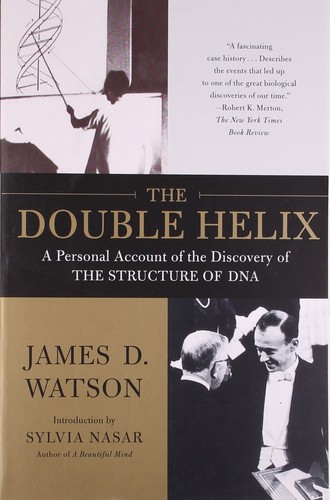
The Double Helix
Touchstone · 1968 · 256 pages
ISBN: 9780743216302
Review Editor
Lena Park
The Most Controversial Science Memoir Ever Written
James Watson published The Double Helix in 1968, fifteen years after he and Francis Crick built the model of DNA that explained how genetic information is stored and copied. The book was controversial before it was published – Francis Crick tried to stop it, the original publisher Harvard University Press backed out under pressure, and several of Watson’s colleagues objected to its characterizations. Its treatment of Rosalind Franklin, the X-ray crystallographer whose data was crucial to the discovery, has been debated by historians and scientists for decades. None of this controversy has diminished the book’s importance. It remains the most honest, most psychologically acute, and most illuminating account of how major science gets done.
What Watson captures that no other science book quite manages is the texture of competitive scientific work at the highest level: the personal ambitions, the institutional rivalries, the wrong turns, the luck, the occasional ethical shortcuts, and the intoxication of approaching a discovery that will change everything. Whether or not Watson’s characterizations of his colleagues are fair – and many are not – the underlying portrait of scientific practice rings true in ways that more decorous accounts do not.
The Race to Find the Structure of DNA
The narrative is a thriller. By the early 1950s, it was clear that DNA was the molecule of heredity and that understanding its structure would be essential to understanding how genes work. Three groups were in contention: Watson and Crick at Cambridge, Linus Pauling at Caltech (then the world’s most celebrated chemist), and Rosalind Franklin and Maurice Wilkins at King’s College London. The competition was understood to be a race, and Watson describes it as such – he is almost comically obsessed with the possibility that Pauling will get there first.
The book moves quickly through the false starts and recalibrations that preceded the final model. Watson and Crick built physical models – cardboard and wire constructions – and kept making structural mistakes. They briefly considered a triple helix. They consulted Chargaff, who had established that adenine pairs with thymine and cytosine pairs with guanine in DNA, without initially grasping the full significance of this constraint. They were shown Franklin’s X-ray diffraction photograph – the famous Photo 51 – by Wilkins without Franklin’s knowledge, and this data was crucial to confirming the double helix model.
The account of the final breakthrough is one of the great passages in science writing. Watson arrived at the lab one morning and started moving cardboard bases around on his desk, trying to figure out how they could pair with each other. He noticed that an adenine-thymine pair had almost exactly the same shape as a cytosine-guanine pair, and that both would fit the observed dimensions of the helix. He ran to find Crick. By the end of the day, they knew.
The Problem of Rosalind Franklin
The book’s treatment of Rosalind Franklin is the source of most of its ethical complexity. Watson portrays her unfavorably – as difficult, overly cautious, unaware of the significance of her own data, and resistant to model-building. He refers to her repeatedly and dismissively as “Rosy,” a nickname she apparently disliked. The portrait has been widely criticized as sexist and unfair, and subsequent historical research has substantially rehabilitated Franklin’s reputation.
The harder question is whether Watson and Crick acted ethically in using Franklin’s data without her knowledge or acknowledgment. The 1962 Nobel Prize in Physiology or Medicine went to Watson, Crick, and Wilkins. Franklin had died of ovarian cancer in 1958 at 37, before the prize was awarded. The Nobel is not given posthumously, but the near-invisibility of Franklin’s contribution in the original prize announcement and in much of the early commentary on the discovery is now generally acknowledged as a significant injustice.
Watson added a brief epilogue to the book noting that his initial assessment of Franklin was based on incomplete knowledge and that her personal modesty and essential contributions came to be more fully appreciated after her death. This does not fully repair the damage of the earlier portrait, but it is worth noting that Watson’s reconsideration was public and on the record.
Science as Human Practice
What the book gets right, with uncomfortable candor, is the human reality of competitive science. Scientists are not neutral observers of nature – they have careers, egos, rivalries, and ambitions. They compete for priority, sometimes cut corners, sometimes fail to credit colleagues generously, and sometimes make decisions under competitive pressure that they would not make in calmer circumstances. Watson does not present this as exceptional or aberrant. It is the normal texture of science at the frontier, and pretending otherwise produces a false picture of how knowledge is actually made.
This realism is ultimately the book’s most important contribution to the public understanding of science. It does not diminish the significance of what Watson and Crick achieved – the structure of DNA is one of the most important scientific discoveries of the twentieth century. But it insists that the discovery happened in a specific human context, made by specific human beings with specific limitations, and that this context matters for understanding what science is and how it works.
The Writing and Its Immediacy
Watson writes as if recalling the events in real time, with all the uncertainty and confusion they contained. The prose is direct, sometimes blunt, and deliberately naive in its presentation of scientific reasoning. He records his misunderstandings and his errors as well as his breakthroughs. The effect is a kind of temporal immediacy unusual in scientific memoir – the reader does not know that the double helix will be discovered, even when it is weeks away.
The social world of the book is as vivid as the science. The description of postwar Cambridge – the colleges, the sherry parties, the hierarchies of British academic life – situates the science in a specific cultural moment. Watson and Crick were outsiders in some respects, both to the established British science establishment and to the DNA research community proper. Their approach – model building from physical and chemical constraints rather than direct X-ray analysis – was heterodox and initially dismissed by some of their colleagues.
Why Every Science Reader Should Read This Book
The Double Helix has been assigned in biology and history of science courses for decades, and for good reason. It teaches more about how science actually works than any number of more idealized accounts. The competition, the collaboration, the lucky insights, the institutional constraints, the ethical gray areas, the role of personality in shaping discovery – all of these are present in this book and absent from most others. Reading it alongside a biography of Rosalind Franklin provides the corrective needed for the book’s most significant blind spots.
The discovery it describes remains one of the greatest in human history. Understanding that life stores and transmits information in a double helix, that the two strands are complementary and can serve as templates for copying, that the genetic code works through the specific pairing of bases – these insights opened the entire modern era of molecular biology, genetic medicine, and biotechnology. The Double Helix is the best account of how that understanding came to be.
Frequently Asked Questions
Is Watson’s portrayal of Rosalind Franklin fair?
Most historians of science now believe it is not. Franklin was a rigorous and accomplished scientist whose X-ray data was essential to the discovery, and the dismissive portrait Watson draws has been substantially contradicted by subsequent biographical research. The book should be read with this limitation clearly in mind – Brenda Maddox’s biography Rosalind Franklin: The Dark Lady of DNA provides the necessary corrective.
Did Watson and Crick steal Rosalind Franklin’s data?
The question is genuinely complex. Franklin’s Photo 51 was shown to Watson by Wilkins without her knowledge or consent. The data in her research reports was also shared with Watson and Crick through an MRC report, possibly without her awareness. Whether this constitutes theft depends on the standards of scientific practice one applies. Most historians agree that Franklin’s contribution was insufficiently acknowledged at the time and that this failure had significant consequences for her career and legacy.
Why did Watson write the book so personally and provocatively?
Watson later said he wanted to write a book that would be readable by people who would not ordinarily read a science book, and that this required honesty about the personal and competitive dimensions of scientific work. Whether he succeeded depends on how one values the honesty relative to the damage done to reputations. The book is certainly readable – it has stayed in print for over fifty years – and it certainly provoked.
What happened to the other people in the book?
Francis Crick continued working in molecular biology and later moved to the Salk Institute to work on consciousness. Rosalind Franklin died in 1958 at 37, never knowing the full significance of her contribution. Maurice Wilkins shared the 1962 Nobel Prize with Watson and Crick. Linus Pauling, who nearly got there first, won the Nobel Chemistry Prize in 1954 and the Peace Prize in 1962 and lived to 93. Watson directed the Cold Spring Harbor Laboratory for decades and made several highly controversial public statements about race in later life.
Does understanding the book require a science background?
No. Watson explains the relevant chemistry and crystallography clearly enough for a general reader, and the scientific details are secondary to the human story he is telling. Readers who want more background on DNA structure and molecular biology will find it elsewhere, but the book works as a narrative without that background.
What is the significance of the double helix structure?
The double helix structure explains how genetic information can be copied with high fidelity: each strand serves as a template for a new complementary strand, producing two identical double helices from one. This mechanism is essential for cell division and for the transmission of genetic information across generations. Understanding it opened the door to understanding the genetic code, mutations, gene expression, and ultimately the entire modern field of molecular biology.
Is there an updated edition with more context about Franklin?
Several editions of the book include scholarly apparatus that places Watson’s account in historical context, including accounts of Franklin’s contributions. The 2010 Simon and Schuster edition includes documents, commentary, and critical responses that substantially enrich the original text. This edition is recommended for readers who want to engage seriously with the history.
How has the scientific community viewed the book?
With a mixture of admiration and discomfort. The book is widely acknowledged as a masterpiece of science writing in terms of capturing the reality of scientific practice. Its treatment of Franklin is widely criticized. Many scientists have expressed ambivalence about a work that is simultaneously honest about how science works and unfair to one of its key contributors. This ambivalence is appropriate and should inform how readers approach it.
Book Details
- Title
- The Double Helix
- Author
- James Watson
- Genre
- Science & Nature
- Publisher
- Touchstone
- Year Published
- 1968
- Pages
- 256
- ISBN
- 9780743216302
- WritersReview Rating
- 5.0 / 5