
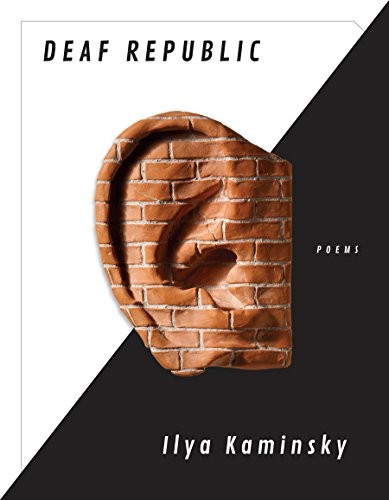
Deaf Republic
Graywolf Press · 2019 · 80 pages
ISBN: 9781555978310
Review Editor
Clara Fontaine
A Country Under Occupation, A People Gone Deaf
Ilya Kaminsky’s Deaf Republic arrived in 2019 and immediately announced itself as something rare: a book of poems that reads with the urgency of a novel and the moral weight of a parable. Set in an unnamed occupied town called Vasenka, the collection follows the townspeople who, following a soldier’s shooting of a deaf boy named Petya during a puppet show, collectively decide to go deaf – to refuse to hear the occupying soldiers’ orders. What follows is a love story, a resistance narrative, and a meditation on complicity that manages, through the compressed power of lyric poetry, to say more about political violence and civilian cowardice than most novels of three times its length.
The Formal Achievement: A Play Within a Collection
Kaminsky structures the collection as a kind of verse play in two acts, complete with a cast of characters, stage directions rendered in italics, and a chorus function performed by the town’s deaf citizens. This theatrical scaffolding does two things simultaneously: it gives the reader a clear narrative thread to follow, and it makes the horror of the occupation feel both particular and universal. The play-within-a-poem format recalls Brecht’s alienation effect, but Kaminsky deploys it not to create distance but to intensify intimacy. We know these characters – Alfie and Sonya, whose love story unfolds inside the occupation; Alfonso, who builds a resistance; the soldiers, who are never quite villains in the cartoonish sense but are terrifying precisely because of their banality.
Language and Deafness as Political Act
The central metaphor of the collection – deafness as refusal, as resistance, as solidarity – operates on multiple levels simultaneously. Kaminsky himself has been deaf since childhood, and the collection draws on that embodied knowledge to make deafness something other than a symbol of ignorance or limitation. To be deaf in Vasenka is to be free of the soldiers’ commands, to occupy a space they cannot fully enter. Sign language becomes a form of encrypted communication, a resistance underground that uses the body itself as cipher. “We lived happily during the war,” the collection’s famous opening line announces, and the tension between that happiness and the horror surrounding it is where most of the collection’s emotional and political work is done.
The Love Poems Inside the Catastrophe
Kaminsky is also writing a love story, and the love poems inside Deaf Republic are among the most beautiful in recent American poetry. Alfie and Sonya’s courtship, conducted through sign, charged with the desperation of people who know their time is limited, generates lyrics that are simultaneously erotic and elegiac. “I will be / the last man standing” is both a love promise and a war boast and a lie, and Kaminsky holds all three meanings without flinching. The tenderness of these poems makes the violence that surrounds them more unbearable, not less.
The American Coda and Its Challenge
The collection ends with a coda addressed directly to American readers: “We lived happily during the war / and when they bombed other people’s houses, we / but it wasn’t easy to do nothing, / it wasn’t easy to ignore, / but it wasn’t impossible / either.” The shift from the fictional Vasenka to the United States is abrupt and deliberate. Kaminsky is accusing his readers of exactly the collective deafness his characters performed as resistance – but in our case, the deafness is not heroic but complicit. This ending is what elevates Deaf Republic from a very good book to an essential one. It refuses to let the reader remain a witness; it insists on implication.
A Book for Our Moment
Deaf Republic won the National Book Critics Circle Award and was a finalist for the National Book Award, both of which seem to have surprised no one who read it. It is one of those rare books that feels simultaneously timely and timeless – rooted in specific historical atrocities (Kaminsky’s family fled Odessa; the book draws on European Jewish history) and entirely alive to present conditions. The collection is not long – eighty pages – and it can be read in a single sitting. It will not leave you the same way it found you.
Verdict
Deaf Republic is a masterpiece of the contemporary American lyric, a book that uses the compressed resources of poetry to do things that prose cannot. Kaminsky’s language is strange and beautiful; his moral vision is unsparing; his craft is extraordinary. This is the book to read if you want to understand what poetry can do at its highest pitch.
What is Deaf Republic about?
Deaf Republic is a verse collection set in an imaginary occupied town called Vasenka, where the townspeople collectively go deaf as an act of resistance after a soldier shoots a deaf boy named Petya. The collection follows the love story of Alfie and Sonya, a puppeteer’s resistance movement, and the widening spiral of occupation and reprisal – all told through lyric poems arranged as a two-act play.
Is Deaf Republic based on real events?
Not on any single event, but deeply rooted in historical reality. Kaminsky grew up in Odessa, Ukraine, in a Jewish family, and his family’s history of surviving authoritarian violence shapes the entire collection. The imaginary Vasenka draws on Eastern European Jewish history, Soviet occupation, and more recent conflicts. The collection was written before Russia’s 2022 invasion of Ukraine but is widely read now in that context.
What awards did Deaf Republic win?
Deaf Republic won the National Book Critics Circle Award for poetry in 2019 and was a finalist for the National Book Award. It was also named a best book of 2019 by numerous publications and is now widely taught in university poetry courses. Kaminsky was named a finalist for the Griffin Poetry Prize for the collection.
Is Ilya Kaminsky himself deaf?
Yes – Kaminsky lost most of his hearing from a childhood illness at age four. His own experience of deafness is central to the collection’s understanding of what it means to occupy a linguistic and perceptual space that the hearing world cannot fully access. The collection treats deafness not as disability but as a distinct form of consciousness and a potential mode of resistance.
How does the structure of Deaf Republic work?
The collection is organized as a verse play in two acts, with a cast of characters listed at the front, stage directions delivered in italics, and a chorus that speaks in the collective voice of the deaf townspeople. This theatrical structure gives the book narrative momentum unusual in a lyric collection while maintaining the compression and intensity of poetry. Each poem can be read individually, but they build collectively toward the book’s devastating conclusion.
Who should read Deaf Republic?
Readers who care about political poetry, about how art responds to violence, and about what contemporary American poetry can do at its most ambitious should read this book. It is accessible even to readers who do not normally read poetry – the narrative structure and clear cast of characters provide entry points that purely lyric collections do not offer. It is an ideal first book for readers coming to poetry from fiction.
How does the American coda at the end change the book’s meaning?
The coda shifts the address of the entire collection from its fictional Vasenka to contemporary America, implicating the reader in the very complicity it has been dramatizing. Where the townspeople’s deafness was heroic – a chosen refusal of oppression – American deafness is comfortable: we simply do not listen to what is happening elsewhere. The coda refuses the reader the position of sympathetic observer and insists on co-implication. It is one of the most powerful endings in recent American poetry.
What other books by Ilya Kaminsky should I read?
Kaminsky’s first collection, Dancing in Odessa (2004), is also essential – it draws more directly on his family’s history in Odessa and his grief for his father, and it shows the full range of his lyric gifts in a slightly different register. He has also edited and translated extensively, including 100 Poets Against the War and The Ecco Anthology of International Poetry. All are worth reading for anyone who wants to understand his work in context.
Book Details
- Title
- Deaf Republic
- Author
- Ilya Kaminsky
- Genre
- Poetry
- Publisher
- Graywolf Press
- Year Published
- 2019
- Pages
- 80
- ISBN
- 9781555978310
- WritersReview Rating
- 5.0 / 5