
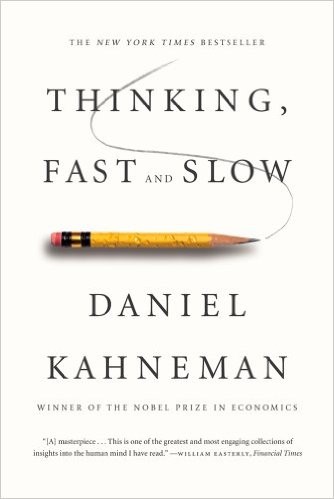
Thinking, Fast and Slow
Farrar, Straus and Giroux · 2011 · 499 pages
ISBN: 9780374533557
Review Editor
Daniel Okafor
Daniel Kahneman spent his career demonstrating that human beings are not the rational agents that economic theory assumes — that judgment and decision-making are systematically biased in predictable ways. Thinking, Fast and Slow is his attempt to synthesize a lifetime of research into a unified account of the two cognitive systems that he argues govern human thought. “System 1” is fast, automatic, associative, and largely unconscious. “System 2” is slow, deliberate, effortful, and rational. Most of the book is an account of the ways System 1 misleads System 2 — the cognitive biases, heuristics, and illusions that cause even highly educated, thoughtful people to make systematically poor judgments. The book won Kahneman the Nobel Prize… which he had already received in 2002, for the research that underlies it. Thinking, Fast and Slow is among the most important popular science books of the century so far.
Character Arcs
The book’s main “character” is Kahneman himself — a researcher whose career has been organized around the uncomfortable task of demonstrating how unreliable human intuition is, including his own. He is unusually honest about the limits of his findings and about the extent to which knowing about cognitive biases doesn’t protect against them. His long collaboration with Amos Tversky, whose early death before the Nobel Prize Kahneman has described as the greatest loss of his life, runs through the book like a presence. Their joint work on prospect theory and heuristics is presented with evident affection for the process as well as the findings. The autobiographical thread makes this a warmer book than its subject matter might suggest.
Pacing
The book is long — over 500 pages — and organized into five sections covering the two-system framework, heuristics and biases, overconfidence, choices, and two selves. The early chapters on the two-system model and the cognitive illusions it produces are the most accessible and engaging. The middle sections on overconfidence and expert judgment are among the most important — Kahneman’s demolition of financial expert performance and clinical prediction is bracing. The later sections on prospect theory are more technical and require more engagement. The book rewards patience — the cumulative picture it builds of human irrationality is more persuasive than any single chapter would be.
Thematic Depth
The book’s intellectual range is unusual — it covers visual perception, memory, statistics, economics, clinical judgment, and investment strategy while maintaining a coherent central argument. Kahneman is particularly effective on two themes: the limits of expert intuition (under what conditions can experts be trusted, and when is their confidence largely illusory?), and the systematic errors that affect large institutions as well as individuals. His work on “noise” — random variation in human judgment that is just as damaging as systematic bias — is developed more fully in his subsequent book Noise (2021) but is introduced here. The discussion of the “planning fallacy” (the systematic tendency to underestimate how long and costly projects will be) is one of the most practically useful sections.
Style and Voice
Kahneman writes with the clarity of someone who has spent decades making technical research accessible to non-specialists, and with the intellectual modesty of someone whose career has been organized around the unreliability of human judgment including his own. He anticipates objections, acknowledges limitations, and distinguishes between what the evidence shows and what he believes. This makes the book more credible rather than less confident — the humility is grounded in genuine uncertainty rather than false modesty. The writing is occasionally demanding, particularly in the prospect theory sections, but never gratuitously technical.
Verdict
Thinking, Fast and Slow is a landmark. It synthesizes decades of Nobel Prize-winning research into a unified and accessible account of how human judgment works and fails, with implications for medicine, law, finance, public policy, and daily decision-making. Not all of its findings have held up equally well in the replication crisis that has followed its publication, and Kahneman himself has been engaged in revising conclusions that didn’t survive subsequent testing. But the core framework and the most important findings remain robust, and no other book offers this much genuine insight into human psychology in a form that a general reader can engage with.
Rating: 4.2 out of 5
Book Details
- Title
- Thinking, Fast and Slow
- Author
- Daniel Kahneman
- Genre
- Business
- Publisher
- Farrar, Straus and Giroux
- Year Published
- 2011
- Pages
- 499
- ISBN
- 9780374533557
- WritersReview Rating
- 4.2 / 5