
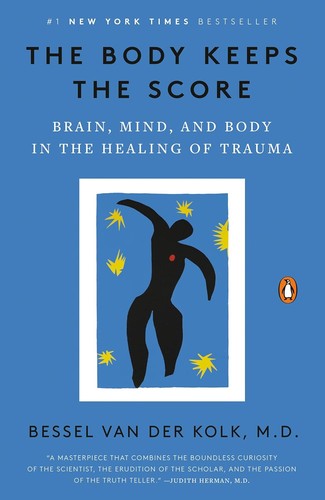
The Body Keeps the Score
Penguin Books · 2014 · 464 pages
ISBN: 9780143127741
Review Editor
Sofia Reyes
Bessel van der Kolk has spent four decades studying trauma — how it lives in the body, how it disrupts the nervous system, how it distorts perception and memory, and how it can be healed. The Body Keeps the Score is his attempt to synthesize that research for a general audience, and it is one of the most important books written about psychological trauma in the last thirty years. The title is the book’s thesis: trauma is not merely a mental event but a physical one — it alters the brain’s threat-detection systems, disrupts the capacity for emotion regulation, and leaves the body stuck in patterns of survival response that outlast the original threat. Understanding this, van der Kolk argues, changes everything about how trauma should be treated.
Character Arcs
Van der Kolk writes as a clinician and researcher, and the book is structured around the cases he has treated and the research questions those cases generated. His patients — veterans with PTSD, abuse survivors, children whose early trauma has rewired their developing nervous systems — are rendered with care and specificity, anonymized but not abstracted. He tracks his own intellectual evolution through the book: his early clinical training, which missed the somatic dimensions of trauma entirely; his research with Vietnam veterans, which showed how trauma patterns persist across decades; and his gradual conversion to therapies — EMDR, yoga, theater, neurofeedback — that work through the body rather than the talking cure alone.
Pacing
The book is ambitious in scope, covering neuroscience, developmental psychology, attachment theory, and multiple treatment modalities across 450 pages. The early chapters establishing what trauma does to the brain and body are the most grounded and the most important. The middle sections on developmental trauma — what happens when the threat is a caregiver rather than an external event — are harrowing and essential. The later treatment chapters are more varied in quality: the sections on EMDR and somatic therapies are well-supported by evidence; the chapter on theater as trauma treatment is intriguing but thinner than what precedes it. The book occasionally sprawls, but van der Kolk earns the scope with the depth of his case material.
Thematic Depth
The book’s central intellectual contribution is its argument that trauma treatment must engage the body, not only the mind. Talk therapy, van der Kolk argues, has real limits in treating trauma precisely because trauma is stored in the body’s alarm systems and often can’t be accessed through language alone. The neuroscience he presents — on the amygdala as threat detector, on Broca’s area going offline under extreme stress, on how the nervous system learns to be perpetually vigilant — explains why trauma survivors are often unable to simply talk themselves out of survival states. This isn’t a polemic against talk therapy but an argument for its limits and for the therapies — somatic, movement-based, body-oriented — that can reach what language can’t.
Style and Voice
Van der Kolk writes with the authority of a clinician who has spent decades in the room with suffering, and with the engagement of someone who has never become numb to it. The prose is clear and accessible without oversimplifying. He translates neuroscience for general readers without dumbing it down, and he illustrates abstract concepts through patient stories that make the science human. He is also honest about the limits of his own knowledge and the contested state of trauma research — a scientific modesty that makes his stronger claims more credible. The book occasionally reads as advocacy for specific treatments he favors, which some reviewers have noted, but the advocacy is grounded in evidence rather than mere enthusiasm.
Verdict
The Body Keeps the Score is essential reading for anyone who works with trauma, lives with it, or loves someone who does. It is one of the most thorough and readable accounts available of what trauma is, what it does to the brain and body, and what actually helps. The treatment sections are uneven but the foundational science is solid and clearly explained. More than a decade after publication, it has shaped how trauma is understood and treated across psychiatry, psychology, and social work, and it shows no signs of being superseded. This is the kind of book that changes how readers understand not just trauma but the relationship between experience, body, and mind.
Rating: 4.5 out of 5
Book Details
- Title
- The Body Keeps the Score
- Author
- Bessel van der Kolk
- Genre
- Self-Help
- Publisher
- Penguin Books
- Year Published
- 2014
- Pages
- 464
- ISBN
- 9780143127741
- WritersReview Rating
- 4.5 / 5