Elie Wiesel
Elie Wiesel was born on September 30, 1928, in Sighet, a small town in the Carpathian Mountains of Romania (then part of Hungary). He was the third of four children in a deeply observant Jewish family; his father was a shopkeeper and a pillar of the local Jewish community, and from his earliest years Wiesel was immersed in Jewish religious life, mysticism, and scholarship, particularly the traditions of Hasidism and the Kabbalah. This world—vibrant, rooted, ancient—was obliterated in the spring of 1944, when the Jews of Sighet were transported to Auschwitz. Wiesel was fifteen years old. His mother Sarah and his youngest sister Tzipora were killed upon arrival. Wiesel and his father were sent to the men’s camp, where they endured together until his father’s death from dysentery, exhaustion, and starvation in the final weeks of the war, in the Buchenwald camp. Wiesel was liberated in April 1945, one of a shattered remnant.
After liberation, Wiesel was taken to France, where he lived in an orphanage and eventually studied at the Sorbonne. He became a journalist, writing for French and Israeli newspapers, and for ten years maintained a self-imposed silence about his experiences in the camps, believing that the Holocaust was beyond the reach of language. It was the writer Francois Mauriac who persuaded him to break that silence. The result was a lengthy memoir in Yiddish, Un di velt hot geshvign (And the World Remained Silent), published in 1956, which Wiesel later condensed and translated into French as La Nuit, published in 1958 and in English as Night in 1960.
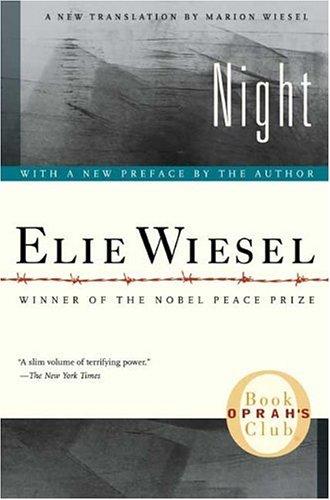
Night, available on Writers Review, is among the most important books ever written about the Holocaust and about human evil. In fewer than 120 pages, Wiesel recounts the destruction of his world, the systematic dehumanization of the camps, the death march from Auschwitz, and the death of his father—events rendered with a precision and restraint that makes them more devastating than any more rhetorically amplified account could be. The book’s central crisis is not physical survival but spiritual: the young Wiesel’s agonizing confrontation with the silence of God in the face of absolute evil, his loss of faith, and his equally agonizing inability to fully abandon it. It is a book that poses, without resolving, the most fundamental theological and moral questions of the century.
Wiesel went on to write more than fifty books—novels, essays, plays, and additional memoirs—as well as to become one of the most prominent public advocates for Holocaust memory, human rights, and the responsibilities of witness. He taught at Boston University for many years and was awarded the Nobel Peace Prize in 1986, with the Nobel Committee describing him as a “messenger to mankind.” His Nobel lecture remains one of the most powerful statements ever made about the obligation of those who survived atrocity to speak for those who did not.
Elie Wiesel died on July 2, 2016, in New York City. His legacy is twofold: as a literary artist who found language adequate to the most extreme human experience, and as a moral witness whose life and work stand as a permanent injunction against indifference. Night has sold more than ten million copies in the United States alone and has been translated into thirty languages. It is taught in schools and universities around the world, and its central question—how human beings can commit such crimes, and what obligations fall upon those who know—remains as urgent as it was when Wiesel first set it down.