
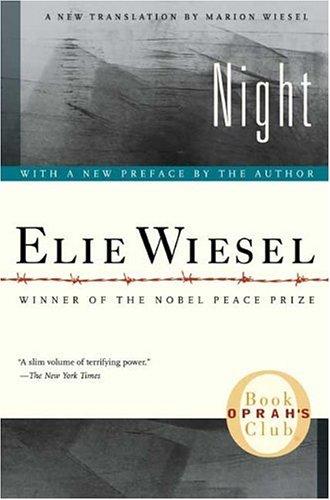
Elie Wiesel was fifteen years old when the Hungarian gendarmerie rounded up the Jews of Sighet, his Transylvanian hometown, and loaded them onto cattle cars. He arrived at Birkenau in the spring of 1944. He survived Auschwitz and Buna. He arrived at Buchenwald after the death march from Buna in January 1945. He was liberated in April 1945. His father did not survive. Night — 120 pages, first published in French as La Nuit in 1958 — is Wiesel’s account of those years, and it is one of the essential testimonies to the Holocaust: spare, unadorned, and written with the discipline of someone who understood that what happened resisted most of the tools that prose ordinarily deploys.
Character Arcs
The central relationship in Night is between Wiesel and his father, Shlomo Wiesel, and the book’s most harrowing achievement is its honest account of what survival conditions did to that relationship. The camps required each prisoner to devote every resource to personal survival, and Wiesel depicts without flinching the moments when he failed his father, the moments when he considered failing him, and the complex guilt of the survivor who outlived the person he most wanted to protect. This is not self-condemnation; it is testimony. He shows what the camps were designed to do to human bonds, and that showing is itself an indictment.
The young Wiesel who enters the cattle car in Sighet is a devout student of Talmud and Kabbalah who believes, with the conviction of his upbringing, in a God who watches over his people. The Wiesel who is liberated in Buchenwald has undergone a transformation that the book traces with precision — not a loss of faith in the sense of simple disbelief, but a rupture with a God who had not answered, who had not intervened, who had been silent when silence was the most devastating possible response. This theological dimension of Night distinguishes it from testimony that is primarily historical.
Pacing
Night is short because it is concentrated. Wiesel had originally written a much longer account, published in Yiddish, which he later condensed into the French text. The condensation required decisions about what to include and what to omit that are visible in the finished book: some episodes are rendered in extraordinary detail; others pass in a sentence. The pacing follows what stays in the mind rather than what a historian would require, and this is exactly right for what the book is trying to do.
The death march from Buna in the winter of 1945, during which prisoners who stopped moving were shot, is rendered in fragmentary passages that capture the experience of pushing through extreme cold on legs that have stopped feeling. These passages demonstrate what the spare prose accomplishes that a more elaborate style would not: the reader is not explaining what the march was like but experiencing something of its condition.
Thematic Depth
Night is about the systematic destruction of a people, but its particular contribution to that subject is the interior dimension — what it felt like, what it did to faith and family and the sense of self. Wiesel is not writing history; he is writing testimony, and the distinction matters. History accounts for what happened; testimony accounts for what it was to have it happen to you.
The book’s engagement with faith is its most enduring and most contested aspect. Wiesel does not resolve the theological problem that the Holocaust presents to Jewish thought — he holds it open, and the openness is the most honest possible response. His later career as a witness, lecturer, and Nobel laureate extended the work of Night into a different register, but the book itself remains the purest and most concentrated form of what he had to say.
Style and Voice
The prose of Night is controlled to a degree that can initially seem flat but reveals itself, on sustained reading, as exactly calibrated. Wiesel could have written a more emotionally expressive account; he chose not to, understanding that the events described exceed what emotional prose can contain. The flatness is itself an expression of what was experienced — the numbing that survival required, the inadequacy of ordinary registers of feeling to what was being done.
The sentences are short and declarative. Subject, verb, object. The only ornamentation is what is needed to see: the flames, the smoke, the silence. This discipline is sustained for 120 pages and never breaks. It is one of the most difficult things a writer can do, and Wiesel does it without apparent effort, which is the sign of absolute mastery over the material.
Verdict
Night is not a comfortable book and it is not a beautiful one in any conventional sense. It is a necessary one — a book that earns a place alongside the primary documents of one of the twentieth century’s central events, not because of its historical comprehensiveness but because of what it does that history cannot do: put the reader inside the experience of a person for whom what happened was happening. It is one of the most important memoirs ever written, and one of the most technically accomplished. The 120 pages accomplish what most writers cannot achieve in ten times the length.
Rating: 4.3 out of 5
Book Details
- Title
- Night
- Author
- Elie Wiesel
- Genre
- Biography
- Publisher
- Hill and Wang
- Year Published
- 1958
- Pages
- 120
- ISBN
- 9780374500016
- WritersReview Rating
- 4.3 / 5