
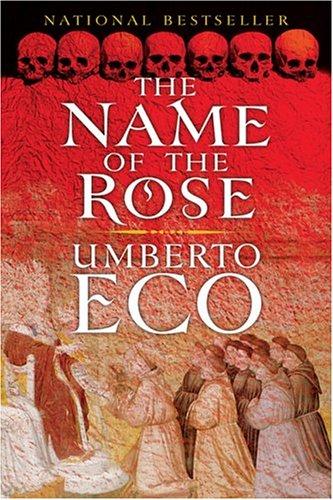
The Name of the Rose
Harcourt Brace / Harvest Books · 1983 · 536 pages
ISBN: 9780156001311
Review Editor
James Voss
Umberto Eco was a professor of semiotics at the University of Bologna, not a novelist, when he published his debut novel in Italian in 1980. The Name of the Rose arrived in English in 1983 in a translation by William Weaver, and it became one of the more improbable bestsellers of the decade: a seven-hundred-page medieval murder mystery saturated with Latin, theological disputation, and semiotic theory. It has since sold more than fifty million copies worldwide. That number tells you something real: beneath the scholarly apparatus is a story that grips, a detective who compels, and a set of ideas that press against each other with genuine friction.
The novel opens in November 1327 at a fictional Benedictine abbey in northern Italy. A Franciscan friar named William of Baskerville arrives with his young novice, Adso of Melk, to participate in a theological debate about whether Christ and his apostles were bound by a vow of absolute poverty. The dispute sounds dry on the page, but Eco grounds it in real stakes: which institution controls the interpretation of Scripture, and who loses if the answer changes. Within a day of William and Adso’s arrival, a monk is found dead. Then another. Then more. The abbot, anxious to keep order before the papal delegation arrives, asks William to investigate quietly. At the center of every death stands the abbey’s library, a deliberate labyrinth in a fortified tower, accessible only to the librarian and guarded more jealously than anything else in the community.
The story is told entirely by Adso, who narrates as an old man looking back. He warns us from the first pages that the detective does not fully succeed, that what happened cannot be recovered whole, and that the names of things outlast the things themselves. That framing lifts the novel above the mechanics of plot. We are reading a meditation on what knowledge is, how institutions treat it, and what happens when both knowledge and the institution collapse together.
Character Arcs and Development
William of Baskerville is the most satisfying thing in the book, and also the most instructive. Eco named him deliberately after Sherlock Holmes (Hound of the Baskervilles) and William of Ockham simultaneously: he is an empiricist who reasons from physical evidence, distrusts superstition, and brings a naturalist’s patience to human behavior. In an early scene, he identifies a horse he has never seen by reading tracks in the snow, manure on a bush, and claw marks on bark. Adso is dazzled. But William spends much of the novel constructing a theory about the murders based on the sequence of the Book of Revelation’s seven trumpets, and for a long time it seems to fit. When the truth finally emerges, he realizes the pattern was partly coincidental and partly engineered by someone who understood how he thought. He solves the case, but imperfectly, and the loss that follows on his watch marks him. He is a portrait of rational intelligence at its best and at its ceiling.
Adso is the novel’s emotional center. He is seventeen, devoted to his novice’s vows, and entirely unprepared for the world William moves through with such ease. One night, leaving the library through the kitchen, he encounters a peasant girl from the village below the abbey. They do not share a language. What follows is his only experience of physical love, and Eco writes the scene with unexpected tenderness rather than scandal. Adso goes to William immediately afterward, shattered. William listens carefully, offers absolution, and they never fully return to it. As an old man, Adso still thinks of her. He never learns her name. That namelessness connects to everything the novel argues about the limits of what we can hold onto, and it gives the book its one genuinely heartbreaking note.
The antagonist, Jorge of Burgos, stands in sharp contrast to both men: he is old, blind, conservative, and sincere in a way that makes him harder to dismiss than a straightforward villain. His convictions about knowledge and order go back decades and rest on a coherent, if extreme, theological logic. He believes that certain ideas, if allowed to circulate freely, corrode the fear that sustains faith. He acts on this belief without hesitation. Eco drew the character as a homage to Jorge Luis Borges, and the connection is exact: like Borges, Jorge of Burgos is a blind librarian whose imagination runs to labyrinths and whose relationship to knowledge is proprietary rather than generous.
Pacing
The first quarter of the novel is deliberately slow. Eco builds out the abbey’s architecture, the political context of the theological dispute, and the internal hierarchy of the Benedictine community with the care of someone who spent years in the archives to get it right. Readers expecting the novel to move at the speed of modern crime fiction will be startled, and some will put it down. That is a real limitation. The book trusts you to care about apostolic poverty debates and the classification system of a medieval library, and not every reader will make that trust work. But the structure rewards patience: the middle section builds real momentum as the deaths accumulate and William’s investigation runs into one barrier after another, and the final two days of the seven-day structure accelerate quickly, with revelations pressing close together. There is a sag in the fifth day that even admirers notice, when the narrative stops to accommodate a lengthy inquisition scene that runs longer than the plot strictly requires. Eco earned his digressions, but not every one of them.
Deeper Thematic Exploration
The novel’s deepest argument concerns what institutions do to knowledge when they decide to protect it. The abbey’s library is not a repository of learning but a gatekeeping device: it contains books the librarian has decided ordinary monks should not read, organized in a deliberate labyrinth that only the librarian can navigate. Knowledge is not withheld maliciously, exactly; it is withheld paternalistically, which Eco treats as nearly as dangerous. The deaths in the novel trace directly back to that arrangement. Access to certain books became something to kill for, not because the books were worth killing for, but because someone had made them forbidden.
Running alongside this is a sustained argument about laughter. Jorge believes, in complete sincerity, that comedy is a threat to Christian order: if laughter makes sacred things seem small, it drains the fear that holds the community together. He cites the authority he knows against it. William disagrees, and makes his case on humanist grounds: laughter is part of what it means to be rational and embodied, and suppressing it does not protect faith, it deforms it. The debate between them is never resolved, and Eco does not declare a winner. Jorge dies unpersuaded. William escapes, but the library and everything in it burns. What is left is the question.
Eco also builds through the novel a running meditation on semiotics, on the gap between signs and what they signify. William reads the world like a text: footprints, stains, architectural features, the order of deaths. He constructs meaning from evidence with confidence. But the novel keeps showing him reading correctly and still arriving somewhere wrong. The final line, in Latin, translates roughly as: “The rose of old exists only in its name; we hold only naked names.” What we can know of the past, or of anything, is its name. The thing itself is always partially out of reach. For a murder mystery, that is an unusually honest conclusion.
Style and Voice
Eco writes in Adso’s voice, which is formally medieval in its construction without becoming opaque. William Weaver’s translation manages to sound antique and alive at the same time, a balance that most literary translations of difficult source texts fail to achieve. The prose is dense with learning, carries Latin phrases that are either translated in context or explained by William, and does not apologize for the density. Eco wrote the book he wanted to write, and the texture of the sentences is part of the argument: reaching this knowledge requires effort, and some knowledge cannot be translated into simpler terms without losing what makes it worth having. There are passages of real beauty, especially in Adso’s descriptions of the church at dawn and his account of the peasant girl’s face, places where the learning falls away and what remains is a young man trying to describe something he cannot fully understand. Those passages are worth the long road to reach them.
Verdict
This novel is not a book for everyone. It asks real patience: with medieval history, with theological argument, with a detective story that ends in qualified success and significant loss rather than resolution. What it gives back is proportionate to what it asks. You come out of it having thought seriously about censorship, about what institutions do to ideas, about whether rational investigation can reach truth or only approximate it, and about the particular grief of a young man who fell in love once and never learned the name of the person he loved. If historical fiction with philosophical weight is your territory, or if you want a mystery that will still be worth thinking about three months after you finish it, read this. If you need narrative momentum from the first page, go elsewhere first. But if you go in knowing what you are getting, few novels from the last half-century will stay with you longer.
Frequently Asked Questions about The Name of the Rose
What is The Name of the Rose by Umberto Eco about?
The Name of the Rose is a murder mystery set in a Benedictine abbey in northern Italy in November 1327. A Franciscan friar named William of Baskerville and his young novice Adso investigate a series of suspicious deaths connected to the abbey’s labyrinthine library. Beneath the mystery plot, the novel is a philosophical exploration of knowledge, censorship, faith, and the gap between what we think we know and what we can actually prove.
Is The Name of the Rose difficult to read?
It is a genuinely demanding book. Eco was a semiotics professor before he was a novelist, and he builds out the theological and political context of 14th-century Christianity in considerable detail. At 500-plus pages, with Latin passages and extended digressions on medieval thought, it asks patience from readers used to faster fiction. The detective plot gives it structure and forward motion, but the first quarter especially is slow. Readers who push through to the midpoint generally find it accelerates significantly and becomes harder to put down.
What are the main themes in The Name of the Rose?
The novel develops four major themes in tandem. Knowledge and censorship: who decides what people can read, and at what cost. Laughter and its value: whether comedy is a threat to religious order or an essential part of human rationality. Epistemology: the limits of logical deduction and whether we can ever fully know the truth of past events. And the fragility of cultural memory: the library at the center of the story represents an irreplaceable archive, and the novel is acutely interested in what happens when that archive is lost.
Is there a movie or TV adaptation of The Name of the Rose?
Yes, two. In 1986, director Jean-Jacques Annaud adapted the novel into a film starring Sean Connery as William of Baskerville and Christian Slater as Adso. The film compresses the novel substantially but captures its atmosphere well and received strong reviews. In 2019, an eight-part Italian television miniseries aired, starring John Turturro as William and Rupert Everett as the Grand Inquisitor Bernard Gui. The series has more room to develop the theological context and is worth watching if you want more of the novel’s depth.
What is the significance of the title The Name of the Rose?
Eco has said he chose it precisely because “the rose is a symbolic figure so rich in meanings that by now it hardly has any meaning left.” The title deliberately resists a single interpretation, which reflects the novel’s argument about the gap between signs and the things they represent. The book’s last line, a verse by the medieval monk Bernard of Cluny, translates as: “The rose of old exists only in its name; we hold only naked names.” It is a statement about knowledge and loss that applies to everything in the story.
Who is William of Baskerville based on?
William of Baskerville is a double allusion. His surname references Arthur Conan Doyle’s Sherlock Holmes story The Hound of the Baskervilles, and Adso’s early description of William deliberately echoes Watson’s first description of Holmes in A Study in Scarlet. His first name references William of Ockham, the medieval philosopher associated with the principle of Occam’s razor: prefer the simplest explanation consistent with the evidence. William combines the deductive method of one and the philosophical frame of the other.
How does The Name of the Rose compare to Eco’s other novels?
The Name of the Rose is Eco’s most accessible novel and the best entry point to his fiction. His second novel, Foucault’s Pendulum (1988), is considerably more demanding: it follows three editors who construct an elaborate conspiracy theory about the Knights Templar that begins to feel real, and it requires more patience with postmodern literary games. The Island of the Day Before (1994) and Baudolino (2000) are also historical, also intellectually dense, and also rewarding, but none of them combine the accessibility of a detective plot with the philosophical weight as successfully as the first novel does.
Should I read The Name of the Rose and is it worth the effort?
If you read for ideas as much as for plot, yes, absolutely. The novel has something real to say about how institutions control knowledge, how rational investigation works and fails, and what the human cost of certainty looks like. If your primary interest is in fast-paced mystery fiction, it will frustrate you at least in the first hundred pages, and possibly throughout. The honest recommendation is this: read the first fifty pages and judge whether you want to stay. If the texture of the world Eco builds there engages you, the rest of the novel will more than repay the investment.
Book Details
- Title
- The Name of the Rose
- Author
- Umberto Eco
- Genre
- Mystery & Thriller
- Publisher
- Harcourt Brace / Harvest Books
- Year Published
- 1983
- Pages
- 536
- ISBN
- 9780156001311
- WritersReview Rating
- 4.5 / 5