
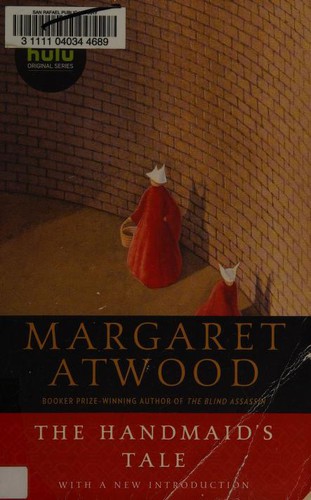
The Handmaid’s Tale
Anchor Books · 1985 · 311 pages
ISBN: 9780385490818
Review Editor
Marcus Webb
Margaret Atwood wrote The Handmaid’s Tale in Berlin in 1984, surrounded by the evidence of what totalitarian regimes could do. She imposed on herself a rule that would define the novel’s peculiar authority: nothing would appear in the book that had not already happened somewhere in human history. No invented atrocities. No speculative technology. Only the past, reassembled into a plausible future. The result is one of the most important novels of the twentieth century, and one that has refused to become dated.
What Happens in The Handmaid’s Tale
The Republic of Gilead has replaced the United States government following a series of attacks attributed to Islamic terrorists. Gilead is a theocratic state governed by a fundamentalist Christian patriarchy that has responded to a fertility crisis by enslaving women who are still fertile – the Handmaids – and assigning them to high-ranking male officials (the Commanders) and their wives. The Handmaids’ function is reproductive; they participate in a monthly Ceremony designed to produce children for Commander households.
The narrator is Offred – a name derived from “of Fred,” the Commander to whom she is assigned. She was previously a woman with a husband, a daughter, a job, and a name. All of this was taken from her when Gilead came to power. She narrates from within her current servitude, recalling her former life in fragments and navigating a world where nearly every interaction is surveilled, where women cannot read, and where the penalties for disobedience are public hanging.
The novel follows Offred through one posting in one Commander’s household over a period of months. She develops a cautious relationship with the Commander, who invites her to secret evenings in his study that violate Gilead’s own rules. She begins an affair with his driver, Nick. She makes contact with a resistance network called Mayday. She does not escape; she survives.
Offred’s Voice
Atwood’s narrative strategy is to give Offred a voice that is acutely self-aware about the conditions of its own narration. Offred knows she is constructing a story; she knows that memory is unreliable; she offers alternate versions of events and acknowledges their inconsistency. She says, near the novel’s end: “This is a reconstruction. All of it is a reconstruction.” This reflexivity does not undermine the reader’s investment; it deepens it, by acknowledging the difficulty of bearing witness under conditions designed to prevent witness.
Offred’s tone is dry, precise, and capable of sudden tenderness. She mourns her previous life in specific sensory details – the feel of her daughter’s hair, the smell of her husband’s skin. She observes the women around her with a novelist’s attention. She does not idealize anyone, including herself.
Gilead as System
Atwood builds Gilead with the specificity of a sociologist. Every element of its structure has a historical precedent. The Handmaid system draws on Jacob’s wives in Genesis; the color coding of women by function draws on historical sumptuary laws; the political violence draws on twentieth-century totalitarianisms. The novel is not a warning about Christianity per se; it is a warning about what any ideology does when it acquires the power to enforce itself without restraint.
The women of Gilead are complicit in their own oppression in varying degrees. The Wives resent the Handmaids but rely on their function. The Aunts enforce the system’s rules with genuine conviction. Offred’s predecessor in the Commander’s house hanged herself. These details accumulate into a portrait of how totalitarianism works: not simply by imposing force from outside, but by restructuring the conditions of life so thoroughly that resistance becomes difficult to sustain even in imagination.
The Historical Notes
The novel ends with an academic appendix: a transcript of a symposium held in 2195 in which scholars discuss the “Gildean Studies” field and the authenticity of the document the reader has just read. This structural move is brilliant and unsettling. It places Gilead in the past, confirms that it eventually ended, and transforms the novel into a historical document. It also raises questions about how scholars interpret the lives of people who lived under oppression: the male academics in the symposium are more interested in the document’s provenance than in Offred’s experience.
Who This Book Is For
The Handmaid’s Tale is essential reading for anyone interested in feminist literature, dystopian fiction, or the political novel. It is not a comfortable book, but it is a necessary one, and Atwood’s control over every element – the narrative voice, the world-building, the structural irony – makes it a model of what the genre can achieve.
Frequently Asked Questions
- Is The Handmaid’s Tale anti-Christian?
- The novel critiques a specific form of fundamentalist theocracy, not Christianity broadly. Atwood draws on the Bible throughout – the red of the Handmaids’ robes references the blood of Christ, the naming system references Genesis – but her argument is about power, not faith.
- Does The Handmaid’s Tale have a sequel?
- Yes. Atwood published The Testaments in 2019, which won the Booker Prize and is set fifteen years after the events of The Handmaid’s Tale. It is narrated by three women including Aunt Lydia, one of the Gilead system’s enforcers.
- What is the TV adaptation?
- Hulu’s The Handmaid’s Tale (2017) stars Elisabeth Moss and has run for multiple seasons, extending far beyond the novel’s events. It is highly regarded but takes significant liberties with the source material.
- What happened to Offred?
- The novel does not resolve her fate. She is taken away in a vehicle at the end; it is unclear whether the men taking her represent the regime or the resistance. The Historical Notes appendix implies she survived long enough to record her account, but provides no details of her life afterward.
- Is the novel set in the future?
- It is set in an unspecified near future, sometime in the late twentieth century based on the Historical Notes’ reference to a 2195 symposium. Atwood was deliberately vague about the timeline.
- Why can’t women read in Gilead?
- Literacy gives women access to information, argument, and alternative ways of thinking. Gilead restricts it for the same reason all totalitarian systems restrict it: to limit the conditions under which resistance can form.
- What does “Offred” mean?
- It is a possessive construction derived from the Commander’s name, Fred – “Of Fred.” The Handmaids take the names of their Commanders, which signals that they are property rather than persons. Offred notes that her real name is buried somewhere inside the word if you look at it the right way.
- Is The Handmaid’s Tale more relevant now than when it was published?
- Many readers feel it is. Atwood herself has argued that what she was describing was not speculative so much as historically grounded, and that the conditions she depicted are not as remote as comfortable readers might hope. The novel’s readership has grown significantly in periods of political turmoil.
Book Details
- Title
- The Handmaid’s Tale
- Author
- Margaret Atwood
- Genre
- Literary Fiction
- Publisher
- Anchor Books
- Year Published
- 1985
- Pages
- 311
- ISBN
- 9780385490818
- WritersReview Rating
- 5.0 / 5