
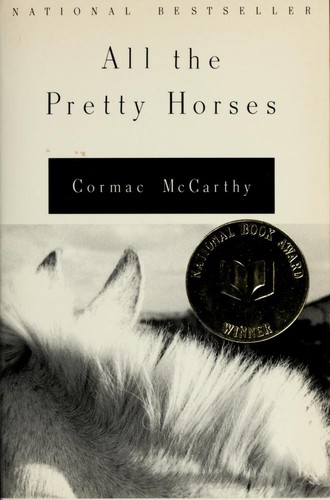
All the Pretty Horses
Vintage International · 1992 · 302 pages
ISBN: 9780679744399
Review Editor
admin
Summary
All the Pretty Horses is the most emotionally accessible of Cormac McCarthy’s novels, which is not the same as saying it is simple. Published in 1992, it is the first volume of the Border Trilogy and the book that gave McCarthy a mainstream readership after decades of southern Gothic and Blood Meridian. John Grady Cole is sixteen, has just lost the family ranch in Texas to his mother’s decision to sell it, and rides south into Mexico with his friend Lacey Rawlins in search of a life that still makes sense. He finds work as a horse breaker on a vast hacienda in Coahuila, proves himself extraordinary with horses, and falls in love with the hacendado’s daughter, Alejandra. None of this ends the way he wants it to.
The novel is a love story, a coming-of-age story, and an elegy for a way of life that had already ended before John Grady was born. The Mexico he rides into is not a fantasy of freedom but a place with its own violence, its own hierarchies, its own indifference to the romantic expectations of a sixteen-year-old from Texas. His love for Alejandra is real and is requited and is impossible for reasons that have nothing to do with either of them.
McCarthy’s treatment of horses is as close to the center of the novel as the human characters. John Grady’s relationship with horses is not sentimental; it is a form of deep attentiveness and respect, and the novel’s most beautiful passages describe his work with them. The horses are the one thing that remains legible and trustworthy in a world that keeps becoming incomprehensible.
Character Arcs and Development
John Grady Cole begins as someone who believes that skill and integrity will be sufficient. The novel does not dispute these qualities; it shows what happens to them when they encounter a world that does not share his assumptions. His arc is not from naivety to cynicism but from innocence to something harder: a knowledge of loss that is not quite bitterness because he is not constitutionally capable of bitterness. He returns to Texas at the end diminished in what he expected and unchanged in what he is.
Lacey Rawlins is the novel’s warm counterweight to John Grady’s intensity: more cautious, more practical, occasionally more perceptive about danger, ultimately less transformed by the experience. His decision to return home while John Grady presses on is one of the novel’s quietly significant moments.
Alejandra is drawn with real complexity: she is not a passive object of John Grady’s love but someone with her own knowledge of what her world will and will not permit, and her choice at the end, which breaks John Grady, is not weakness but a different and harder form of realism than he is capable of.
Themes and Symbolism
The horses are the novel’s central symbol: they represent the world John Grady understands and that understands him, a world of direct relationship between effort and result, of beauty that is also functional, of wildness that can be brought into partnership without being destroyed. The world of human politics and family and money does not work like this, and the novel’s tension is between these two registers.
The border itself operates as a threshold throughout the novel. Crossing into Mexico is crossing into freedom of a kind; what John Grady discovers is that freedom does not mean safety or legibility, that the other side of the border has its own structures that he cannot navigate by his own code.
Writing Style and Craft
McCarthy’s prose here is both more restrained and more lyrical than in Blood Meridian. There are long, beautiful sentences about landscape and horses, and short declarative sentences for violence and loss. The Spanish is not translated; McCarthy trusts the reader to follow the sense from context, which creates an immersive effect in the Mexico sections. The dialogue is exceptional: McCarthy’s ear for the way men talk when they are not talking about what matters is unmatched in American fiction.
Historical and Cultural Context
Set in 1949-50, the novel takes place at the moment when the world John Grady wants to inhabit was definitively ending. The mechanization of ranching, the consolidation of land, the fading of the cowboy economy: all of this is background to the story but shapes its elegiac tone. McCarthy is not sentimentalizing this world so much as recognizing that its loss was real and that people like John Grady had no other vocabulary for understanding themselves.
Final Assessment
All the Pretty Horses is the right entry point for readers coming to McCarthy for the first time. It has his violence and his darkness, but it also has warmth and beauty and a protagonist worth following through difficulty. The love story is genuine. The horses are magnificent. The ending is the kind that stays with you for years because it does not resolve into either tragedy or hope but into something more accurate: the continuing fact of a life that must go on after losing what it most wanted.
FAQ
- Is All the Pretty Horses appropriate for young adults?
- It is commonly taught in high school and is appropriate for mature teenagers. It contains violence and some sexual content, but McCarthy handles both with restraint compared to his other novels. The themes of identity, loss, and moral integrity are extremely well-suited to young adult readers.
- Is All the Pretty Horses part of a series?
- Yes. It is the first volume of the Border Trilogy, followed by The Crossing (1994) and Cities of the Plain (1998). The three novels are loosely connected and can be read independently, but reading them in order deepens the experience of each.
- What are the main themes in All the Pretty Horses?
- The loss of innocence and the collision between personal codes of honor and the wider world’s indifference to them, the relationship between humans and animals, love and its limits, and elegies for a way of life that has already ended before the protagonist is old enough to live it.
- How does All the Pretty Horses compare to Blood Meridian?
- All the Pretty Horses is far more accessible. It has a conventional narrative arc, a protagonist the reader can identify with, a love story, and far less graphic violence. Blood Meridian is philosophically darker and more formally demanding. Both are great novels, but they offer very different reading experiences.
- Is there a film adaptation of All the Pretty Horses?
- Yes. Billy Bob Thornton directed a 2000 adaptation starring Matt Damon and Penelope Cruz. The film was troubled in production and is generally considered inferior to the novel, though it captures some of the landscape and the love story adequately.
- What does the title All the Pretty Horses mean?
- It comes from a traditional lullaby (also known as Hush-a-Bye) and evokes the world of gentle domesticity and innocence that the novel systematically dismantles. The horses in the novel are not pretty in the sentimental sense; they are magnificent and difficult and real. The title holds the sentimental expectation up against what the novel actually delivers.
- Is the Spanish in All the Pretty Horses translated?
- No. McCarthy leaves Spanish dialogue untranslated throughout. This is a deliberate choice that creates immersion in the Mexico sections and places the reader in the same position as John Grady: having to follow meaning from context and gesture rather than from complete comprehension. Most readers find they can follow the essential meaning without translation.
- Should I read All the Pretty Horses?
- Yes, especially if you are new to McCarthy. It is his most emotionally accessible novel, his most conventionally beautiful, and the one that most directly rewards the reader with a complete and deeply felt story. It is also, arguably, his most hopeful: not in its ending, which is sad, but in its portrait of what a person can be.
Book Details
- Title
- All the Pretty Horses
- Author
- Cormac McCarthy
- Genre
- Literary Fiction
- Publisher
- Vintage International
- Year Published
- 1992
- Pages
- 302
- ISBN
- 9780679744399
- WritersReview Rating
- 5.0 / 5