
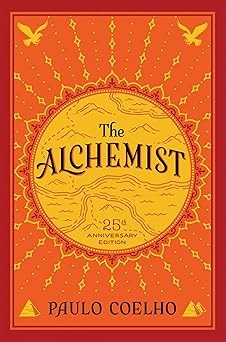
The Alchemist
HarperCollins Publishers · 1988 · 208 pages
ISBN: 9780062315007
Review Editor
Sofia Reyes
Summary
Santiago is an Andalusian shepherd boy who keeps having the same dream: a child takes him to the Egyptian pyramids and tells him he will find treasure there. When a mysterious old king named Melchizedek confirms the dream is a true omen, Santiago sells his flock and boards a ship to Africa in pursuit of what the king calls his Personal Legend, the thing he was put on earth to accomplish.
The journey does not go smoothly. In Tangier, a thief steals every coin Santiago has, stranding him in a foreign city without a friend or a word of the local language. He rebuilds his savings working for a kindly crystal merchant, then joins a desert caravan crossing the Sahara. On that crossing he meets an Englishman obsessed with alchemy and, at a desert oasis, a young woman named Fatima, with whom he falls in love. An alchemist eventually takes Santiago under his wing for the final, most dangerous leg of the journey through warring tribal territory to the pyramids. What Santiago finds there, and what he learns the treasure actually is, completes the folktale with a satisfying twist that readers either greet as profundity or roll their eyes at, depending on their tolerance for parable.
The novel is lean, barely 170 pages in most editions, and reads at a brisk pace. First published in Portuguese in Brazil in 1988, it sold slowly until Coelho secured a foreign translation deal, after which it spread first through France, then across the world. By the mid-2000s it had become one of the best-selling books in history, and in 2009 earned its author a Guinness World Record as the most translated living author. Its staying power across decades and cultures makes it worth examining not just as a story, but as a cultural phenomenon.
Character Arcs and Development
Santiago is less a fully realized character than an every-person vessel. He has wants (the treasure), fears (poverty, wasted potential), and a growing intuition, but readers learn little about his inner life beyond what the allegory requires. Coelho is transparent about this: the boy is meant to stand in for any person who hesitates at the call of their own destiny.
The supporting cast follows the same logic. Fatima is the idealized beloved who waits without complaint. The Englishman embodies bookish seeking that has not yet become lived experience. The crystal merchant represents the tragedy of the unlived life: a man who knows his Personal Legend, to visit Mecca, but nurtures the dream unfulfilled because it keeps him going. His is arguably the novel’s most quietly devastating portrait, a person who has made a philosophy of deferral.
The Alchemist himself functions less as a character than as a mouthpiece for the book’s cosmology. He speaks in aphorisms, demands that Santiago trust the Soul of the World, and then disappears. For readers who come to fiction expecting psychological depth, these figures will feel thin. For readers who come open to parable, they feel archetypal in the proper, useful sense.
The most convincing arc belongs to the crystal merchant. Santiago’s transformation is announced rather than dramatized; we are told he has changed more than we feel it. But the merchant’s stasis is rendered in precise, telling detail. He has a list of excuses so well worn they have become furniture. That contrast, between the boy who acts and the man who almost does, is the emotional spine of the first half, and it lands.
Pacing
The first third of the book, from Santiago’s initial dream through his stranding in Tangier and slow recovery working for the crystal merchant, is the strongest. Coelho allows time to accumulate. The reader feels the weight of the setback and the satisfaction of watching Santiago rebuild through patience and attentiveness.
Once Santiago joins the caravan and the abstract lessons begin arriving faster, the pacing tightens into something closer to a fable summary than a novel. The desert crossing is handled in compressed strokes. The tribal conflict that threatens Santiago’s life is resolved so quickly it barely registers as danger. The final revelation at the pyramids, when it comes, lands in fewer pages than the setup warranted.
This is a structural choice, not a careless one. Coelho is writing allegory, and allegory does not linger. But readers who have settled in for a fully realized adventure may feel the back half shifts register on them without warning.
The chapter structure reinforces the pace. Chapters are short, rarely more than a few pages, which keeps the book moving even during its more philosophical passages. This is deliberate technique: the brevity of each unit makes the accumulated length feel lighter than it is, and allows readers to set the book down and return without losing the thread. The novel was clearly engineered to be read, and re-read, easily.
Deeper Thematic Exploration
The novel’s central concept, the Personal Legend, carries both its power and its most significant vulnerability. The idea that each person has a unique destiny the universe is conspiring to help them fulfill is enormously comforting and deeply appealing. It has also attracted pointed criticism: a philosophy of individual destiny that places the universe’s resources at the service of the protagonist’s journey sits awkwardly beside questions of privilege, accident, and structural constraint. What is the Personal Legend of a person born into circumstances that foreclose most choices?
Coelho does not engage with this critique directly. The novel trusts its conceit completely. Whether that trust reads as wisdom or as wishful thinking depends considerably on where the reader is standing when they open the book. Many readers encounter The Alchemist at a turning point, late adolescence, mid-career restlessness, recovery from loss, and find its framing transformative. Others, reading in more stable circumstances or with a more skeptical disposition, find the philosophy underdeveloped.
The Soul of the World is presented as a kind of universal language that transcends the particulars of culture and religion. The novel draws on Islamic, Christian, and alchemical traditions with a deliberately syncretic looseness. This is both one of its strengths, in that it travels across cultures, and one of its weaknesses, as it does not go deep into any tradition. The alchemy is decorative. The Sufi resonances are gestural.
What holds is the novel’s insistence that the journey matters more than the destination, and that paying attention to signs and omens is a form of aliveness. That is a real insight, even if the scaffolding around it strains under close examination.
Style and Voice
Coelho writes in a stripped, parabolic prose that owes more to the fable tradition than to the literary novel. Sentences are short. Dialogue is clean and declarative. Metaphors are stated rather than discovered: the reader is told what things mean rather than left to feel it. This directness is a feature, not a failure; it is the register of oral storytelling, of folk wisdom, of the kind of story that travels well across languages.
The prose does not attempt surprise or sonic texture. It aims at clarity, and it achieves it. Whether that feels like a virtue or a limitation depends on what the reader wants from fiction. Readers who value the sentence as a unit of pleasure will find Coelho’s style lean. Readers who want to be carried swiftly through a meaningful story without obstruction will find it ideal.
There is a lineage worth naming. The Alchemist sits in a tradition that includes Antoine de Saint-Exupery’s The Little Prince and Richard Bach’s Jonathan Livingston Seagull: slim, parabolic books that have reached enormous audiences by making large philosophical claims in simple, accessible language. Coelho’s novel belongs on that shelf. It shares their strengths and their vulnerabilities.
The translation from Portuguese by Alan R. Clarke in the HarperCollins edition is smooth and does not call attention to itself, which is the correct ambition for this kind of work. That the book has been translated into more than 80 languages, and feels native in many of them, is its own testament to the portability of Coelho’s style.
Verdict
The Alchemist is not trying to be a complex novel, and measured against what it is trying to do, it largely succeeds. It is a parable about the importance of following your deepest calling, written in clear, portable prose, structured with the satisfying arc of the classic folktale. It has reached hundreds of millions of readers for reasons that are genuine: it arrives at a useful emotional truth and delivers that truth without waste.
Its limitations are real. The characters are functions more than people. The philosophy is comforting to the point of bypassing difficulty. The back half rushes. But these are the compromises of allegory, and they have not prevented the book from doing the work it was meant to do: arriving in the hands of someone uncertain, reminding them that the thing they most want to do is worth doing, and sending them back out into the world a little less afraid.
That is not a small thing.
Frequently Asked Questions
Is The Alchemist worth reading?
For most readers, yes. Its brevity means the investment is low and the potential return is high. Whether you find it life-changing or merely pleasant depends largely on how open you are to fable as a form. Readers who encounter it at a moment of uncertainty or transition tend to find it landing hardest.
What is The Alchemist about?
On the surface, it is about a Spanish shepherd boy who journeys to Egypt in search of treasure. Beneath the surface, it is about the idea that every person has a Personal Legend, a unique calling, and that the universe actively conspires to help those who pursue it. The treasure, when found, carries a meaning beyond its literal value.
What is the main message of The Alchemist?
The central message is that pursuing your deepest desire, your Personal Legend, is not just personally fulfilling but is what the universe intends for you. A secondary message, delivered through the crystal merchant, is that deferring your deepest desire indefinitely may be the most costly choice you can make.
Is The Alchemist based on a true story?
No. It is a work of fiction in the parable tradition. However, Coelho has said that Santiago’s journey mirrors his own experience of abandoning a conventional life to pursue writing. The novel draws on real geographic locations and several real spiritual and alchemical traditions, but the story itself is invented.
How long does it take to read The Alchemist?
Most readers finish it in two to four hours. At roughly 35,000 words and with its short, fast-moving chapters, it is an unusually quick read for a book that has had such a long shelf life. Many readers report re-reading it in a single sitting.
What does the treasure in The Alchemist symbolize?
The treasure is a symbol of the Personal Legend itself: the thing you are meant to do or be. Crucially, the treasure is found near where Santiago started, which reinforces the novel’s message that the journey is necessary even when the destination turns out to be closer than expected. The external treasure is secondary to the inner transformation the journey produces.
Why is The Alchemist so popular?
Several factors converge. It is short, which lowers the barrier to reading. Its message is universally appealing, touching a nearly universal anxiety about whether one’s life is being lived rightly. It travels well across cultures because its syncretic spirituality borrows from many traditions without being owned by any. And it has a genuine narrative pull, even within its compressed form.
Is The Alchemist suitable for younger readers?
Yes. The novel contains no graphic violence, no sexual content, and no language that would concern parents of younger teenagers. Many high school English programs have assigned it. Its themes of finding one’s purpose are particularly resonant for readers in their teens and early twenties, and the simple, direct prose makes it accessible to readers who do not consider themselves bookish.
Book Details
- Title
- The Alchemist
- Author
- Paulo Coelho
- Genre
- Self-Help
- Publisher
- HarperCollins Publishers
- Year Published
- 1988
- Pages
- 208
- ISBN
- 9780062315007
- WritersReview Rating
- 4.2 / 5