
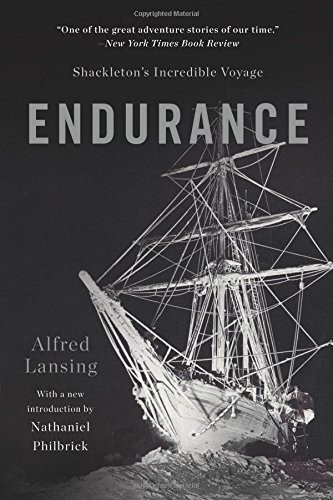
Alfred Lansing’s Endurance, first published in 1959, is the definitive account of one of the most extraordinary survival stories in the history of exploration. It follows the twenty-eight men of the Imperial Trans-Antarctic Expedition of 1914, led by Irish-born polar explorer Sir Ernest Shackleton, from the moment their ship became locked in the ice of the Weddell Sea to the conclusion that defied every reasonable expectation: not a single man died.
Shackleton had assembled his crew for what was meant to be the last great land journey of the Heroic Age of Antarctic exploration, a crossing of the Antarctic continent from the Weddell Sea to the Ross Sea, via the South Pole. The ship Endurance set out from South Georgia Island in December 1914 and sailed south toward Antarctica. Within weeks it was caught in pack ice that refused to release it. For ten months the ship drifted, gripped by ice, until the crushing pressure finally broke its hull and sent it to the bottom of the Weddell Sea in November 1915. The men were left standing on the ice with three small lifeboats, hundreds of miles from any land, in one of the most hostile environments on earth.
What followed was a twenty-two-month ordeal that tested every man aboard in ways that resist easy description. Lansing does not embellish. He researched the book over several years, interviewing most of the surviving crew members and reading every diary and journal from the expedition. The result is a narrative that feels immediate and true, as if you are out on the ice with the men, trying not to think too hard about the odds stacked against them. He completed the book in 1959, when many crew members were still alive, and the material he gathered from those interviews lends the text a firsthand texture that no amount of archival research alone could replicate.
Character Arcs and Development
At the center of everything is Shackleton himself, and Lansing captures him with unusual complexity for a nonfiction account. The Shackleton of popular imagination tends toward sainthood, but Lansing’s portrait is more interesting: a man of tremendous instinctive leadership who was not particularly good at planning ahead, who made at least one critical miscalculation by entering the Weddell Sea so late in the season, and who compensated for these shortcomings with an almost uncanny ability to manage people under impossible pressure.
Shackleton’s genius was psychological. He organized the men into sleeping configurations designed to prevent factions from forming, assigned his most potentially troublesome crew member to his own tent where he could keep watch, and maintained an optimism that was not entirely honest but was exactly what the men needed to hear. When the carpenter Harry McNish refused a direct order during the ice march (one of the more remarkable acts of insubordination in the annals of polar exploration), Shackleton handled it in a way that preserved McNish’s cooperation without visibly undermining his own authority. He later denied McNish a Polar Medal for it, but in the moment, he chose pragmatism over punishment. That tension between institution and necessity runs through the whole book.
Frank Wild, the second-in-command, and Frank Worsley, the ship’s captain and navigator, emerge as the other anchors of the expedition. Worsley in particular becomes indispensable when the crew must navigate the James Caird, a twenty-two-foot lifeboat, across eight hundred miles of the Southern Ocean using only a sextant, dead reckoning, and whatever glimpses of the sun he could catch through near-constant cloud cover. His navigation, by any rational measure, should not have worked. The fact that it did remains one of the more astonishing single-man achievements in the history of maritime travel. Lansing handles a large cast without reducing anyone to a type, and the secondary crew members reward close attention; some of the most affecting passages in the book concern men who receive only a few pages of direct attention.
Pacing
The book moves in waves, which mirrors the actual experience of the expedition. The early chapters covering the Endurance‘s drift through the Weddell Sea are deliberately measured, almost slow, and this is the right choice. You need to feel the long monotony of waiting before the ice finally takes the ship. The middle section, after the ship sinks and the men are camped on the ice with nowhere to go, is the most psychologically intense stretch of the book even though relatively little happens in terms of plot movement. Lansing keeps it from sagging by rotating between characters and by conveying with real skill how much energy it takes to simply stay warm, stay fed, and maintain the kind of mental equilibrium that keeps a group of cold, hungry men from turning on each other.
The final third accelerates considerably. The open-boat journey and the crossing of South Georgia Island are the sections most readers remember, and the writing tightens in response to the events. If there is a lull, it comes just before the final rescue attempt, when the narrative briefly shifts to the men left behind on Elephant Island. That section is shorter than it probably deserves to be, and it is the one place where the book’s event-focused structure works slightly against it. But it is a minor complaint against a book that otherwise sustains its tension across 280-plus pages with impressive discipline.
Deeper Thematic Exploration
The obvious theme is human endurance (the title is not understating it), but what Lansing actually excavates is something more specific: the relationship between institutional structure and individual will under conditions where neither alone is adequate.
Shackleton ran a ship according to the traditional conventions of British naval hierarchy, with clear rank and formal authority. When the ship sank and the men were living on ice floes, that structure became simultaneously a liability and a lifeline. On one hand, the crew’s conditioning to follow orders meant they did not dissolve into panic or mutiny when the situation became genuinely dire. On the other hand, the more rigid members of the expedition struggled profoundly with a situation that demanded improvisation and a tolerance for uncertainty that years of formal training had never prepared them for. The men who adapted best were not always the most accomplished; they were the ones who could hold both structure and flexibility at the same time.
The book is also, in a quieter register, about the gap between what we set out to accomplish and what we actually achieve. Shackleton had planned to be the first man to cross Antarctica. He never came close. What he achieved instead required capacities he did not know he had and demanded a kind of leadership that had almost nothing to do with conquest. There is something quietly devastating in this, and Lansing is smart enough not to editorialize about it. He simply presents the facts and lets the reader sit with the irony.
A class thread also runs through the narrative. The Endurance carried university-educated scientists alongside working-class sailors, and the tensions between these groups are never entirely absent. Lansing handles this with a light touch, noting friction without moralizing. What the book shows, through accumulation rather than argument, is that under shared extreme suffering, hierarchies of birth and education dissolved in ways that feel genuinely earned rather than sentimental. The men who helped each other most in the final months were not always the men who had been natural allies at the start.
What the book finally gets right about endurance is that it is not a single heroic act. It is the accumulation of thousands of small decisions to keep going rather than stop. Shackleton understood this. When he reached the whaling station at Stromness after crossing South Georgia Island, the station manager told him the men there had lived through the worst Antarctic winter in living memory. Shackleton replied: “Yes, I know.” He and his party had spent that entire winter outdoors.
Style and Voice
Lansing writes in a mode that feels natural now but was quite distinctive for its time: clear, precise, journalistic in the best sense, with an eye for the concrete detail that makes a scene real. He does not write about “the cold” as an abstraction; he writes about the specific temperatures at which a man’s breath freezes in his beard and what prolonged exposure does to the skin around the mouth. He is sparing with sentiment, which makes the moments of genuine emotion land with more force than they would if the prose were working to produce them.
The narrative perspective shifts between close third-person and something more panoramic, pulling back to give a sense of the Weddell Sea’s geography or the mechanics of polar pack ice before zooming back in to a single diary entry. This technique can occasionally make the men feel momentarily distant, but Lansing earns back the intimacy quickly. The prose is not lyrical in the way that dedicated nature writing tends to be, and it does not need to be. His achievement is harder to pull off: he makes a historical event feel present-tense. You know how it ends before you start. You keep reading anyway.
Verdict
Endurance has stayed in print for more than six decades because it delivers exactly what it promises. If you want to understand what people are capable of when everything has gone wrong, this is a very good place to start. It works for readers with no particular interest in polar exploration because it is fundamentally a story about a group of people trying to stay alive and stay sane, and those are not specialized interests. It works for history readers because the research is thorough and the respect for the primary sources is evident on every page. It works for general nonfiction readers because it is well-written and it keeps moving.
The one caveat is for readers who find sustained survival narratives emotionally taxing: the middle sections hold a great deal of vicarious stress, and there is no relief from the knowledge that these were real men in real conditions. But most people who pick this up find themselves reading faster than they intended. If you are looking for a book that earns its reputation, start here.
Frequently Asked Questions about Endurance: Shackleton’s Incredible Voyage
What is Endurance by Alfred Lansing about?
Endurance tells the story of Ernest Shackleton’s 1914 Imperial Trans-Antarctic Expedition, in which his ship became trapped in the ice of the Weddell Sea and was eventually crushed. The book follows the twenty-eight crew members through nearly two years of survival on ice floes, in lifeboats, and on remote Antarctic islands before Shackleton managed to rescue every one of them. Alfred Lansing researched the account by interviewing survivors and reading expedition diaries, giving the narrative a depth and immediacy rare in historical writing.
Did all of Shackleton’s men survive the Endurance expedition?
Yes. All twenty-eight men of the Endurance expedition survived, which is a large part of what makes the story so remarkable. Not a single crew member died during the twenty-two months between the ship’s becoming trapped and the final rescue from Elephant Island. This outcome required extraordinary leadership from Shackleton and equally extraordinary resilience from his crew, particularly during the crossing of eight hundred miles of open Southern Ocean in a twenty-two-foot lifeboat.
What are the main themes in Endurance by Alfred Lansing?
The central themes are survival, leadership under extreme conditions, and the tension between institutional discipline and individual adaptability. Lansing also traces how class and professional hierarchy functioned (and sometimes failed) among a mixed crew of scientists and sailors. Running beneath everything is a quieter theme about the gap between what we set out to accomplish and what we actually achieve: Shackleton never crossed Antarctica, but the expedition he actually completed became the defining achievement of his life.
How long is Endurance by Alfred Lansing and is it a difficult read?
This edition runs to approximately 280 pages and reads quickly despite the weight of its subject matter. Lansing writes in a clear, journalistic style with no academic apparatus, and the narrative follows the expedition chronologically in a way that is easy to track. Most readers with a moderate reading habit will finish it in two to four sittings. The content is intense in places, but the challenge is emotional rather than intellectual; the prose never gets in the way of the story.
Is there a movie or TV adaptation of the Endurance story?
Several adaptations exist. The most notable is the 2000 IMAX documentary Endurance, which incorporates footage from the original expedition filmed by photographer Frank Hurley. Kenneth Branagh starred in a 2002 television film also titled Endurance, produced by Channel 4 and A&E. A 2022 documentary covered the discovery of the Endurance wreck on the floor of the Weddell Sea. None of these replaces Lansing’s book, which benefits from a narrative intimacy that film cannot easily replicate.
Who was Alfred Lansing and how did he research Endurance?
Alfred Lansing (1921-1975) was an American journalist who spent several years researching the Shackleton expedition before writing the book. He tracked down and interviewed nearly all of the surviving crew members, obtained access to the diaries and journals kept during the voyage, and worked closely with Dr. Alexander Macklin, one of the expedition’s surgeons, who provided extensive firsthand material. Lansing died in 1975, and Endurance remains his only major book, which makes the quality of the research and the writing all the more striking.
How does Endurance by Alfred Lansing compare to other books about Shackleton?
Lansing’s book is generally considered the definitive popular account of the expedition and the version most readers encounter first. Roland Huntford’s biography Shackleton (1985) goes deeper into Shackleton’s character and complicated personal history, but it is considerably longer and more demanding. Caroline Alexander’s The Endurance (1998) is visually stunning, built around Frank Hurley’s original expedition photographs, but reads more as an illustrated companion than a narrative account. For storytelling and immediacy, Lansing’s remains the standard.
Should I read Endurance by Alfred Lansing, and is it worth it?
Yes, particularly if you have any interest in nonfiction narrative, survival stories, or the history of exploration. The book works even for readers who would not describe themselves as fans of any of those categories, because at its core it is about how a group of people decided to keep going when all reasonable expectations pointed the other way. It has been in continuous print since 1959 for good reason. If you are only going to read one book about the Heroic Age of Antarctic exploration, make it this one.
Book Details
- Title
- Endurance
- Author
- Alfred Lansing
- Genre
- History
- Publisher
- Basic Books
- Year Published
- 1959
- Pages
- 357
- ISBN
- 9780465062881
- WritersReview Rating
- 4.5 / 5