
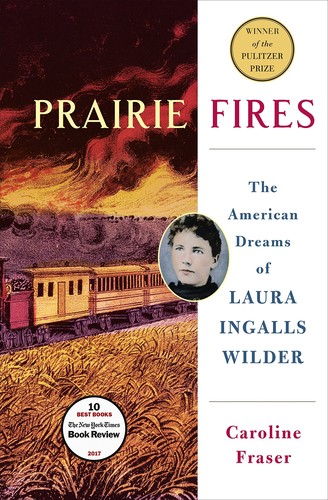
Prairie Fires
Metropolitan Books, Henry Holt and Company, LLC · 2017 · 625 pages
ISBN: 9781627792769
Review Editor
Thomas Calloway
Prairie Fires: The American Dreams of Laura Ingalls Wilder landed in bookstores in November 2017 and promptly won the National Book Award for Nonfiction. The following spring it took the Pulitzer Prize for Biography. Those awards are not decoration; they tell you what kind of book this is. Not a fan appreciation, not a gentle literary introduction, but a work of serious, exhaustively researched biography that happens to be about one of the most beloved children’s authors in American history. Caroline Fraser, who edited the Library of America’s authoritative edition of Wilder’s novels, spent years deep inside this material before writing a word of her own. It shows on every page.
The Little House books, eight novels published between 1932 and 1943, shaped how generations of Americans understand westward expansion: as a story of individual courage, family warmth, and the rewards of honest labor. Fraser’s book does not set out to demolish that image. What it does is place that image honestly within the actual history of the Great Plains and the late nineteenth century, and the result stands as one of the most illuminating works of American biography in recent memory. To understand what Fraser accomplishes, it helps to know what her book is replacing: a century’s worth of reverential Wilder scholarship that largely took the novels at face value and left the harder questions unasked.
At 625 pages, built on years of archival research into unpublished manuscripts, financial records, and private correspondence, Prairie Fires ranges from the 1830s through the post-World War II years. This is not a slim literary biography. It is an attempt to understand an entire strain of American experience, one that continues to reverberate in the country’s politics and culture today. Fraser brings to the project a scholar’s rigor and a reader’s love for the source material, and the combination proves irresistible.
Character Arcs and Development
What distinguishes Prairie Fires from conventional literary biography is that Fraser writes it as a dual portrait. Laura Ingalls Wilder is very much at the center, but the book becomes increasingly absorbed by her daughter Rose Wilder Lane, who grew from a difficult, restless child into one of the founders of American libertarian philosophy. Fraser argues, with substantial archival evidence, that Rose shaped the Little House manuscripts more extensively than Wilder ever publicly acknowledged. The manuscript revisions, the editorial correspondence, the financial arrangements between mother and daughter: Fraser traces all of it.
Rose is one of the most compelling figures in the book: a foreign correspondent who reported from Albania and the Soviet Union, a novelist in her own right, a woman who became convinced, after witnessing famine and state violence abroad, that federal government expansion posed a mortal threat to human freedom. The tension between Rose’s ideology and the reality of her parents’ lives, which depended substantially on federal farm programs and New Deal assistance to survive, gives the book much of its intellectual energy and its emotional sting.
Laura herself emerges as someone considerably more complicated than the cheerful, rosy-cheeked girl of the novels. The real childhood involved grinding poverty, repeated crop failures, grasshopper plagues that stripped entire harvests, and near-starvation. Pa Ingalls, for all his fiddle-playing warmth, moved his family repeatedly in pursuit of homestead claims that did not pan out. The family survived on charity and on the earnings of Mary and Laura in ways the novels never quite acknowledge. Fraser tracks all of this with compassion and without contempt for her subjects. You come away from the book caring more about these people than you did when you started, which is not the obvious outcome for a biography that corrects the record this forcefully.
Pacing
For a 625-page biography, Prairie Fires moves with more momentum than you might expect. The early sections covering Laura’s childhood and young adulthood have real propulsive force. Fraser’s chapter on the Hard Winter of 1880 to 1881, when the Ingalls family sat snowbound and near-starving for months on end, reads almost like survival narrative. The prose is at its most vivid here, matching the desperation of the material.
The book does slow in its middle sections, which give extended coverage to Rose’s career as a journalist and her years in Albania and the South of France. These chapters feel more like parallel biography than integrated narrative, and readers who came specifically for Laura may grow impatient during Rose’s political evolution and romantic entanglements. That said, this is a minor weakness in an otherwise tightly constructed book. The final sections, dealing with the actual composition of the Little House manuscripts and the tangled question of attribution and authorship, pull the dual threads together effectively and make the slower middle feel worth the investment.
Deeper Thematic Exploration
The most ambitious thing Fraser does is use Laura and Rose as lenses for examining the mythology of American self-reliance itself. The Little House books helped cement the idea that westward expansion rewarded individual virtue and Protestant work ethic. Fraser shows this picture to be, at best, selective. The real homesteading era relied on government land grants, railroad subsidies, and federal programs. The displacement of Native American communities that made settlement possible receives honest attention here, more than Wilder’s novels ever provided. The drought cycles that drove families off their claims were not aberrations but recurring features of the Great Plains ecology that land speculators chose not to advertise.
Real pathos runs through the sections showing Laura, in her seventies, writing books that celebrated radical self-reliance while Almanzo’s farming operations depended on federal price supports. Fraser does not use this irony to diminish Wilder. She uses it to explore the distance between lived experience and the story a culture tells itself. The America that Laura’s books describe is also the America that many people needed to believe in, especially during the Depression years when the novels first appeared. The books worked precisely because they were aspirational rather than documentary, and Fraser understands that the aspiration itself is worth taking seriously.
The Rose subplot adds another dimension to this theme. Fraser presents Rose’s radicalization into libertarianism as a response to genuine horrors she witnessed, but she remains skeptical of the ideology’s internal consistency. The contradiction between Rose’s belief in absolute individual freedom and her long emotional and financial dependence on her mother, combined with her complicated use of her parents’ lives as raw material, forms one of the book’s richest and most unsettling threads. Fraser resists the temptation to reduce Rose to a villain or a hypocrite; instead she lets the contradictions breathe, and they illuminate something true about how ideologies form under pressure.
Style and Voice
Fraser writes with clarity and evident authority. The scholarship is total: footnotes and bibliography run to nearly a hundred pages. She never lets the research turn dry, though. The prose is lean without being sparse, and Fraser has a gift for the summary sentence that captures complex historical forces without oversimplifying them. The book comes most alive when she is doing close reading of the Little House texts against the archival record, showing exactly where events were compressed, softened, or reshaped for the published novels. These passages reward readers who know Wilder’s work well, though Prairie Fires stands completely on its own for those coming fresh to the subject.
Fraser also has a fine instinct for when to let a fact speak for itself and when to press for meaning. Some of the book’s best moments are the quiet ones: a line from Laura’s financial records, a sentence from a letter to Rose that reveals the mother’s exhaustion and the daughter’s blind spots, a moment where the archival evidence contradicts something the novels present as triumphant. The genuine passion Fraser brings to this material saves the book from the neutral, airless tone that sometimes afflicts thoroughly researched biography. You sense throughout that she loves these books even as she complicates them, that the complicating is itself a form of care.
Verdict
Prairie Fires stands as essential reading for anyone who grew up with the Little House books, and it rewards readers who never touched them just as well, because its real subject is America’s relationship with its own founding myths. Fraser handles a genuinely difficult task, correcting the record without destroying the affection millions of people hold for Wilder’s work, and she does it with skill and evident love for her subjects. Give it to history readers, literary biography readers, and anyone who has ever wondered what the American frontier actually felt like from the inside.
If you want a biography that will change how you understand a canonical American text and the historical forces that shaped it, you should read this book. Readers who prefer their biographies celebratory will find Prairie Fires uncomfortable. Those who want their subjects fully human, with ideological contradictions intact and a dependence on systems they publicly disdained, will find it unforgettable. It is the rare biography that both illuminates its subject and expands your sense of the country that subject inhabited.
Frequently Asked Questions about Prairie Fires
What is Prairie Fires by Caroline Fraser about?
Prairie Fires is a biography of Laura Ingalls Wilder, the author of the Little House on the Prairie series, and her daughter Rose Wilder Lane. Published in 2017, the book draws on unpublished manuscripts, letters, and financial records to place the beloved Little House stories within the actual history of homesteading, poverty, and federal policy on the American frontier. Fraser explores not only who Laura was but how she and Rose collaborated to write the novels, and what those novels tell us about the stories America tells itself.
Did Prairie Fires win the Pulitzer Prize?
Yes. Prairie Fires won the Pulitzer Prize for Biography or Autobiography in 2018. It also won the National Book Award for Nonfiction in 2017, making it one of the rare books to take both of the most prestigious American literary awards. Caroline Fraser also received the National Book Critics Circle Award for Biography in 2018 and the Chicago Tribune Heartland Prize the same year.
What are the main themes in Prairie Fires by Caroline Fraser?
The book explores several interlocking themes: the mythology of American self-reliance and how it diverges from the economic reality of frontier life; the complicated relationship between mothers and daughters, particularly Laura and Rose; the role of federal programs in the history that the Little House books celebrate while obscuring; and the question of literary authorship and how the novels actually came to be written. Fraser also examines the politics of the American West and how those politics shaped the libertarian ideology that Rose Wilder Lane helped found.
How long is Prairie Fires and is it a difficult read?
Prairie Fires is 625 pages, including a substantial bibliography and footnotes. The reading level is that of serious narrative nonfiction: clear and accessible, not academic, but demanding enough to reward attention. Most readers who enjoy literary biography will find it manageable over two to three weeks of steady reading. The middle sections, which focus on Rose’s journalism career and political evolution, require more patience than the sections about Laura’s childhood and the writing of the novels.
Is there a movie or TV adaptation of Prairie Fires?
As of 2026, Prairie Fires itself has not been adapted for film or television. There have been several adaptations of the Little House on the Prairie stories that Fraser’s biography examines: the iconic NBC television series starring Melissa Gilbert ran from 1974 to 1983, and various stage adaptations have appeared over the decades. Fraser’s biography examines the same historical world those productions drew from, but the book itself remains in print only.
Who is Rose Wilder Lane and why does she matter in Prairie Fires?
Rose Wilder Lane was Laura Ingalls Wilder’s daughter, born in 1886. She became a notable journalist, novelist, and one of the intellectual founders of American libertarianism alongside Ayn Rand and Isabel Paterson. Fraser argues in Prairie Fires that Rose played a much larger editorial and creative role in shaping the Little House manuscripts than Wilder publicly acknowledged, and that Rose’s political convictions influenced how the novels portrayed pioneer self-reliance. The tension between Rose’s ideology and her parents’ actual dependence on federal programs is one of the book’s most provocative threads.
How does Prairie Fires compare to other biographies of Laura Ingalls Wilder?
Prairie Fires is the most comprehensive and rigorously researched biography of Wilder to date, widely considered the definitive account. Earlier studies tended toward more reverential treatment of their subject. Fraser covers more archival ground, addresses the question of Rose’s co-authorship more directly, and situates the Little House stories within a broader history of American economic and political life. Readers interested in the topic might also look at John E. Miller’s Becoming Laura Ingalls Wilder or Pamela Smith Hill’s Laura Ingalls Wilder: A Writer’s Life, though neither matches the scope or ambition of Fraser’s work.
Should I read Prairie Fires if I love the Little House books?
Yes, with the honest caveat that this book will complicate the stories you love in ways that can feel uncomfortable at first. Fraser writes with genuine affection for Wilder’s work, and Prairie Fires is not a takedown. It is an honest account of a complicated woman who lived a harder life than her novels let on and who, with her daughter’s help, transformed that life into something enduring. Most readers who love the Little House books report that Prairie Fires deepened rather than diminished their appreciation for them.
Book Details
- Title
- Prairie Fires
- Author
- Caroline Fraser
- Genre
- History
- Publisher
- Metropolitan Books, Henry Holt and Company, LLC
- Year Published
- 2017
- Pages
- 625
- ISBN
- 9781627792769
- WritersReview Rating
- 4.5 / 5