
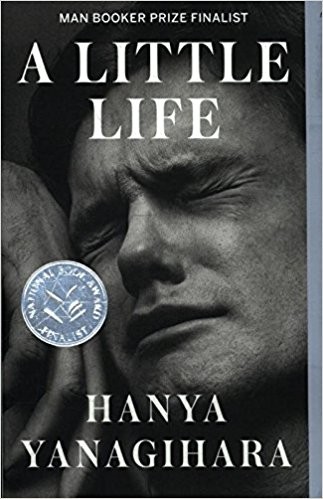
A Little Life
Anchor Books · 2015 · 736 pages
ISBN: 9780804172706
🏆 Kirkus Prize (2015, won)
Man Booker Prize (2015, shortlisted)
National Book Award for Fiction (2015, finalist)
Women's Prize for Fiction (2016, shortlisted)
Review Editor
Eleanor Marsh
Hanya Yanagihara’s A Little Life, published by Doubleday in 2015, opens with a familiar setup: four college friends move to New York City to chase their ambitions. There’s Willem, a kind and handsome aspiring actor; JB, a brash and talented painter; Malcolm, a thoughtful architect still living with his parents; and Jude, a brilliant lawyer whose past remains stubbornly, conspicuously hidden. You might expect a panoramic novel about young men finding themselves in the city. You would be wrong.
What begins as a generational portrait narrows, over its 736 pages, into something far more consuming. Jude St. Francis gradually becomes the book’s gravitational center, and the story of his life, shaped by horrors he endured as a child and teenager, reshapes everything around it. Yanagihara traces these four friendships across three decades, through careers and breakups and dinner parties and hospital visits, but the book belongs to Jude. His damage, his brilliance, his refusal to let anyone fully see him: these become the novel’s central obsessions.
A Little Life was shortlisted for the Man Booker Prize in 2015, named a finalist for the National Book Award, and won the Kirkus Prize. It also became a genuine cultural phenomenon, the kind of book people press into your hands with a warning. That warning is earned. This is not a comfortable read.
Character Arcs and Development
Jude is one of the most fully realized characters in contemporary fiction, and also one of the most harrowing. Yanagihara reveals his backstory in increments: the monastery where he was raised, the string of abusers who followed, the years spent on the road with a predatory mentor named Brother Luke. Each revelation lands harder because you’ve already come to care about Jude as an adult, a man of dry humor and fierce intelligence who bakes elaborate cakes for his friends and limps through courtrooms on damaged legs. The gap between who Jude is to his friends and who he is alone, in his bathroom with a razor blade, generates the novel’s terrible momentum.
Willem is the book’s moral anchor. His love for Jude, which evolves from friendship into something deeper, is the most generous portrait of devotion Yanagihara offers. Willem never demands that Jude explain himself. He simply stays. His patience feels earned rather than saintly because Yanagihara gives him his own interior life, his own doubts about whether staying is enough. Their relationship in the novel’s middle sections is the closest A Little Life comes to tenderness without qualification.
JB and Malcolm receive less attention, though their arcs carry weight. JB’s cruelty toward Jude at a pivotal party, when he mimics Jude’s limp for laughs, is one of the book’s most painful scenes precisely because it comes from someone who loves Jude. Malcolm remains the most lightly drawn of the four, his privilege and his passivity a kind of running counterpoint to the intensity around him. Harold and Julia, the law professor and his wife who adopt Jude as an adult, round out the constellation of people trying to love someone who cannot believe he deserves it.
Pacing
At 736 pages, A Little Life asks for a serious commitment, and Yanagihara does not always honor that investment equally. The first 200 pages move deliberately, establishing the four friendships and New York’s geography with a patient accumulation of dinners, studio visits, and late-night conversations. This stretch rewards attention, but some readers will find it slow before the novel finds its true subject.
Once Jude’s past begins to surface in earnest, the book accelerates in a way that feels almost relentless. The middle third hits a rhythm of revelation and crisis that can be overwhelming. Yanagihara does not pace Jude’s suffering the way most novelists would, parceling it out with breathing room between episodes. She stacks it. Some of this stacking works brilliantly, creating a claustrophobic sense of what it feels like to live inside a body that has been made into a site of violence. Some of it, in the later sections, tips into accumulation for its own sake, where you start to feel the architecture of the plot rather than the life of the character.
Deeper Thematic Exploration
Beneath the plot, A Little Life is a sustained argument about whether love can repair what violence has broken. Yanagihara’s answer is complicated and, depending on your reading, either courageous or nihilistic. Jude has people who love him well. Harold tells him he is worthy. Willem holds him through panic attacks. Andy, his doctor, stitches his self-inflicted wounds without judgment. And yet the book keeps circling the question: is this enough? Can external love override what Jude believes about himself at the cellular level?
The novel is also, quietly, one of the most radical explorations of male vulnerability in American fiction. Yanagihara strips away the usual scaffolding of masculinity. Her men cry openly. They hold each other. Willem washes Jude’s wounds. The friendship between these four is physical and tender in ways that fiction rarely allows between straight men. By refusing to label these relationships according to conventional categories, Yanagihara creates something that feels both specific and universal: a vision of intimacy that transcends the usual boundaries.
There is also an argument running through the book about storytelling itself. Jude’s refusal to narrate his own past, his insistence that what happened to him is unspeakable, puts pressure on the reader’s desire to know. Yanagihara gives you the details anyway, through flashbacks and omniscient narration, but she makes you aware of the cost of that knowledge. You want to understand Jude. You also start to wonder whether understanding him requires witnessing every horror he endured, or whether the novel’s accumulation of trauma serves the reader’s appetite more than the character’s dignity. This tension is either the book’s deepest insight or its central flaw, and smart readers will disagree.
Style and Voice
Yanagihara writes in a close third person that moves between characters with a fluid, almost cinematic quality. Her prose is detailed and steady, rarely showy, with a preference for long sentences that build through clauses the way a piece of music builds through variations. She handles the passage of decades with offhand elegance, slipping years into a paragraph break, letting you feel time the way her characters do: as something that moves unevenly, speeding through the good stretches and slowing to a crawl during the bad ones.
Her descriptions of New York, of food, of the textures of creative work, ground the novel in physical specificity. You can feel the wooden floors of Jude and Willem’s Lispenard Street apartment. You can taste the clafoutis Jude makes for Harold’s birthday. These domestic details serve as counterweight to the darkness: small, concrete pleasures that make the suffering bearable, both for the characters and for you.
Verdict
A Little Life is a book that will change the way you think about fiction’s capacity for emotional extremity. If you are the kind of reader who wants novels to push past politeness and sit with the worst of what people do to each other, and with the best of what friendship can offer in response, this book will stay with you for years. It earns its length and its reputation.
But it is also a book with real weaknesses. The relentlessness of Jude’s suffering can strain credulity: at a certain point, the sheer volume of abuse begins to feel engineered rather than observed. Malcolm and JB fade from the narrative in ways that feel like a loss. And Yanagihara’s refusal to give Jude any meaningful agency in his own recovery raises questions about whether the novel respects its protagonist as much as it loves him. If you need your fiction to offer some movement toward healing, or if you find sustained depictions of self-harm and abuse unbearable (which is entirely reasonable), this is not the book for you. For everyone else, it is among the most ambitious and emotionally honest novels of the past decade, a book that takes the measure of suffering and refuses to look away.
Frequently Asked Questions about A Little Life
What is A Little Life by Hanya Yanagihara about?
A Little Life follows four college friends who move to New York City and traces their lives over three decades. While it begins as an ensemble story about ambition and friendship, it gradually centers on Jude St. Francis, a brilliant lawyer hiding a past marked by severe childhood abuse. The novel explores whether love and friendship can repair the damage done by trauma.
Is A Little Life based on a true story?
A Little Life is entirely fictional. Hanya Yanagihara has said in interviews that she wanted to explore what would happen to a person who experienced the worst possible childhood and then entered a world full of people who loved him. The characters and events are invented, though the emotional dynamics feel grounded in careful psychological observation.
What are the main themes in A Little Life?
The novel’s central themes include trauma and its lasting effects on identity, the power and limits of friendship, chosen family versus biological family, and male vulnerability and intimacy. It also wrestles with questions about self-worth, the nature of recovery, and whether love from others can overcome deeply internalized shame.
How long is A Little Life and is it a difficult read?
The hardcover edition runs 736 pages. It is a demanding read, both in length and in emotional content. The novel contains graphic depictions of child abuse, sexual violence, and self-harm. Many readers describe needing to take breaks between sections. The prose itself is accessible and clear, so the difficulty is emotional rather than stylistic.
Is there a movie or TV adaptation of A Little Life?
There is no film or TV adaptation as of 2026. Producer Scott Rudin optioned the book for a limited series in 2016, but the project stalled. The novel has been adapted for the stage, with a production directed by Ivo van Hove that premiered in Amsterdam in 2018 and later ran on London’s West End in 2023.
What age group or reading level is A Little Life appropriate for?
A Little Life is written for adult readers. Its graphic content involving child sexual abuse, self-harm, and sexual violence makes it unsuitable for younger readers. Most booksellers and librarians recommend it for readers 18 and older. The reading level is accessible for any confident adult reader, but the subject matter requires emotional maturity.
How does A Little Life compare to Hanya Yanagihara’s other novels?
Yanagihara’s debut, The People in the Trees (2013), is a much shorter, more contained novel about an anthropologist accused of abuse. Her third novel, To Paradise (2022), is an ambitious triptych spanning centuries. A Little Life sits between them in ambition but surpasses both in emotional intensity and popular impact. It remains her most widely read and discussed work by a significant margin.
Should I read A Little Life and is it worth it?
If you want a novel that takes friendship seriously, that builds characters you will think about long after finishing, and that is willing to confront suffering without flinching, then yes. It won the Kirkus Prize and was shortlisted for both the Booker Prize and the National Book Award. But be honest with yourself about your tolerance for graphic content involving abuse and self-harm. Many readers who love the book also describe it as one of the most emotionally punishing things they have ever read.
Book Details
- Title
- A Little Life
- Author
- Hanya Yanagihara
- Genre
- Literary Fiction
- Publisher
- Anchor Books
- Year Published
- 2015
- Pages
- 736
- ISBN
- 9780804172706
- Awards
- 🏆 Kirkus Prize (2015, won) Man Booker Prize (2015, shortlisted) National Book Award for Fiction (2015, finalist) Women's Prize for Fiction (2016, shortlisted)
- WritersReview Rating
- 4.9 / 5