
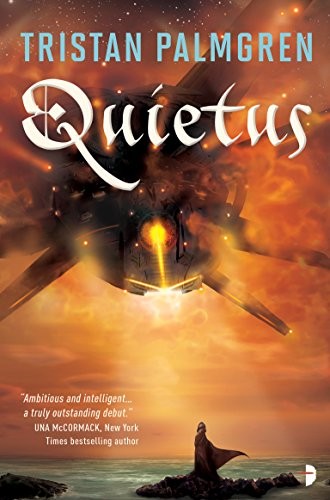
Quietus
Angry Robot · 2018 · 460 pages
ISBN: 9780857667434
Review Editor
Marcus Webb
Tristan Palmgren’s debut novel opens inside a Carthusian monastery outside Florence in 1348, as the Black Death begins its catastrophic sweep through Europe. Brother Niccoluccio Caracciolo has watched his brothers die one by one. He is the last alive, surrounded by the silence they left behind, his faith shaken and his prayers going unanswered. Into this carefully rendered tragedy arrives Habidah, an anthropologist from a parallel dimension assigned to observe, document, and above all, not interfere. She saves Niccoluccio from the brink of death anyway. That decision, breaking the most fundamental rule of her profession, sets the entire novel in motion.
Angry Robot published Quietus in March 2018; it is the first volume in Palmgren’s Unity duology, followed by Terminus later that year. On the surface, this looks like a novel with a familiar premise: a trained observer violates non-interference protocols when faced with real human suffering, then has to reckon with the consequences. But Palmgren pushes much further than that premise suggests. The conspiracy Habidah stumbles into is not a localized problem but a civilizational one, involving an empire so vast that it redefines the scale of every event the novel has depicted. The Black Death, which has been the center of the book’s emotional gravity, turns out to be one small data point in a much larger accounting of suffering. The scope of that revelation, handled with restraint rather than bombast, is one of the novel’s genuine achievements.
What Palmgren constructs is essentially a first-contact story filtered through historical catastrophe. The novel asks a simple question with no clean answer: if you had the power to stop suffering, but your professional code demanded otherwise, what would you choose? Habidah and Niccoluccio come from radically different worlds, understand mortality in incompatible terms, and interpret what is happening to them through entirely different frameworks. Yet their bond feels entirely earned by the time the plot widens its scope. The reason this works is that Palmgren never reduces either character to a symbol. Niccoluccio is not just “medieval faith confronting modernity.” Habidah is not just “rationalism in crisis.” They are particular people, with specific voices and specific contradictions, and Palmgren gives them room to surprise the reader before the novel is over.
Character Arcs and Development
Niccoluccio is the more accessible of the two leads, and the easier one to love. He begins as a man whose faith defines every thought and movement. His chapters in the early sections of the book capture monastic life with genuine specificity: the rhythm of the daily offices, the small routines that structure a cloistered existence, the smell of illness creeping through the dormitory, the creeping emptiness as one brother after another disappears. Palmgren makes you feel the weight of the community before destroying it, and that sequence, from ordinary devotional life to total desolation, carries genuine grief. When the Black Death has taken everyone Niccoluccio loves, and his prayers have produced nothing but silence, the novel does not ask him to lose his faith neatly or resolve his doubt into atheism. Instead, Niccoluccio holds both things at once, the training of a lifetime and the evidence of his own eyes, and that tension drives his character through everything that follows.
Habidah takes longer to open up, and that is deliberate. She is a trained observer, and in the early chapters she reads as carefully contained, someone who processes suffering through the buffer of professional distance. The note-taking, the clinical categorization, the practiced detachment: all of this is convincing before it breaks. The moment she decides to save Niccoluccio rather than watch him die is the hinge of the entire novel. Palmgren earns that moment by taking time to establish her neutrality as something Habidah truly believes in, not just a bureaucratic rule she follows grudgingly. Breaking it costs her something real, and the reader can feel the weight of that cost. As the story develops and she discovers that her assignment, her organization, and her home world’s own plague may be connected to something far larger and more deliberately engineered than anyone told her, Habidah has to dismantle the professional identity she built her life around. That process, painful and incomplete, is the best thing in the book.
The supporting characters serve their functions without much depth of their own, and that is one of the novel’s real limitations. Habidah’s colleagues in the Unity occupy a carefully calibrated moral grey zone, and Palmgren uses them effectively to complicate the question of intervention: they are not villains, they are people operating inside a system that produces villainous outcomes at scale. But they do not stick in memory the way Niccoluccio and Habidah do.
Pacing
Quietus is not a fast book, and it is honest about that from the first chapter. The early sections in medieval Florence are immersive and accumulative, building slowly toward catastrophe rather than rushing through it. Readers who expect the novel to pivot into space opera momentum quickly may find the first hundred pages a genuine test of patience. Palmgren is methodical in establishing Niccoluccio’s world before fracturing it, and that patience pays off in emotional weight later, but the reader has to trust the process to get there. The sections where the conspiracy mechanics of the Unity start multiplying, roughly in the middle third of the book, are the most demanding. Plot logistics crowd the emotional center of the story, and for a stretch the novel loses the intimate focus that made its early sections so effective. The final third restores the balance and builds to a conclusion that earns its resonance. But the mid-book sagging is real, and readers who need continuous momentum will feel it.
Deeper Thematic Exploration
The central question running through Quietus is whether observation can ever truly be neutral. Habidah’s organization, the Unity, has built its entire ethical framework on a non-interference policy, premised on the idea that studying civilizations from outside protects both the observers and the observed. Palmgren refuses to let that premise stand unchallenged. Every moment Habidah spends watching Niccoluccio’s world die is itself a choice with moral consequences. The plague does not wait for her to resolve her ethical questions. The novel keeps the cost of inaction visible throughout, and in doing so it challenges readers to think about what it means to call something mere observation. This is science fiction doing what the genre does at its best: using a speculative premise to force a question that the real world usually lets us avoid.
Alongside this, Quietus functions as a meditation on what happens when the institutions that provide meaning stop working. For Niccoluccio, the Church and the monastery represent a complete world, and the Black Death destroys both in weeks. For Habidah, the Unity and its scientific mission have served exactly that structural function. Both characters discover that the frameworks they trusted were built on incomplete information, and that the people who built those frameworks had specific reasons to keep them incomplete. This parallel never feels forced. It gives the historical setting genuine thematic function rather than treating the Black Death as an atmospheric backdrop for a science fiction story that could have been set anywhere.
The deeper layer of the novel is about empire. Who gets to decide which civilizations matter, which ones can be sacrificed for a larger stability, and what gives any power the right to make that accounting? The Unity, for all its technological sophistication, turns out to be an empire like any other, capable of extraordinary cruelty in service of its own continuity. Palmgren makes the chilling choice not to populate this empire with obvious villains. The people inside it are doing their jobs, following reasonable-sounding rules, producing terrible outcomes at scale. That structural portrait of how harm compounds through institutions is more unsettling than any individual antagonist would be.
Style and Voice
Palmgren’s prose is careful and precise without becoming cold. The medieval sections carry a measured, accumulative quality that fits Niccoluccio’s interior life: things gather slowly, a dead brother here, an empty cell there, until the full weight of what has happened arrives all at once. The science fiction sections shift register slightly, becoming more expansive and abstract as Habidah’s world opens outward, but they never lose their grounding in physical sensation. Palmgren writes the plague landscape, the quality of light on stone, the specific silence of a place where people used to be, with real attentiveness. These passages stay with you after the plot mechanics have faded. The dual-perspective structure is handled with confidence unusual for a debut. Palmgren never lets the two strands feel like separate novels sharing a cover, which is a genuine technical challenge in this kind of blended historical and speculative fiction.
Verdict
Quietus is a thoughtful, ambitious debut that earns its complexity. If you read science fiction for ideas as much as for action, and you can give a slow-burn novel the first hundred pages it needs, this one will reward you. The book is especially good for readers who like the moral questions that space opera tends to raise without stopping to examine: what do we owe to strangers, what do institutions do to the people inside them, and what happens to faith when its objects disappear? Niccoluccio and Habidah are characters worth spending time with, and the central ethical argument of the novel stays in your head.
Its weaknesses are real. The pacing demands patience that not every reader will give it. The middle section gets crowded and loses focus. Some supporting characters exist as functions more than people. But Palmgren demonstrates in this debut a command of scale and emotional architecture that most writers take several books to develop. Pick this one up if you want science fiction that slows down and thinks for a while, and if the particular combination of medieval plague and multiverse conspiracy does not put you off. It should not. It is exactly as strange and as rewarding as it sounds.
Frequently Asked Questions about Quietus
What is Quietus by Tristan Palmgren about?
Quietus follows two main characters: Niccoluccio, a Carthusian monk in 14th-century Florence who loses his entire monastic community to the Black Death, and Habidah, a multiverse-traveling anthropologist assigned to observe his world without interfering. When Habidah breaks protocol to save Niccoluccio’s life, the conspiracy pulls them both into a plot spanning multiple worlds that threatens an empire that humans cannot yet comprehend. The novel blends medieval historical fiction with space opera on a large scale.
Is Quietus part of a series?
Yes. Quietus is the first book in the Unity duology by Tristan Palmgren. The sequel, Terminus, was published later in 2018 by Angry Robot and continues the story of Habidah and Niccoluccio. Both books form a complete story arc across the two volumes and are best read in order.
What are the main themes in Quietus by Tristan Palmgren?
The main themes are interventionism versus neutrality, the failure of institutions, faith under extreme duress, and the ethics of empire. The novel centers on the question of whether any organization has the right to decide which civilizations deserve protection. Faith and its collapse, both religious and institutional, run through both main characters as a parallel. The Black Death serves as the historical vehicle for exploring how meaning collapses when the systems built to provide it stop working.
How long is Quietus and is it a difficult read?
Quietus runs 460 pages and reads at a deliberate pace. It is not difficult in terms of prose complexity, but it rewards patient readers far more than impatient ones. The first hundred pages are slow and accumulative, and the payoff comes later. Think of it as thoughtful literary science fiction rather than fast-paced space opera, even though it contains elements of both genres.
Is Quietus science fiction or historical fiction?
It is both. The novel opens in 14th-century Italy during the Black Death and stays grounded in that historical setting for a significant portion of the book. The science fiction elements, including multiverse travel, an alien civilization, and a space opera conspiracy, layer on top of that historical foundation. Readers who enjoy genre-blending fiction and have any interest in medieval history will get the most out of it.
Is there a movie or TV adaptation of Quietus by Tristan Palmgren?
No film or television adaptation of Quietus has been announced or produced as of 2026. The novel has received positive critical notices from The Guardian, Locus, and Publishers Weekly, but it remains a literary science fiction title rather than a mainstream crossover property. Readers interested in the story will need to start with the source material and its sequel, Terminus.
How does Quietus compare to other science fiction novels about time travel and history?
Quietus draws natural comparisons to Connie Willis’s Oxford Time Travel series, particularly Doomsday Book, which also places a time traveler in medieval Europe during the Black Death. Quietus is more contemplative and philosophically focused than Willis’s novels, with a heavier emphasis on moral questions and less on procedural plot mechanics. Fans of Willis’s work, or of Kage Baker’s Company series, in which time-traveling agents struggle with non-interference directives, are the most natural audience for Palmgren’s debut.
Should I read Quietus by Tristan Palmgren, and is it worth it?
If you enjoy science fiction that asks moral questions without providing easy answers, and you appreciate historical settings used as genuine thematic architecture rather than decoration, then yes, Quietus is worth reading. Go in knowing the book is deliberately paced and will ask something of you in the first third. If you want propulsive action from page one, this is not the right book. But if you want a debut novel with real ambition, two characters worth caring about, and something to think about after you close the cover, Quietus delivers.
Book Details
- Title
- Quietus
- Author
- Tristan Palmgren
- Genre
- Science Fiction
- Publisher
- Angry Robot
- Year Published
- 2018
- Pages
- 460
- ISBN
- 9780857667434
- WritersReview Rating
- 5.0 / 5