
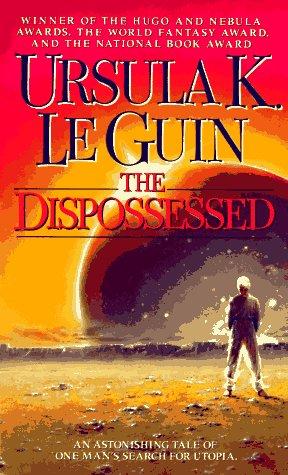
The Dispossessed
HarperPrism · 1974 · 387 pages
ISBN: 9780061054884
Review Editor
Marcus Webb
The Dispossessed, subtitled An Ambiguous Utopia, appeared in 1974 from Ursula K. Le Guin and promptly swept the Hugo, Nebula, and Locus Awards for Best Novel, making it one of the rare books to take all three prizes in the same year. It belongs to Le Guin’s loosely connected Hainish Cycle, a series of novels and stories set across the same fictional universe, but it stands entirely on its own. You do not need to have read anything else she wrote to follow every word of it, and many readers who come to it first end up working their way back through her other books afterward.
The story follows Shevek, a theoretical physicist living on Anarres, a dry, resource-scarce moon orbiting the lush planet Urras. About 170 years before the novel begins, a group of anarchist revolutionaries called Odonians won the right to settle Anarres as a way of defusing a rebellion on Urras. The Odonians built a society without money, without government, and without ownership. Their constructed language, Pravic, has no comfortable possessives: you do not say “my book,” you say “the book I use.” Children are raised to understand that nothing belongs to any individual. The DivLab, a labor coordination bureau, matches people with work assignments on a voluntary basis. There are no laws, no prisons, and no hierarchy in any formal sense.
Shevek is a physicist working toward what he calls a General Temporal Theory, a breakthrough that would make faster-than-light communication possible across the vast distances of space. His work keeps getting blocked by Sabul, a senior physicist who controls which papers get submitted to researchers on Urras and who quietly appropriates credit for ideas that are not entirely his. Shevek eventually arranges to travel to Urras to complete his research with scholars there, becoming the first Anarresti to cross between the worlds in generations. The novel alternates between his arrival on Urras (odd chapters, moving forward in the present) and his earlier life on Anarres (even chapters, tracing his past). By the time you understand why Shevek left Anarres, you also understand what he is arriving into on Urras, and neither side of that contrast is flattering.
Character Arcs and Development
Shevek is not a conventional protagonist. He is not especially charming or socially nimble. He struggles with group dynamics and does not always read people’s intentions accurately. He is devoted to his physics in a way that occasionally makes him blind to the people around him: when Takver, his partner, is assigned to work in a distant region during a drought, he throws himself into research rather than fighting to stay near her, and there is an honest reckoning with that later. What makes him compelling is his sincerity. He genuinely believes in the anarchist principles he was raised with, which means he is genuinely disturbed when those principles turn out to have their own silent corruptions.
Takver, his partner on Anarres, is one of the novel’s strongest secondary characters. She is a marine biologist, practical and warm, and her relationship with Shevek is one of the most convincing partnerships in science fiction because Le Guin never makes it frictionless. The years they spend separated by a drought-era labor assignment give the Anarres chapters most of their emotional weight. When Shevek finally returns to her after four years apart, the scene is rendered with the kind of restraint that makes it quietly devastating.
Sabul is worth dwelling on because he is the novel’s most instructive character: a petty, territorial man made possible by a utopia. Because Anarres has no formal power structures to climb, he has built his influence through reputation, gatekeeping, and accumulated social credit over decades. Le Guin uses him to demonstrate that hierarchy is not an institution; it is a human tendency that institutions merely formalize. Remove the institutions, and people will build it again from whatever materials are available. Sabul is what it looks like when those materials are philosophical credibility and academic gatekeeping.
Pacing
The alternating chapter structure is elegant on a conceptual level and occasionally demanding in practice. The Anarres chapters ask you to inhabit a world without conventional dramatic tension. There is no villain to defeat, no plot deadline pushing toward resolution. Instead, you follow Shevek through childhood, education, his first friendships, his first encounters with Sabul, his relationship with Takver, and the slow development of his physics over years. Le Guin asks you to find meaning in the texture of a life rather than in its events.
The Urras chapters are easier going. Because Shevek is an outsider, he notices everything: the extravagant food, the elaborate social rituals, the beautiful university campus, the well-dressed physicists who admire him the way collectors admire a rare specimen. There is a dinner party scene midway through the Urras section that is one of the best passages in the book. Shevek gets drunk, says exactly what he thinks about the people around him, and stumbles into a situation that shatters his idea of what his visit was meant to accomplish. Le Guin lands it with the lightness of a writer completely in control of her material.
The hardest stretch is the Anarres drought section, where Shevek and Takver are separated for years and the forward momentum slows considerably. Readers who put the book down often do so here. That section does important work, however. It is the novel’s argument, made through lived experience rather than exposition, that even a society built on solidarity and mutual aid can be profoundly lonely.
Deeper Thematic Exploration
The central question of The Dispossessed is not whether anarchism is better than capitalism. Le Guin is too honest, and too intellectually serious, to make that case cleanly. The question is subtler: what do walls do to the people who build them?
The wall appears throughout the novel as its dominant image. Anarres has a single spaceport, surrounded by a low wall bearing the only “No Trespassing” signs on the planet. Shevek notices early that the wall could keep outsiders from entering, or it could keep Anarresti from leaving. The novel begins and ends at this wall, and the ambiguity never resolves. “Those who build walls are their own prisoners,” Shevek tells his Urrasti hosts at one point, and he is describing his own world as much as theirs.
On Urras, Shevek encounters a different kind of wall: the invisible barrier between A-Io’s wealthy university world and the poverty of the people beyond its gates. He joins a labor protest that is violently suppressed, and in that moment he understands something that life on Anarres did not prepare him for: some walls are maintained not by convention or social pressure, but by men with weapons. He is not naive about this; he is simply unprepared to see it at such close range.
Anarres, meanwhile, has replaced coercive walls with social pressure and convention. Nobody tells Shevek he cannot publish his theory. Nobody arrests him for holding unconventional views. But Sabul controls the communications channels between worlds, and the community treats anyone who seems to want too much, or to stand out too much, as a quiet threat to Odonian values. The mechanisms are different from those on Urras; the isolation they create is comparable.
Le Guin is also thinking seriously about time. Shevek’s physics theory holds that time is not purely sequential: past, present, and future exist in a kind of simultaneity, and what we experience as linear sequence is a feature of how consciousness works. The novel’s alternating structure enacts this idea, asking you to hold two timelines in mind at once. This is not a formal trick. It is a suggestion that the relationship between Anarres and Urras, between revolution and bureaucracy, between the ideal and the institution that replaces it, is not a progression from one to the other but a tension held permanently open.
Style and Voice
Le Guin’s prose is spare without being cold. She describes Anarres’s landscape with a geologist’s precision: the gray dust, the thin air, the way settlements look like outgrowths of the rock around them. There is no sentimentality about the hardship, but no contempt either. The planet is difficult, and the people who live there are accustomed to difficulty in a way that has shaped how they understand almost everything else.
The Urras chapters take on a different quality. Because Shevek is a stranger there, the prose becomes more observational and almost anthropological, cataloguing abundance through the eyes of someone who has never seen a private garden or a well-stocked marketplace. The contrast between the two modes is subtle but sustained throughout, and by the time Shevek’s Urras sections grow darker and more dangerous, the tonal shift registers immediately. Pravic, the Anarresti language, works its way into the narrative through small, accumulated details: no possessive constructions, no word for “my” used comfortably. After a while you start to notice when Urrasti characters say “mine,” because the word has accumulated a faint charge it did not carry before.
Verdict
The Dispossessed is a book for readers who want science fiction to do serious philosophical work without becoming a lecture. Le Guin is thinking hard about power, ownership, freedom, and what it would actually take to build a more equitable society, and she is doing it through living characters in a convincing world rather than through arguments staged as plot. The novel does not resolve its central tension because Le Guin does not think that tension resolves in real life, and she respects you enough not to pretend otherwise.
If you enjoy ideas-driven fiction, particularly questions of political philosophy and social organization, this is essential reading. Readers who love Iain M. Banks’s Culture novels, Kim Stanley Robinson’s work, or Samuel Delany’s Triton will find The Dispossessed a natural companion and likely predecessor to everything they love about that tradition. Give the Anarres chapters the time they need, push through the drought section, and by the final pages you will have read something that stays with you far longer than most novels twice its length.
Frequently Asked Questions about The Dispossessed
What is The Dispossessed by Ursula K. Le Guin about?
The Dispossessed follows Shevek, a physicist from the anarchist moon Anarres, who travels to the wealthy planet Urras to complete a groundbreaking theory of time and simultaneity. The novel alternates between his earlier life on Anarres and his arrival on Urras, using the contrast between the two societies to examine freedom, ownership, and what it actually costs to build a just world. Published in 1974, it won the Hugo, Nebula, and Locus Awards for Best Novel.
What awards did The Dispossessed win?
The Dispossessed won the Hugo Award for Best Novel, the Nebula Award for Best Novel, and the Locus Award for Best Novel, all in 1975, making it one of very few science fiction novels to sweep all three major prizes in a single year. It was later inducted into the Prometheus Award Hall of Fame. The achievement is widely considered one of the most significant in the genre’s history.
What are the main themes in The Dispossessed?
The novel’s primary themes are anarchism and capitalism as competing social systems, neither of which Le Guin portrays as simply better than the other. It also explores walls as both protection and imprisonment, the way social pressure can replicate the coercion it was built to replace, and the relationship between individual ambition and collective responsibility. Shevek’s physics theory about the simultaneity of time runs through the book as a sustained metaphor for how past and present exist in tension rather than sequence.
How long is The Dispossessed and is it a difficult read?
The novel is 341 pages in the first edition, with some later editions running longer. It is not technically difficult prose, but it asks for patience: the alternating chapter structure means the narrative moves slowly, and the Anarres chapters prioritize atmosphere and philosophy over plot. Most readers who engage seriously with it finish in about a week. Those who prefer fast-paced science fiction may find the first half slow going.
Is there a movie or TV adaptation of The Dispossessed?
No adaptation has been released. In October 2021, 1212 Entertainment and Anonymous Content announced plans to adapt the novel as a limited television series, but no further production updates have been publicly confirmed. The novel’s philosophical and structural complexity makes adaptation genuinely challenging.
What age group is The Dispossessed written for?
The Dispossessed is written for adult readers, though thoughtful older teenagers who enjoy serious literary fiction will find it accessible. The political and philosophical content is sophisticated, and readers who come to it without any familiarity with anarchism, utopian fiction, or theoretical physics may want to read some context first. It is regularly taught in university courses in literature, political science, and philosophy.
How does The Dispossessed compare to Le Guin’s other novels?
The Dispossessed is generally considered one of Le Guin’s two most important novels, alongside The Left Hand of Darkness (1969). The Left Hand of Darkness is somewhat more accessible as a narrative and focuses primarily on gender; The Dispossessed is more politically philosophical and structurally demanding. Both belong to the Hainish Cycle, though they can be read independently. For readers new to Le Guin, The Left Hand of Darkness or the Earthsea fantasy series are often recommended as entry points, with The Dispossessed saved for afterward.
Is The Dispossessed worth reading today?
Yes, especially for readers interested in how political ideas work in fiction. The Dispossessed does not offer easy answers to the questions it raises about freedom, ownership, and the limits of utopia, and that refusal is precisely what makes it worth returning to. Over fifty years after its publication, the questions Le Guin is asking feel no less urgent, and few novels in any genre have framed them more carefully or more honestly.
Book Details
- Title
- The Dispossessed
- Author
- Ursula K. Le Guin
- Genre
- Science Fiction
- Publisher
- HarperPrism
- Year Published
- 1974
- Pages
- 387
- ISBN
- 9780061054884
- WritersReview Rating
- 4.6 / 5