Doris Kearns Goodwin
Doris Kearns Goodwin was born on January 4, 1943, in Rockville Centre, New York, and grew up on Long Island as a passionate baseball fan—her father taught her to keep score at Brooklyn Dodgers games—and a voracious reader of history. She earned her bachelor’s degree from Colby College and her PhD in government from Harvard University, where she became one of the first women admitted to Harvard’s graduate program in government. As a White House Fellow in 1967 she met President Lyndon Johnson and was subsequently invited to assist him with his memoirs, an experience that gave her direct access to the inner life of the presidency and became the subject of her book Lyndon Johnson and the American Dream (1976).
Goodwin’s approach to presidential history is shaped by deep biographical immersion—years of reading correspondence, diaries, contemporary journalism, and oral histories to reconstruct not just the decisions presidents made but the character and relationships that produced those decisions. Her The Fitzgeralds and the Kennedys: An American Saga (1987) examined the intertwining families across three generations. No Ordinary Time: Franklin and Eleanor Roosevelt: The Home Front in World War II (1994) won the Pulitzer Prize for History and established her as one of the preeminent popular historians in America, praised for its intimate portrait of the Roosevelts’ complicated marriage and partnership during the defining crisis of the twentieth century.
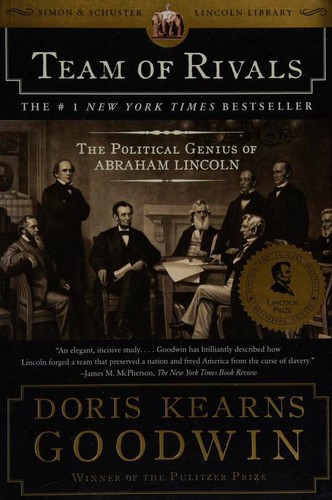
Her most celebrated book, Team of Rivals: The Political Genius of Abraham Lincoln, published in 2005, examined Lincoln’s decision to populate his Cabinet with the men who had competed against him for the Republican nomination in 1860—William Seward, Salmon Chase, and Edward Bates—and argued that Lincoln’s capacity to manage their egos and channel their abilities while maintaining his own moral clarity and political vision was the central story of his presidency. The book spent years on bestseller lists, won numerous awards, and became so widely read that Secretary of State Hillary Clinton and President-elect Barack Obama both cited it as essential reading during the 2008 transition. Steven Spielberg’s film Lincoln (2012) was based in part on Goodwin’s research.
She has continued to produce major works of presidential history, including The Bully Pulpit: Theodore Roosevelt, William Howard Taft, and the Golden Age of Journalism (2013) and Leadership in Turbulent Times (2018), which examined the leadership development of four presidents—Lincoln, Theodore Roosevelt, Franklin Roosevelt, and Lyndon Johnson—through their responses to crisis. She is also a familiar presence as a political commentator on television and a beloved public intellectual who has made the presidency comprehensible and compelling to generations of readers.
Doris Kearns Goodwin’s career demonstrates that popular history, written with scholarly rigor and narrative ambition, can function as civic education—helping readers understand not just the past but the persistent challenges of democratic leadership that the past illuminates.