
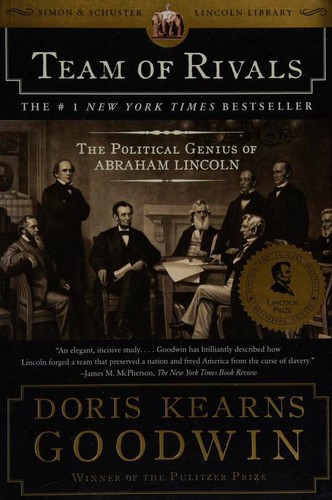
Team of Rivals
Simon & Schuster · 2005 · 944 pages
ISBN: 9780743270755
Review Editor
Thomas Calloway
Summary
In 1860, Abraham Lincoln was the least credentialed man seeking the Republican presidential nomination. William H. Seward was the party’s intellectual leader and presumptive nominee. Salmon P. Chase had been a senator and governor of Ohio. Edward Bates was a former congressman and respected elder statesman. All three considered Lincoln a provincial lawyer whose nomination would be an embarrassment. Lincoln won the nomination anyway, and then did something none of them expected: he offered each of them a cabinet position.
Doris Kearns Goodwin’s Team of Rivals is the story of what happened next. It is structured as a quadruple biography, tracing the parallel lives of Lincoln, Seward, Chase, and Bates from their childhoods through the Civil War, illuminating Lincoln’s character by contrast with the men who were convinced they were better suited for the presidency than he was. By the end of the war, each of them had come to understand, some more reluctantly than others, that they were wrong.
The book runs nearly a thousand pages, which it needs. Goodwin has spent decades studying Lincoln and has marshaled an extraordinary range of primary sources: letters, diaries, newspaper accounts, and the recorded memories of people who knew these men. The result is the most thorough account of Lincoln’s presidential years since Carl Sandburg, and a more analytically rigorous one.
Character Arcs and Development
Seward is the most fascinating figure in the book after Lincoln. He arrived in Washington convinced he would be the power behind a weak president, and gradually became Lincoln’s most loyal and effective ally. The transformation is rendered with precision: Goodwin traces the exact moments when Seward’s condescension shifted into respect, his respect into admiration, and his admiration into something approaching devotion. Their friendship, conducted at the highest pitch of national crisis, is one of the great political relationships in American history, and Goodwin does it full justice.
Chase is the book’s villain, if it has one. His ambition was extraordinary even by the standards of politicians: he never stopped trying to replace Lincoln on the ticket, even while serving as Secretary of the Treasury. Goodwin renders his self-delusion with sympathy; she understands that Chase genuinely believed he would be a better president, and that his inability to see what Lincoln was doing was a failure of imagination rather than character. He was a man of real ability who happened to be in proximity to genius and could not quite perceive it.
Lincoln himself is rendered with a fullness that few biographers have managed. Goodwin captures the depression he fought throughout his life, the storytelling as social strategy, the silence when silence was required, and the moral clarity that emerged, slowly and then suddenly, on emancipation. She is particularly good on his patience: Lincoln endured provocations from Chase that would have broken any ordinary president, and did so because he understood that Chase’s talents were necessary to the war effort and that removing him would cost more than enduring him.
Pacing
At 944 pages, Team of Rivals could feel exhausting but does not. Goodwin organizes the parallel biographies in the early sections so that the reader is always moving between lives, which creates momentum even through the most detailed passages of political background. The Civil War sections accelerate naturally: the material drives itself forward. The final chapters, covering Lincoln’s assassination and the aftermath, are among the most affecting in recent popular history.
The book’s length is justified by its ambition. Goodwin is not just narrating events; she is building a case about Lincoln’s character that requires hundreds of pages of evidence. Readers who come wanting a quick account of the Lincoln cabinet will find more than they bargained for. Readers who come wanting to understand what made Lincoln Lincoln will find exactly what they need.
Deeper Thematic Exploration
The book’s central argument is that Lincoln’s emotional intelligence was the source of his political genius. He had grown up poor, in circumstances that would have broken many men, and had developed through experience what his rivals had never needed to develop: the ability to inhabit other people’s perspectives, to understand what they wanted and feared, to calculate what they could be persuaded to do and when. His rivals were men of considerable gifts who had never been required to develop this capacity. Lincoln had been required to develop it every day of his life.
Goodwin is also making an argument about the relationship between ambition and virtue. All four men were deeply ambitious; Lincoln’s ambition was no less fierce than Seward’s or Chase’s. What distinguished him was the capacity to subordinate personal ambition to a larger purpose at the moments when it mattered most. Chase never managed this. Seward managed it after considerable struggle. Lincoln managed it consistently, which is why he is Lincoln and they are his rivals.
There is a quieter argument about the nature of democratic leadership running through the book: that the presidency, at its highest, requires not just the ability to make decisions but the ability to hold together people who disagree, to give each their due, and to use their competing strengths toward a common end. Lincoln did this better than any president before or since. The cabinet was not a team of friends; it was a team of rivals, and managing them was Lincoln’s greatest political achievement.
Style and Voice
Goodwin writes popular history with the assurance of a historian who has spent decades with her sources and knows how to make the past feel present. Her prose is clear, unhurried, and authoritative, with a warmth that never tips into sentimentality. She allows herself moments of admiration for Lincoln that less scrupulous historians would suppress, and the book is better for her honesty about her feelings: she loves Lincoln, as her sources did, and the love is earned rather than assumed.
The sourcing is meticulous and the bibliography formidable. Goodwin is a scholar writing for general readers, which means she has translated a vast apparatus of documentation into something that reads like a story. The footnotes are a treasure in themselves for anyone who wants to trace her arguments back to their sources.
Verdict
Team of Rivals is the definitive single-volume account of Lincoln’s presidency and one of the essential works of American political biography. It will not tell readers everything about Lincoln: no book could. But it will tell them the most important things, with a clarity and depth that no comparable work has matched. It is a book that confirms what Lincoln’s contemporaries slowly came to understand: that they had misread him completely, and that their misreading was their problem, not his.
Five stars: a masterpiece of popular history and the standard by which Lincoln biographies will be measured for decades.
What is Team of Rivals about?
Team of Rivals is Doris Kearns Goodwin’s political biography of Abraham Lincoln, structured around his decision to appoint his three main rivals for the 1860 Republican nomination, William H. Seward, Salmon P. Chase, and Edward Bates, to his cabinet. The book argues that this decision revealed Lincoln’s extraordinary emotional intelligence and political genius, and traces how each rival came to understand, often reluctantly, that they had underestimated him.
Is this book too long for a general reader?
At 944 pages it is a commitment, but Goodwin writes with enough narrative drive that the length rarely feels punishing. She structures the early sections as parallel biographies, which keeps the material moving, and the Civil War sections accelerate as events accelerate. Most readers who begin the book finish it, which is the most useful measure of whether length is justified. Those wanting a shorter introduction to Lincoln might start elsewhere, but those willing to invest the time will find it rewarded.
What was Lincoln’s relationship with William Seward?
Seward arrived in Washington expecting to function as the power behind a weak president and gradually became Lincoln’s most loyal ally. Their relationship evolved from Seward’s barely disguised condescension to genuine friendship and admiration. By the end of the war, Seward considered Lincoln the greatest man he had known. They were together the night Lincoln was shot, and Seward was himself nearly assassinated in his home by a co-conspirator on the same evening.
Why did Lincoln keep Salmon Chase in his cabinet despite Chase’s disloyalty?
Chase never stopped angling to replace Lincoln on the ticket, even while serving as Secretary of the Treasury. Lincoln kept him because Chase was genuinely brilliant at managing war finances and because removing him would have created a more dangerous political enemy outside the cabinet than inside it. Lincoln’s patience with Chase was strategic as well as temperamental: he understood that his own renomination was more secure with Chase inside the tent.
What is the book’s central argument about Lincoln’s leadership?
That Lincoln’s emotional intelligence was the source of his political genius. He could inhabit other people’s perspectives with unusual accuracy, which allowed him to calculate what they wanted, what they feared, and what they could be persuaded to do. His rivals were men of considerable ability who had never needed to develop this capacity. Lincoln had been developing it since childhood in conditions that required it for survival. The book argues that his mastery of the cabinet was an expression of this capacity, not of conventional political cunning.
How did this book influence Barack Obama?
Obama cited Team of Rivals as a major influence on his decision to appoint Hillary Clinton as Secretary of State and to build a cabinet that included rivals and critics. He framed his approach explicitly in terms Goodwin would recognize: surrounding himself with strong, independent voices rather than loyalists, on the theory that good decisions require genuine debate. The book’s influence on how a generation of politicians and executives think about leadership and team-building has been substantial.
Is this primarily a biography of Lincoln or of all four men?
It is structured as a quadruple biography but Lincoln is clearly the center. The portraits of Seward, Chase, and Bates are vivid and substantial, but they are rendered primarily as contrasts to Lincoln: their qualities illuminate his qualities by difference. Readers primarily interested in Seward or Chase will find material here that is unavailable in comparable depth elsewhere, but they will also find that these men are ultimately supporting characters in Lincoln’s story, which is the correct assessment of history.
Does Team of Rivals cover Lincoln’s assassination?
Yes, the final chapters cover the assassination in detail, including the evening at Ford’s Theatre, the simultaneous attack on Seward, and the aftermath. Goodwin handles this material with appropriate gravity, tracing the reactions of each rival cabinet member to the death of the man they had once dismissed and had come to revere. The conclusion is one of the most affecting passages in the book.
Book Details
- Title
- Team of Rivals
- Author
- Doris Kearns Goodwin
- Genre
- History
- Publisher
- Simon & Schuster
- Year Published
- 2005
- Pages
- 944
- ISBN
- 9780743270755
- WritersReview Rating
- 5.0 / 5