
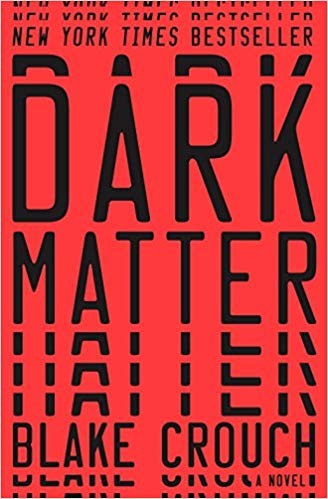
Dark Matter
Crown Publishers · 2016 · 342 pages
ISBN: 9781101904220
Review Editor
Marcus Webb
Summary
Jason Dessen is, by his own accounting, an ordinary man. He teaches physics at a small Chicago college, is happily married to Daniela, and loves his son Charlie. He sometimes wonders about the version of his life he might have had if he had pursued his research rather than choosing family, but he does not wonder very hard. He is, as the novel opens, genuinely content.
Then he is abducted at gunpoint, drugged, and wakes up in a laboratory surrounded by people treating him as a celebrated scientist who has just returned from a breakthrough experiment. His wife, his son, his entire life as he knew it: gone. Replaced by a reality in which he made different choices fifteen years ago, and those choices built a different world.
Blake Crouch’s Dark Matter is a thriller built on the many-worlds interpretation of quantum mechanics, the scientific hypothesis that every quantum event that can go multiple ways does go multiple ways, spawning parallel universes at every branch point. Crouch translates this into the story of one man’s desperate attempt to find his way back to a world of seven billion possibilities, where a single one is the one he calls home.
The novel’s premise could easily collapse into cold abstraction. Crouch never lets it. At every turn, the quantum conceit is anchored in the specific, physical, emotional texture of one marriage, one family, one love. The science is in service of the story, and the story is about what it means to choose a life and then fight to return to it.
Character Arcs and Development
Jason Dessen begins the novel as a man who has made peace with his choices. He is not someone who regrets his life; he simply lives it. His abduction forces him to confront, from the outside, what his life might have looked like from a different angle, and what he discovers is that he is more himself than he realized. When stripped of everything that defined him — his job, his home, his family — what remains is a man who will destroy himself to return to the people he loves. His identity, Crouch argues, is not his achievements. It is his commitments.
Daniela Dessen is rendered with particular care for a character who spends much of the novel off-page. Crouch conveys her clearly enough through Jason’s memories and variations that when we finally see her in the novel’s climax, she feels fully inhabited. Her artistic ambition, her intelligence, her specific quality of love for Jason — all of it has been built piece by piece through his recollection.
The antagonist is conceptually brilliant: Jason’s own shadow, the version of himself who made the other choice. There is no monster here, only a man who wants what Jason has and believes his claim is legitimate. The confrontation between the two is the novel’s most philosophically daring material, and Crouch does not resolve it with the comfortable clarity we might want.
Amanda Lucas, the scientist who accompanies Jason through his odyssey, provides a crucial external perspective. Her relationship with Jason is complex — she develops feelings for him that he cannot reciprocate — and Crouch handles the asymmetry honestly, without sentimentality.
Pacing
Dark Matter moves like a physical force. Crouch writes in short chapters, often ending each one at a moment of acute suspense or revelation, and the cumulative effect is a book that is genuinely difficult to put down. The novel’s middle section, in which Jason and Amanda navigate an apparently infinite sequence of alternate realities in search of his world, could easily become repetitive. Crouch avoids this by making each world distinct, each deviation from the familiar an opportunity to explore what the same city, the same history, could become under different conditions.
The final third accelerates beyond what seems possible. When the situation expands in a way I will not describe for readers who haven’t yet reached it, the novel becomes something genuinely surprising — not a twist, exactly, but a logical extension of its own premises that opens up philosophical territory the thriller genre rarely explores. The resolution is earned rather than imposed.
Deeper Thematic Exploration
The novel’s central question is: what is the self? Jason Dessen is, across the multiverse, a different person in a thousand different ways. He is a celebrity in one world, a murderer in another, an ordinary man in the one he came from. What remains constant? Crouch’s answer, delivered through the plot rather than stated outright, is the quality of love and the specificity of commitment. Jason is not attached to a life in the abstract; he is attached to this woman, this child, this kitchen table, these particular mornings.
The many-worlds interpretation, in the novel’s framework, is not liberating. It is terrifying. If every choice spawns a universe, then the self is not a coherent identity but a kind of probability distribution across infinite versions. What you are depends entirely on what you chose, and the knowledge that you chose differently in an infinite number of other worlds does not diminish the weight of what you chose here. It intensifies it. The multiverse makes every decision an act of self-definition.
Crouch also explores the relationship between regret and gratitude. Jason’s alternate self created the box as a machine for regret — a way to return to the fork in the road and take the other path. But Jason, once he has traveled through that machine, discovers that the path he took is the one he would take again. The novel is, at its heart, a love story in the form of a thought experiment.
Style and Voice
Crouch’s prose is functional rather than literary in the elevated sense, but it is extremely precise. He writes with a science teacher’s clarity and a thriller writer’s economy. Technical concepts are explained through action and experience rather than lectures — we understand quantum superposition not through a classroom explanation but through Jason’s terrifying experience of it. This is the correct approach for this kind of novel, and Crouch executes it without condescension.
The first-person present-tense narration creates an unusual intimacy, plunging the reader directly into Jason’s disorientation. When Jason does not know what is real, neither does the reader. When he is frightened, the tense construction makes the fear immediate. It is a choice that could easily become gimmicky, but Crouch deploys it with enough control that it serves the story throughout.
Dialogue is handled efficiently: characters say what they need to say, revealing themselves through emphasis and omission rather than elaborate speeches. This is genre fiction that takes its genre seriously, and it benefits from that seriousness without pretending to be something it isn’t.
Verdict
Dark Matter is the rare thriller that achieves the combination of plot momentum and genuine intellectual depth. It keeps its promises to the reader as a suspense novel while consistently delivering more than those promises require. The quantum physics is accurate enough to satisfy the curious without overwhelming readers who are not scientists. The emotional stakes are real. The climax is unexpected and earned.
Most importantly, the novel says something true about human experience: that the life we build through specific, contingent choices — the partner we happened to meet, the job we happened to take, the morning we happened to wake up in a particular way — becomes irreplaceable not because it is objectively the best of all possible lives but because it is ours. The multiverse cannot improve on that. It can only show us, by contrast, why it matters.
A five-star thriller that uses science fiction to deliver a deeply human story about identity, love, and the courage it takes to choose one life out of infinite possibilities.
Is Dark Matter based on real science?
Yes, the novel’s central premise is grounded in the many-worlds interpretation of quantum mechanics, a genuine scientific hypothesis proposed by Hugh Everett III in 1957. The idea that every quantum event with multiple possible outcomes generates branching parallel universes is taken seriously by a significant subset of physicists, though it remains unverifiable by definition. Crouch has acknowledged consulting physicists during the writing process, and the science functions plausibly within the novel’s framework.
How long is Dark Matter and how quickly does it read?
The novel is 342 pages with short chapters that drive extremely fast reading. Most readers report finishing it in one or two sittings — it has that quality of forward momentum that makes putting it down feel physically difficult. The pacing is deliberate on Crouch’s part; the kinetic reading experience mirrors Jason’s desperate, disoriented flight through the multiverse.
Is Dark Matter part of a series?
No, it stands alone as a complete novel. Blake Crouch has written other standalone thrillers with science fiction elements, including Recursion and the Wayward Pines trilogy, but Dark Matter does not connect to those narratives. Its ending is conclusive. A television adaptation was produced for Apple TV+ in 2024.
What is the box in Dark Matter?
The box is a chamber that Jason’s alternate self has constructed using a drug that allows the mind to access quantum superposition, enabling travel between parallel universes. The traveler enters a drug-induced state that holds all possibilities open simultaneously; the emotional state and unconscious expectations of the traveler determine which universe they emerge into. It is both a scientific device and a philosophical proposition: the world you find depends on what you are looking for.
Is Dark Matter appropriate for readers who don’t know physics?
Completely. Crouch explains quantum concepts through experience rather than exposition, and the novel requires no scientific background. The many-worlds interpretation functions in the story as a premise rather than a lecture, and readers who finish the book curious about the underlying physics will find that curiosity rewarded by the real science, which is at least as strange as what Crouch describes.
How does Dark Matter compare to other quantum fiction?
Dark Matter occupies a space between literary science fiction and commercial thriller. It is more emotionally grounded and less philosophically dense than something like Greg Egan’s work, and more rigorous about its scientific premise than most parallel-universe thrillers. The comparison that comes up most often is to Richard Curtis’s About Time in its emotional register and to Richard Morgan’s quantum fiction in its conceptual ambition, though Crouch’s prose is more accessible than either.
Does Dark Matter have a happy ending?
This question contains a spoiler, but the answer is: yes, in the way that honest books have happy endings. The resolution is earned through genuine sacrifice and consequence, and it does not pretend the complications have been cleanly resolved. What Jason achieves at the end is what he set out to achieve, but the novel has been honest enough that the achievement carries the weight of everything it cost. It is a satisfying conclusion that does not simplify what preceded it.
What makes Dark Matter different from other parallel universe stories?
The novel’s distinguishing quality is its emotional specificity. Most parallel universe stories derive their power from the grandeur of the concept — infinite worlds, infinite possibilities. Crouch anchors his story at the opposite end of the scale: one marriage, one kitchen table, one particular laugh. The multiverse functions not as spectacle but as a way of asking what is irreplaceable about a single, specific human life. The answer he arrives at is more moving than the science that delivers it.
Book Details
- Title
- Dark Matter
- Author
- Blake Crouch
- Genre
- Science Fiction
- Publisher
- Crown Publishers
- Year Published
- 2016
- Pages
- 342
- ISBN
- 9781101904220
- WritersReview Rating
- 5.0 / 5