
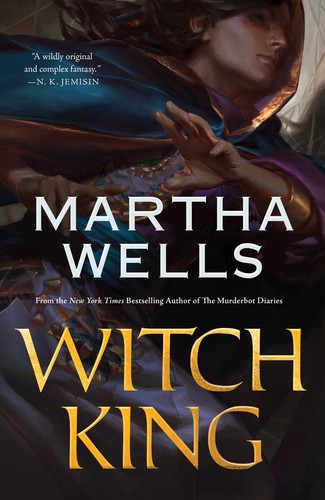
Witch King
Tordotcom · 2023 · 432 pages
ISBN: 9781250826794
🏆 Dragon Award for Best Fantasy Novel (2023)
Locus Award for Best Fantasy Novel (2024)
Hugo Award for Best Novel (2024) - Finalist
Nebula Award for Best Novel (2023) - Nominated
World Fantasy Award for Novel (2024) - Nominated
Review Editor
Marcus Webb
Martha Wells spent the better part of a decade writing the science fiction novella series that made her a household name in genre circles. The Murderbot Diaries gave readers a socially anxious, TV-addicted security construct who would do anything to avoid human interaction, and it won Wells multiple Hugo Awards. So when she announced a return to fantasy, the genre she built her career on before the robot era, readers paid close attention. Witch King, published by Tordotcom in May 2023, is her first fantasy novel since The Harbors of the Sun in 2017, and it makes clear she has not lost her touch with secondary world building, though she approaches it with the economy of a writer who has spent years crafting tight, propulsive novellas.
Set in a world where demons travel between the underearth and the surface by inhabiting the bodies of willing, recently deceased hosts, the novel centers on Kai-Enna, a demon of considerable age and power. The story opens with Kai waking sealed inside a container at the bottom of a lake, with an expositor, one of the mage-types who can bind and control demons, attempting to claim him as a familiar. Kai kills him and escapes, but the process scrambles his consciousness into a new body. He finds his companion Ziede, a witch who has also been imprisoned, and the two set out to locate Ziede’s wife Tahren, an Immortal Blessed warrior who has vanished without explanation.
The novel runs on two timelines. The present narrative follows Kai’s investigation across a world still rebuilding after a brutal colonial occupation by a group called the Hierarchs, who conquered most of the continent several generations before the story begins. The past narrative shows how that occupation ended: how Kai, Ziede, Tahren, and a prince named Bashasa Calis organized and carried out the revolution that brought the Hierarchs down. Wells trusts readers to piece together the world from both directions at once, holding back on explanations and letting the shape of things emerge from context. This approach will frustrate some readers and reward others considerably.
Character Arcs and Development
Kai is a compelling protagonist because he is not particularly interested in being a hero. He is old, powerful, and accustomed to solving problems through a combination of cunning, borrowed bodies, and a willingness to do things others find distasteful. The non-consensual possession he committed during the past timeline, stealing the body of an expositor when he had no willing host, haunts him in a quiet and consistent way. His own kin disowned him for it. He does not apologize or explain himself, but the weight of that act shapes how he moves through the present: with clarity about what he can and cannot justify doing again.
Ziede provides the novel’s emotional texture. She is sharp, impatient, and clearly terrified for Tahren, though she refuses to show it openly. Her relationship with Kai is long enough to have its own shorthand, built on genuine mutual respect and years of shared combat. When Ziede is frightened or angry, it registers precisely because Wells has shown you how composed she normally is. The street kid Sanja, who attaches herself to Kai and Ziede early in the present timeline, serves as the reader’s point of contact in some ways: she is not immortal, not a witch or a demon, not connected to the old power structures, and her presence keeps the story anchored to a human scale. The ambiguous Ramad, personal vanguard to the current prince-heir of Benais-arik, adds useful uncertainty. You spend much of the book trying to figure out whose interests he actually serves, and that uncertainty does real work for the plot.
One area where the character work is thinner is the past timeline’s secondary figures. Bashasa Calis, the prince who organized the original revolution, is vividly drawn, but the full weight of his arc depends on investment in characters whose present-day versions are absent or transformed. Wells does not waste space on backstory for its own sake, which is a virtue, but it occasionally means that emotional beats in the past narrative land at reduced force because the setup is still coming into focus when they arrive.
Pacing
The dual timeline structure means the book has two openings, and neither of them offers a gentle entry. Wells drops you into the present with minimal orientation and into the past with a similar lack of ceremony, expecting you to find your bearings through the momentum of events rather than through any guided tour of the world. For the first hundred pages or so, keeping track of who is who, what the Hierarchs were, what the Rising World coalition is, and how demons actually function requires sustained active attention. This is not a book you can read on autopilot.
Once the two timelines begin to illuminate each other, the pacing clicks into a more satisfying rhythm. The present narrative, with its immediate urgency, provides the forward momentum. The past timeline deepens your understanding of why the present stakes matter. The middle section does slow, circling through several intermediary steps in the conspiracy before the shape of the actual plot against Kai becomes fully visible. But the final third moves with clear purpose, and the dual timeline pays off fully when the two strands converge. Readers who push through the demanding opening will find the payoff proportionate to the effort.
Deeper Thematic Exploration
The most substantial thing Witch King is doing is a meditation on empire: what it costs to resist one, what violence that resistance requires, and what it means to rebuild a world after one falls. The Hierarchs are not presented as complex or sympathetic antagonists. They occupied most of the known world, severed demons from their home, used magical practitioners as tools and weapons, and killed millions. The revolution that ended them was not clean or morally uncomplicated, and Kai carries the marks of choices he made during that war. The world built after the Hierarchs still contains the seeds of new hierarchies and new betrayals. The Rising World coalition of city-states is genuinely better than what it replaced, but it is fragile, contested, and vulnerable to the same concentrations of power that produced the Hierarchs in the first place. Wells is not optimistic about the permanence of progress. She is honest about the work required to defend it.
The treatment of queer relationships deserves attention specifically for how unremarkable it is. Ziede and Tahren are a married couple. Kai’s attractions to men register in passing, without comment or emphasis. The fact that none of this is framed as exceptional or transgressive is itself a substantive choice: these are ordinary facts of life in this world, woven into the social fabric the way that demon possession of willing hosts is woven in. Wells is not making a point about tolerance. She is writing a world where these things have always been present, and the contrast with fantasy fiction that either erases queer people or treats their existence as a category requiring special acknowledgment is quietly powerful.
There is also something worth sitting with in how Kai relates to his own identity. He has inhabited many bodies over centuries. He is, in some sense, unmoored from conventional ideas of a stable physical self. Yet he is among the most grounded characters in the book, with a clear sense of his values and commitments and of what he will not do again. The horror of non-consensual possession coexists with his own ongoing vulnerability to having his self dissolved or captured. Wells does not collapse this into allegory, but the resonances between Kai’s situation and broader questions about what makes identity durable are present throughout.
Style and Voice
Wells writes lean, functional prose that trusts itself to carry weight without ornament. Her sentences are short to medium, direct, and occasionally dry in a way that suits the Kai perspective well. He is watching human beings attempt things he finds mildly absurd, with the patience of someone who has watched a great deal of history happen and expects to watch considerably more. This produces some of the novel’s best moments, particularly when Kai’s composure breaks slightly in the face of something that genuinely surprises him, or when his affection for Ziede and Sanja shows through despite his general preference for keeping people at a distance.
The approach that made the Murderbot books feel immediate, a distinct first-person voice filtering the world through a specific consciousness with specific preoccupations, works differently here. Witch King is third person, and Kai is more guarded than Murderbot. You spend more time interpreting him than inhabiting him. The prose is clear and competent throughout, but it occasionally moves through moments of potential emotional weight a bit too quickly. A few scenes in the past timeline, where the reader most wants to slow down and feel the stakes, receive the same brisk treatment as scenes of tactical exposition. This is the occasional cost of Wells’ economy: efficiency at the expense of resonance.
Verdict
Witch King is for readers who want their fantasy to take them seriously. It does not summarize, explain, or soften its world for newcomers. You either find your footing in the secondary world, or you do not, and Wells seems comfortable with that tradeoff. If you read for immersion in a fully realized setting with a long history and a protagonist who operates outside normal human frameworks, this will satisfy in ways that more familiar fantasy does not.
Readers who prefer their secondary world fantasy to explain itself gradually, or who want emotional warmth to be accessible early, may take longer to connect with Witch King, and some will not connect at all. What is harder to dispute is the quality of the underlying ideas: a world where the aftermath of empire is still being actively negotiated, where queerness is part of the fabric without comment, and where survival over centuries carries its own particular cost. The sequel, Queen Demon, arrived in 2025, which means Wells intends to deepen this world considerably. Starting here puts you ahead of that conversation.
Frequently Asked Questions about Witch King
What is Witch King by Martha Wells about?
Witch King follows Kai, an ancient demon who wakes imprisoned at the bottom of a lake and must escape, rescue his companion Ziede, and track down Ziede’s missing wife Tahren. The story moves across two timelines: the present investigation and the past, which shows how Kai and his companions helped overthrow a brutal colonial empire called the Hierarchs. It is set in a secondary world where demons inhabit the bodies of willing deceased hosts, witches wield specific magical powers, and a coalition of city-states is still rebuilding after the Hierarchs’ fall.
Is Witch King part of a series?
Yes. Witch King is the first book in The Rising World series by Martha Wells, published by Tordotcom. Its sequel, Queen Demon, was released in 2025. The series is a return to fantasy for Wells, who spent the years between 2017 and 2023 writing the science fiction Murderbot Diaries novellas. You do not need to have read the Murderbot books to read Witch King.
What awards did Witch King win?
Witch King won the Dragon Award for Best Fantasy Novel in 2023 and the Locus Award for Best Fantasy Novel in 2024. It was also a finalist for the Hugo Award for Best Novel (2024), the Nebula Award for Best Novel (2023), and the World Fantasy Award for Novel (2024). The New York Times named it one of the top ten science fiction and fantasy novels of 2023.
What are the main themes in Witch King by Martha Wells?
The central themes are empire and its aftermath, the cost of resistance, and identity. The Hierarchs, who colonized most of the world before being overthrown, cast a long shadow over both timelines. The novel also explores queer relationships as a normalized part of the world rather than as exceptional or transgressive, and examines what it means to have a stable sense of self when your physical form is not fixed, as is the case for Kai.
Is Witch King confusing or hard to read?
Many readers find the opening challenging. Wells uses a dual timeline structure and drops you into a complex secondary world without extensive hand-holding. The first hundred pages require active attention to track characters, factions, and terminology. Readers who push through typically find the two timelines start to illuminate each other, and the payoff is substantial. At 432 pages, it is a full novel with a demanding but not inaccessible prose style.
How does Witch King compare to the Murderbot Diaries?
Both series feature a reluctant, socially guarded protagonist navigating a world shaped by institutional power. But Witch King is more expansive and more demanding. Murderbot uses a first-person voice that is immediately intimate; Witch King uses a close third person that is more interpretive. The Murderbot books are also novellas and shorter novels with a lighter touch; Witch King is a denser, slower-building secondary world fantasy. Fans of Murderbot’s voice and humor may find Witch King more challenging, though the quality of the underlying craft is consistent.
Is there a movie or TV adaptation of Witch King by Martha Wells?
As of mid-2026, there is no announced film or television adaptation of Witch King. Martha Wells does have a television adaptation of The Murderbot Diaries in production with Apple TV+, which has brought her work to broader attention. Whether the Rising World series will follow is not yet publicly confirmed.
Should I read Witch King and is it worth it?
If you enjoy secondary world fantasy with real thematic depth, a complex protagonist, and a world built around the aftermath of colonial empire, then yes, unambiguously. The awards recognition reflects genuine quality. If you want fantasy that orients you gently and rewards passive reading, Witch King is likely to frustrate you. The readers who love it tend to love it with real intensity, which is usually a better sign than uniform lukewarm approval.
Book Details
- Title
- Witch King
- Author
- Martha Wells
- Genre
- Science Fiction
- Publisher
- Tordotcom
- Year Published
- 2023
- Pages
- 432
- ISBN
- 9781250826794
- Awards
- 🏆 Dragon Award for Best Fantasy Novel (2023) Locus Award for Best Fantasy Novel (2024) Hugo Award for Best Novel (2024) - Finalist Nebula Award for Best Novel (2023) - Nominated World Fantasy Award for Novel (2024) - Nominated
- WritersReview Rating
- 4.9 / 5