
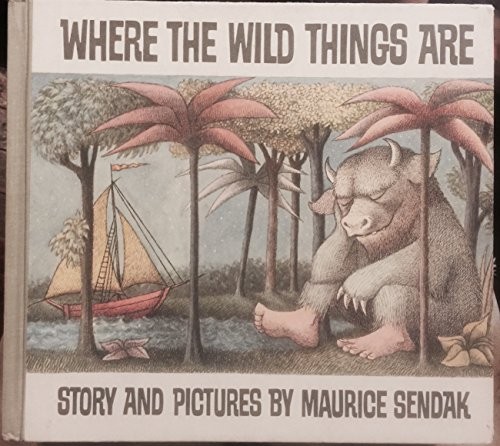
Where the Wild Things Are
Harper & Row · 1963 · 40 pages
ISBN: 9780060254926
Review Editor
Hannah Bright
Where the Wild Things Are arrived in November 1963, a forty-page picture book that changed what picture books could do and be. Maurice Sendak, a child of Brooklyn who spent much of his childhood ill in bed drawing comics and watching the world through apartment windows, wrote and illustrated the story of a boy named Max who wears a wolf suit, gets sent to his room for threatening to eat his mother, and sails to a kingdom of monsters who crown him their ruler. Nothing about that summary prepares you for how the book feels when you actually read it, which is to say: it feels like someone opened a window directly into the emotional weather of early childhood and refused to apologize for what they found there.
Sendak spent years on this book before it reached its final form. Early drafts featured horses that he, by his own admission, could not draw convincingly; the animals were replaced by creatures assembled from imagination and memory, specifically from the relatives who descended on his family’s Brooklyn home for visits and whom the young Sendak found simultaneously frightening and beloved. They had enormous heads and dark circles under their eyes and yellow teeth and claws, and they made promises like “We’ll eat you up, we love you so.” The finished illustrations were built with crosshatching of extraordinary care, each creature given the weight of something that could actually cause damage. The book won the Caldecott Medal in 1964, the highest honor in American picture book illustration. It was later voted the number one picture book of the twentieth century in a poll of librarians and educators, a distinction that understates the case: it is one of the handful of books in any category that genuinely reshapes the field it belongs to.
The story covers three days in compressed form: the day Max is sent to his room without supper, the night of his fantasy voyage, and the night he returns to find his supper still hot. Thirty-seven lines of text, roughly ten sentences total. Illustrations that begin small and contained and expand to double-page spreads as Max reaches the wild things’ land, then contract again as he prepares to leave. The technical structure and the emotional structure are identical. The book achieves in forty pages what most novels labor over four hundred to accomplish.
Character Arcs and Development
Max is four or five years old and furious. His fury is not explained. We do not know what happened before the wolf suit, before the hammer, before the chase through the house that ends with his mother calling him a wild thing. We know only that he retaliates with the most alarming threat a small child possesses: “I’ll eat you up.” He is sent to his room. What happens next is either a dream or a wish, and Sendak declines to specify which. This ambiguity is not an oversight. It is the architecture of the book.
In the land of the wild things, Max does not become gentle. He tames the monsters by staring into their yellow eyes without blinking, which is the child’s version of raw authority, and he rules them as their king. The rumpus they hold, a three-page wordless sequence of creatures leaping through darkness, is not a lesson in managing difficult feelings. It is a full and complete expression of them. Sendak understood something that most adults forget: that children need to experience their own wildness fully before they can set it down. Max does not return home because he has learned his lesson. He returns because he is lonely for the people who love him, because being king of a place where nothing constrains you turns out to be the loneliest possible position.
The wild things themselves are deliberately underdrawn as individuals. They have no separate names, no histories, no motivations beyond loving Max and hating to see him go. They do not need more than that. They are Max’s emotions made visible: enormous, threatening to smaller-seeming people, ultimately controllable by him once he meets them directly and refuses to look away. That is the psychological argument at the center of the book, and it is not a light one. Sendak makes it with pictures and ten sentences where other writers would need an entire novel, and it lands with the force of something true.
Pacing
The pacing of a picture book is controlled not by sentence length or chapter breaks but by page turns. Sendak understands the page turn as the fundamental unit of picture book time. The forest grows from a corner of Max’s bedroom over three spreads, gaining mass and opacity with each turn. The rumpus takes three wordless pages, each wider and more explosive than the last, until the eye can barely hold all the movement. The return home is a single tight page. Then a room. Then the bowl of food with its legend: “and it was still hot.”
That final sentence has no equivalent in picture book literature. The warmth of the supper is not a lesson or a reconciliation. It is evidence. Someone left food out for you even though you said you would eat them up. That is not a given. It is something specific, something requiring a particular kind of love. The book earns this ending by never softening the conflict that opens it: Max is genuinely terrible to his mother, she is genuinely angry, and still, at the end, the supper is there. The pacing builds toward that single warm image through escalating chaos and then through a series of contractions, pulling back and back until the room is small and quiet and the food is steaming beside the bed. If the book makes any argument at all, it is this: unconditional love is a fact, not a reward. Sendak delivers that argument through structure rather than statement.
Deeper Thematic Exploration
The controversy that followed publication is worth knowing. The New York Times children’s book reviewer praised the illustrations but worried that children might find the monsters too frightening. Child psychologists wrote letters about the nightmares the book might cause. Some libraries shelved it in restricted sections. Sendak, who had grown up listening to adults discuss the deaths of relatives in Europe, found the concern for children’s sensibilities somewhat bewildering. He believed, and argued for the rest of his life, that children are not protected from fear by being kept from encountering it in books. They are protected by being given stories that show them how to pass through it and come out the other side.
That argument is now close to orthodoxy in children’s literature, and Where the Wild Things Are helped make it so. The book’s premise, that a child’s inner life includes genuine rage and genuine longing for power and genuine capacity to be frightened by its own desires, and that these emotions are not shameful but human, was not universally accepted in 1963. It is close to self-evident now. The book changed what adults permitted children to read and what children’s books were allowed to say about the inner lives of the people reading them.
Sendak was also doing something more personal. He was raised in a family of Jewish immigrants who carried stories of the old country’s losses with them to Brooklyn, and his childhood was saturated with the sense that the world was capable of sudden and total darkness. The wild things carry traces of those relatives who visited and seemed too large and too loud for the apartment, who loved badly and fiercely and were impossible to fully understand. The book is not only about childhood anger. It is about a particular texture of childhood that includes oversized emotional weather, people whose love feels threatening, and the ongoing work of learning which is which. Max works it out by the last page. He goes home.
The book’s relationship to the broader tradition of children’s fantasy is worth noting as well. Unlike the Narnia books or A Wrinkle in Time, where the magical world is separate and richly developed, the land of the wild things has no internal history, no politics, no inhabitants beyond the wild things themselves. It is explicitly a projection, a space made entirely of Max’s needs at the moment he arrives. When those needs change, when loneliness breaks through the joy of absolute power, the place can no longer hold him. He sails back. The fantasy is not a destination; it is a tool. That is precisely the right relationship for a very young child to have with imagination, and Sendak builds it into the book’s bones.
Style and Voice
Sendak’s prose has the cadence of a chant or a spoken tale. “The night Max wore his wolf suit and made mischief of one kind / and another / his mother called him WILD THING / and Max said I’LL EAT YOU UP / so he was sent to bed without eating anything.” There are no quotation marks. The line breaks fall on rhythm rather than grammar. The effect is of something being told rather than read, closer in feel to oral storytelling than to conventional picture book prose. This register fits the material: the book is a story about the story a child tells himself in his room to survive the night.
The illustrations operate on their own frequency entirely. Sendak’s crosshatching gives the wild things physical density, the sense that they occupy actual space and could knock something over. But their expressions shift with the story’s needs: menacing when they arrive, delighted during the rumpus, mournful as Max prepares to leave. The famous full-bleed spreads of the rumpus are surrounded by dark, creating the impression of firelit darkness and genuine abandon. The final image of Max’s room, the supper steaming beside the bed, is warm and still and intentionally small. The monsters have retreated entirely. The room is safe. The food is hot.
Verdict
If you have not read this aloud to a child, do it this week. If you have read it many times and believe you know it, read it again without a child present and pay attention to what Sendak is doing with the page turns, with the contracting margins, with the syntax of Max’s sentences. The technical achievement is inseparable from the emotional one, and seeing how they work together is one of the more instructive experiences available to anyone interested in how narrative actually functions.
Readers who prefer their children’s books to offer only comfort, to reassure rather than risk, will find Where the Wild Things Are unsettling. That discomfort is intentional and correct. Children already know that anger is real and that love can coexist with it. Sendak gives them a story that confirms both facts and shows Max finding his way back through the wilderness to the warm room and the waiting supper. For any reader, young or not, who has ever felt like a wild thing and wondered whether anyone would still leave food out: this is the book.
Frequently Asked Questions about Where the Wild Things Are
What is Where the Wild Things Are by Maurice Sendak about?
Where the Wild Things Are is a forty-page picture book about a boy named Max who, dressed in a wolf suit, acts out so badly that his mother sends him to bed without supper. From his bedroom, a forest grows and Max sails to a land ruled by enormous creatures called wild things. He tames them, becomes their king, and leads a wild rumpus through the night before deciding he wants to go home. He returns to find his supper waiting, still hot. The book is about childhood anger, imagination as a coping tool, and the fact that being loved does not always feel gentle but tends to outlast the trouble.
What does the ending of Where the Wild Things Are mean?
The book ends with Max returning to his room to find his supper waiting, “and it was still hot.” The hot supper is not a symbol so much as a piece of evidence: someone left food for him after a terrible fight, which means love continued even through the anger on both sides. Sendak never explains whether the voyage to the wild things was a dream or a wish, which leaves the ending deliberately open. What is not ambiguous is the warmth. The room is safe. The food is there. Max was away as long as he needed to be, and the world he returned to had been holding a place for him the entire time.
What are the main themes in Where the Wild Things Are?
The book explores childhood anger and the imagination as a space where difficult emotions can be fully expressed and then set down. It argues that being loved does not protect a child from feelings that frighten them, but that love persists through those feelings anyway. The wild things represent the monstrous inner life that children are often told to suppress; Max’s capacity to tame them by staring them down is Sendak’s version of emotional courage. The book also touches on the loneliness of absolute power and on home as something worth returning to precisely because someone there is still keeping the food warm.
How long is Where the Wild Things Are and what age is it for?
Where the Wild Things Are is forty pages, with only thirty-seven lines of text across the entire book. Most children can sit through a reading in five to ten minutes, and it is typically recommended for ages three through eight as a read-aloud, though older children and adults return to it for different reasons. Some parents find it works best around age four or five, when the emotional territory Max covers, rage, fantasy, and the relief of returning home, maps most directly onto the child’s own experience. The book has no content requiring parental guidance; the monsters are intended to feel alarming and ultimately benign.
Is there a film adaptation of Where the Wild Things Are?
Yes. Director Spike Jonze released a live-action film adaptation in 2009, with a screenplay co-written by Jonze and Dave Eggers. The film expanded the story considerably, giving the wild things individual personalities and a fuller narrative. Max Records played Max. The film received strong critical responses and is considered one of the more thoughtful adaptations of a picture book, though it is tonally quite different from the source material and suits older children and adults more than the three-to-five age group the book originally targets. Sendak was involved in the production and expressed approval before his death in 2012.
Why was Where the Wild Things Are controversial when it was published?
When the book appeared in 1963, some child psychologists and reviewers argued that the monsters would frighten young children and that sending a child to bed as punishment was an unhealthy message to reinforce. Some libraries restricted access to it. Sendak, who believed strongly that children needed books that acknowledged the full range of their emotional experience, disagreed with every objection. The controversy faded quickly as the book’s effects on actual children turned out to be enthusiastically positive. It has been in continuous print for over sixty years and is now a standard of early childhood reading worldwide.
What awards did Where the Wild Things Are win?
Where the Wild Things Are won the Caldecott Medal in 1964, the most prestigious award in American picture book illustration, recognizing it as the previous year’s most distinguished picture book for children. It was later voted the number one picture book of the twentieth century in a survey of children’s librarians and educators. The book has sold over nineteen million copies worldwide as of 2009. Maurice Sendak received the Hans Christian Andersen Award in 1970, the highest international honor in children’s literature, partly on the basis of this book and his broader body of work.
How does Where the Wild Things Are compare to Maurice Sendak’s other books?
Sendak wrote and illustrated dozens of books over a fifty-year career, and Where the Wild Things Are stands as the central achievement. In the Night Kitchen (1970) shares the same dreamlike structure and the same refusal to sanitize a child’s inner life, and generated its own controversy. Outside Over There (1981) completed what Sendak considered a trilogy, dealing with darker material about sibling jealousy and danger. Readers who love Where the Wild Things Are tend to find In the Night Kitchen the most direct companion piece, with the same rhythmic prose and the same trajectory of a child going away and coming back transformed but essentially unchanged.
Book Details
- Title
- Where the Wild Things Are
- Author
- Maurice Sendak
- Genre
- Children's
- Publisher
- Harper & Row
- Year Published
- 1963
- Pages
- 40
- ISBN
- 9780060254926
- WritersReview Rating
- 4.8 / 5