
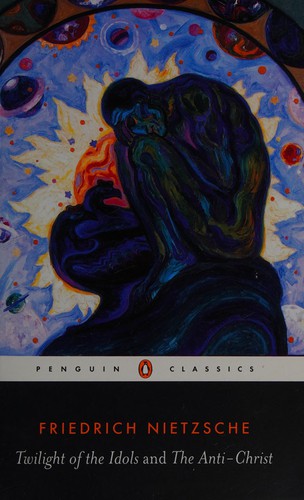
Twilight of the Idols
Penguin Books · 1889 · 210 pages
ISBN: 9780140445145
Review Editor
Owen Strand
Friedrich Nietzsche wrote “Twilight of the Idols” in the summer of 1888, completing it in about two weeks. He was forty-four years old and had roughly six months of productive intellectual life left before his mental collapse in January 1889. The book he produced in that extraordinary burst of late work is compact, ferocious, and deliberately organized as a kind of hammer blow against the philosophical tradition: Nietzsche takes aim at Socrates, Kant, Christianity, German culture, and the concepts of reason, morality, and free will, delivering verdicts in the compressed, aphoristic form that he had been perfecting across a decade of writing.
The title is a pun on Wagner’s “Twilight of the Gods” (Götterdämmerung), and the full German title, “Götzen-Dämmerung,” plays on “Götzen” meaning idols or false gods as opposed to genuine divinities. The idols Nietzsche is attacking are not supernatural beings but philosophical and moral concepts: the idea of a transcendent realm of reason, the belief in a moral world order, the faith that logical argument can establish ultimate truths about existence. These are what he means by idols, and his method, as the subtitle announces, is to sound them out with a hammer, testing whether they ring hollow.
The Penguin edition translated by R.J. Hollingdale is the standard accessible English-language version and the one most readers should start with. Hollingdale’s translation is fluid and accurate, and the volume pairs “Twilight of the Idols” with “The Anti-Christ,” written at roughly the same period, giving readers a sense of the sustained philosophical attack Nietzsche was mounting in his final productive months.
Argument and Structure
The book opens with “Maxims and Arrows,” a sequence of brief aphorisms that set the tone: compressed, punchy, often funny, and designed to unsettle. “Without music, life would be a mistake” is here; so is “I mistrust all systematizers and avoid them.” These are not throwaways but characteristic Nietzschean provocations, designed to lodge in the mind and disturb comfortable assumptions.
The central chapters develop sustained philosophical arguments. “The Problem of Socrates” argues that Socrates’ privileging of reason over instinct was itself a symptom of cultural decline rather than a correction of it: the turn to dialectic was a defensive response to the chaos of the drives, not a conquest of them. “How the ‘True World’ Finally Became a Fable” is one of the most elegantly compressed pieces of philosophical demolition in the literature: six numbered stages tracing the history of the concept of a transcendent real world from Plato through Kant to its final dissolution. “Morality as Anti-Nature” attacks the ascetic ideal and the devaluation of the passions as a misunderstanding of strength and health. Each chapter uses a different mode, some historical, some physiological, some directly argumentative, but all converge on the same target: the life-denying impulses that Nietzsche believes distort Western philosophy.
Key Concepts
Three concepts define the book’s philosophical contribution. The first is the critique of the concept of being: Nietzsche argues that the grammatical structure of language, with its subjects and predicates, its causes and effects, systematically misleads philosophers into positing fixed substances and relations where there are only processes and events. “Reason” in philosophy has been corrupted by language.
The second is the concept of decadence: Nietzsche uses this not as a moral term of abuse but as a physiological and cultural diagnosis. A decadent culture is one that has lost the instinctive vitality to affirm life and has compensated for that loss by inventing transcendent values that devalue the actual world. Christianity, Kantian morality, and Socratic rationalism are all, in his analysis, symptoms of decadence.
The third is the concept of revaluation of all values: the project announced in the book’s concluding sections and in the self-presentation of Nietzsche’s own philosophical task. Revaluation does not mean inverting existing values (making bad good and good bad) but questioning the entire framework by which values are assigned.
Influence and Legacy
“Twilight of the Idols” has had enormous influence on twentieth-century continental philosophy, not primarily through direct argument but through its style and method. The technique of reading philosophical and moral positions as symptoms of underlying psychological and physiological conditions, the genealogical approach, was developed more fully in the Genealogy of Morality, but the Twilight gives the most concentrated and readable version of it. Heidegger’s lectures on Nietzsche engaged closely with this text; Foucault’s genealogical method is in direct descent from it.
The book’s attack on the concept of free will and its defense of a naturalistic account of human agency have also remained productive for philosophers of action and moral psychology. Contemporary debates about moral responsibility, determinism, and the status of retributive punishment regularly engage with positions Nietzsche staked out here in compressed form.
Style and Accessibility
This is one of the best entry points into Nietzsche’s philosophy for readers who find the longer works, particularly “Thus Spoke Zarathustra” or “The Will to Power” notebooks, difficult to navigate. The book is short, structurally clear, and written with exceptional verve. Nietzsche at his best is one of the most entertaining philosophical writers in any language, and the Twilight gives you that quality in concentrated form. The aphoristic sections reward rereading; the sustained argumentative sections, particularly the history of the true world and the critique of Socrates, reward slow, careful attention.
One thing to be prepared for is Nietzsche’s use of physiological and psychological language in ways that can sound reductive if read too literally. When he describes philosophical positions as symptoms of health or disease, he is making a philosophical point about the relationship between intellectual frameworks and forms of life, not a medical diagnosis. Reading him charitably but critically is the right approach.
Verdict
“Twilight of the Idols” is the most efficient introduction to Nietzsche’s late philosophy: compact enough to read in an afternoon, dense enough to think about for years. If you want to understand why Nietzsche matters, why his critiques of reason, morality, and the philosophical tradition still generate productive philosophical work a century after his death, this is the place to start. Readers who have encountered Nietzsche only through secondary accounts and quotations will find the original sharper, funnier, and more rigorous than those accounts suggest. Those who already know his longer works will find here a crystalline summary of what he was after. Either way, the hammer rings clear.
Frequently Asked Questions about Twilight of the Idols
What is Twilight of the Idols by Nietzsche about?
Written in 1888, it is Nietzsche’s compressed philosophical attack on the major idols of Western thought: Socratic rationalism, Kantian morality, Christianity, and the concept of a transcendent realm of reason and truth. The book argues that these philosophical traditions are symptoms of cultural decadence rather than genuine insights into reality, and outlines Nietzsche’s counter-vision of a philosophy that affirms life and the instinctual drives rather than devaluing them.
What does the title Twilight of the Idols mean?
The title is a pun on Wagner’s opera “Twilight of the Gods” (Götterdämmerung). The German word Nietzsche uses, Götzen, means idols or false gods rather than genuine divinities. The idols he is attacking are philosophical and moral concepts, the idea of transcendent reason, moral world order, free will, that he believes Western culture has mistakenly worshipped. The subtitle, “How to Philosophize with a Hammer,” refers to sounding these idols out to test whether they ring hollow.
When did Nietzsche write Twilight of the Idols and why was it his last major work?
Nietzsche wrote it in roughly two weeks during the summer of 1888. It was published in early 1889, just as he was suffering the mental collapse from which he never recovered. The exact cause of his collapse remains debated, but he spent the last eleven years of his life incapacitated. The Twilight and The Anti-Christ, written in the same period, represent the final concentrated expression of his mature philosophy.
What is Nietzsche’s critique of Socrates in Twilight of the Idols?
Nietzsche argues that Socrates’ turn to reason and dialectic was not a triumph of clarity over confusion but a symptom of cultural decadence: a defensive response to the chaos of the instincts rather than a genuine mastery of them. By privileging reason over instinct, Socrates diagnosed Greek culture as sick and then prescribed a medicine, rational self-control, that was itself a form of the disease. The brilliant logical arguments were, for Nietzsche, a sign of weakness rather than strength.
What does Nietzsche mean by the “true world” in Twilight of the Idols?
The “true world” refers to the philosophical tradition of positing a transcendent realm of being, more real or more rational than the world of ordinary experience, that serves as the ultimate reference point for truth and value. Nietzsche traces this tradition from Plato’s Forms through Kant’s noumenal realm to the positivist rejection of metaphysics, arguing that the concept has finally dissolved into nothing and that we must now face the full consequences of living without a transcendent foundation for knowledge and value.
Is Twilight of the Idols a good place to start reading Nietzsche?
Yes, it is one of the best entry points. It is short, structurally clear, covers most of Nietzsche’s major themes, and is written with exceptional literary energy. Beyond Good and Evil and the Genealogy of Morality are deeper treatments of specific themes, and Thus Spoke Zarathustra is his most ambitious literary-philosophical work, but Twilight gives you the essential Nietzsche in the most concentrated and accessible form.
How does Twilight of the Idols relate to Nietzsche’s other late works?
It was written in the same extraordinary summer of 1888 that produced The Anti-Christ, Ecce Homo (Nietzsche’s philosophical autobiography), Nietzsche Contra Wagner, and the Dionysus Dithyrambs. The Anti-Christ extends the critique of Christianity; Ecce Homo provides Nietzsche’s own account of his philosophical development. Together, these late works represent the most concentrated and systematic expression of the positions Nietzsche had been developing since The Gay Science and Beyond Good and Evil.
Does Twilight of the Idols argue against free will?
Yes, explicitly and forcefully. Nietzsche argues that the concept of free will was invented by theologians and philosophers to make human beings responsible, and thus punishable, for their actions. It is a conceptual tool for punishment rather than a genuine description of human agency. Against free will he argues for a naturalistic account of human action as the expression of drives, instincts, and capacities that are themselves the products of natural processes, a position that anticipates twentieth-century compatibilist and hard determinist positions in philosophy of action.
Book Details
- Title
- Twilight of the Idols
- Genre
- Philosophy
- Publisher
- Penguin Books
- Year Published
- 1889
- Pages
- 210
- ISBN
- 9780140445145
- WritersReview Rating
- 4.6 / 5