
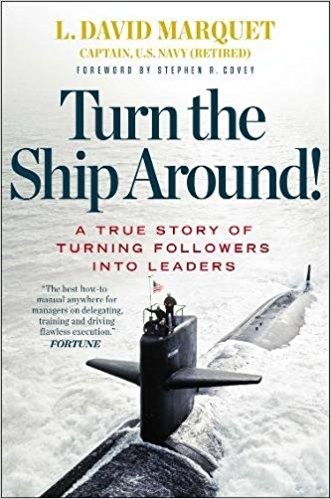
Turn the Ship Around!
Portfolio · 2013 · 272 pages
ISBN: 9781591846406
Review Editor
Daniel Okafor
L. David Marquet spent his Navy career ascending through the ranks of nuclear submarine command. He studied the USS Olympia for a year, committed its systems and crew to memory, and prepared to take the helm. Two weeks before his scheduled command date, the Navy reassigned him. He would command the USS Santa Fe instead: a Los Angeles-class fast-attack submarine he had never trained on, crewed by people who had no reason yet to trust him. Marquet arrived knowing less about his own ship than many of his junior sailors did.
Turn the Ship Around!, published in 2013 by Portfolio, documents the year and a half that followed. The Santa Fe was, when Marquet inherited it, one of the worst-performing submarines in the Pacific Fleet. Sailors were leaving as fast as regulations allowed, morale was low, and the crew functioned exactly as the Navy had trained them to: they followed orders, waited for direction, and kept their ideas to themselves. Marquet’s response to this situation produced one of the more counterintuitive case studies in recent leadership writing.
What Marquet built aboard the Santa Fe is what he calls Intent-Based Leadership, or the “leader-leader” model. The core idea: instead of concentrating authority at the top and pushing orders downward, you push authority downward toward the people who hold the most relevant knowledge. Crew members stop asking permission and start stating their intentions. Officers stop managing and start coaching. The result, documented in retention statistics and operational ratings, was a submarine that went from last to first in the Pacific Fleet. Thirteen of Marquet’s officers eventually commanded their own ships. The book, with a foreword by Stephen R. Covey, went on to become required reading in MBA programs and was named Fortune’s number-one must-read business book of 2012.
Character Arcs and Development
The people in Turn the Ship Around! are real, which means their transformations don’t happen on a fictional schedule. What Marquet tracks instead is how responsibility reshapes behavior over time. At the start, the crew of the Santa Fe operates with the learned helplessness of any highly trained hierarchy: they wait for direction, defer instinctively to rank, and interpret initiative as a form of insubordination.
The moment that crystallizes this most sharply comes early in the book. Still operating on muscle memory from his previous boat, Marquet orders the helmsman “ahead two-thirds.” On the USS Olympia, that was a standard speed command. The Santa Fe didn’t have that setting. The helmsman, fully aware the order made no sense, transmitted it to the engine room anyway. The engine room operator complied without comment. When the executive officer quietly pointed out the problem, Marquet realized he had accidentally built a system willing to execute a wrong order in complete silence. No one had pushed back. No one had flagged the error. The failure wasn’t the crew’s. It was the architecture of command itself.
The secondary figure who earns the most attention is Chief of the Boat Dave Adams. Adams starts where you’d expect a career sailor to start: protective of standard procedure, skeptical of his new captain’s methods, and not especially eager to improvise. Marquet doesn’t manufacture a dramatic turning point for him. What you get instead is a slow shift, visible across dozens of small interactions, as Adams begins to see that the new model produces better outcomes than the old one. His eventual advocacy for the leader-leader approach carries more weight because it wasn’t rushed. Real people change the way Adams does, not the way movie characters do.
What makes the book’s human story work is that Marquet never loses sight of stakes. These are not office workers debating quarterly targets. They are crew members responsible for a nuclear-powered vessel operating under real operational pressure. When Marquet describes a sailor who begins volunteering information he once would have withheld, or an officer who catches an error without being prompted, the small behavioral change carries weight precisely because the consequences of not catching it are serious. The improvement in the Santa Fe’s performance, measured in hard Navy metrics, makes the human transformation visible in a way that most leadership books simply can’t replicate.
Pacing
The book moves briskly through its 272 pages. Marquet structures the narrative around the Santa Fe’s deployment cycle, which gives the whole thing a forward pull. He alternates between scenes from his command (told with enough naval specificity to feel genuine without becoming technical) and brief chapters that name and explain the mechanisms he was developing. This works well in the first half, where the story does most of the teaching and the mechanisms feel like discoveries rather than lessons.
The back half tilts more prescriptive. As Marquet moves from establishing the leader-leader model to codifying it under headings like Control, Competence, and Clarity, the chapters grow shorter and more formulaic. Some mechanisms feel like restatements of insights the narrative has already illustrated. The reader who has been following closely will occasionally feel ahead of the text. This is a minor complaint about a book that largely respects the reader’s intelligence, but it does mean the final quarter reads more like a business manual and less like a memoir.
Deeper Thematic Exploration
The book’s central argument concerns where intelligence lives inside an organization. Traditional command hierarchies assume that knowledge and judgment belong at the top and should travel downward as instructions. Marquet argues the opposite is usually true: the people doing the work know the most about the work, and systems that route their knowledge upward through layers of approval waste it, distort it, and eventually train people to stop exercising it. On a nuclear submarine, this misalignment is potentially catastrophic. In an office, it’s merely chronic.
Marquet makes a distinction that business readers will find either obvious or clarifying depending on where they sit in their organization. There is a difference between compliance and engagement. Compliance is what you get from a leader-follower system: people do what they’re told, adequately, within the boundaries of the order. Engagement is something different. It requires that people feel genuine ownership over outcomes. You can tell them to care. You cannot make them care. You can only build conditions that make caring the natural response. Marquet did this through structure rather than persuasion, and that distinction matters.
The language thread running through the book is the most practically transferable idea. When Marquet asked crew members to stop saying “request permission to…” and start saying “I intend to…”, he was making a structural change disguised as a linguistic one. The new phrasing requires the speaker to commit to a course of action before announcing it. It moves the cognitive work from the captain to the sailor. Marquet noticed, almost immediately, that this changed the quality of thought happening before actions were taken. People who have to state intentions think harder about intentions. This is not self-help advice. It is an observable change in how organizations process information, and Marquet describes its effects with enough specificity to be genuinely useful.
There is also a quiet argument about trust running through the book: not the trust-building exercises of corporate retreats, but the operational trust that comes from demonstrated competence. Marquet pushed authority downward alongside accountability, and he invested seriously in making sure crew members had the knowledge to use the authority they were being given. Empowerment without competence produces noise. The two have to travel together, and the book makes this case more convincingly than most leadership writing does.
Style and Voice
Marquet writes with the clarity of someone who has explained the same ideas in front of many audiences. The prose is clean and spare, occasionally dry, and consistently direct. He doesn’t ornament his sentences. What he does well is sequence: he places the reader aboard the Santa Fe before explaining what they’re about to learn, which keeps the early chapters moving at a pace the mechanism chapters later can’t quite sustain.
The voice is confident without being self-congratulatory, which is notable given that the book is essentially an account of Marquet’s own success. He acknowledges mistakes honestly (the “ahead two-thirds” scene is unflattering in the best way), and he avoids the tone of someone who had everything figured out before anyone else. The book feels like it was written by someone who still finds the ideas interesting, not someone mining their past for a brand.
Verdict
Turn the Ship Around! is most useful to readers who work inside organizations where authority and knowledge have become misaligned, which describes most organizations. Marquet doesn’t ask you to reimagine your company’s entire structure. He offers specific, observable practices that produce specific, measurable changes. If you manage a team of any size, the “I intend to…” shift alone is worth the time, because it forces you to notice how much of your workday is spent answering questions that the people asking them already know the answers to.
The book is less satisfying if you want a deeper analysis of organizational psychology or a rigorous structural theory. Marquet is a practitioner, not an academic, and the mechanisms he offers are practical before they are explanatory. The submarine setting makes the stakes vivid and the examples memorable, but it also limits the generalizability in ways the book doesn’t always acknowledge. Not every workplace involves a chain of command this clear. That said, Turn the Ship Around! earns its reputation as one of the more honest and immediately applicable leadership books of the past two decades. Start with the story. Stay for the practices.
Frequently Asked Questions about Turn the Ship Around!
What is Turn the Ship Around! by David Marquet about?
Turn the Ship Around! is L. David Marquet’s account of how he commanded the USS Santa Fe, a nuclear submarine ranked among the worst-performing boats in the US Navy’s Pacific Fleet, and transformed it into one of the best. Marquet describes the leadership model he developed: instead of issuing orders and expecting compliance, he pushed authority downward toward the people closest to the work, creating what he calls an “intent-based leadership” culture where crew members own their decisions rather than waiting to be told what to do.
Is Turn the Ship Around! based on a true story?
Yes. Marquet commanded the USS Santa Fe from 1999 to 2001, and the events in the book are drawn directly from that experience. The transformation he describes is real and documented: the Santa Fe moved from last in retention and operational standings in the Pacific Fleet to first, and thirteen of Marquet’s officers went on to command their own vessels. The book was published in 2013 with a foreword from Stephen R. Covey.
What is the “I intend to” technique in Turn the Ship Around!?
One of Marquet’s central practices was replacing the phrase “request permission to…” with “I intend to…” When crew members stated their intentions rather than asking for permission, it moved the cognitive work of decision-making from the captain to the sailor. The speaker had to think through a course of action completely before announcing it, which raised the quality of decisions and built genuine ownership over outcomes. It is one of the most immediately transferable ideas in the book, and Marquet applies it to business settings as readily as military ones.
How long is Turn the Ship Around! and is it a difficult read?
The book runs 272 pages and reads quickly. Marquet alternates between narrative scenes from his command of the USS Santa Fe and short chapters explaining the leadership mechanisms he developed. The prose is clear and accessible, with no specialized military jargon or academic language. Most readers finish it comfortably in two or three sittings. It is also structured in a way that rewards rereading: the mechanisms land differently once you’ve seen the full story play out.
What are the main themes in Turn the Ship Around! by Marquet?
The book centers on four interlocking themes: where authority should live inside organizations; the difference between compliance and genuine engagement; how language shapes the behavior and decision-making of teams; and the relationship between empowerment and competence. Marquet argues throughout that traditional top-down command structures train people to stop thinking, and that pushing authority downward, alongside the knowledge needed to use it responsibly, produces better outcomes at every level of the organization.
Is Turn the Ship Around! relevant for non-military readers?
Yes, and that’s largely the point. While the submarine setting is vivid and specific, Marquet wrote the book for business audiences, and the practices translate directly to office environments, hospitals, schools, and any organization where people wait for permission to do work they already understand. Fortune named it the number-one must-read business book of 2012, and it has been used as required reading in MBA programs and corporate leadership development programs around the world.
How does Turn the Ship Around! compare to other leadership books like Leaders Eat Last or Start With Why?
Where Simon Sinek’s work tends toward the inspirational and the philosophical, Marquet’s is operational: he describes specific practices, explains why they work in specific situations, and shows measurable results. Turn the Ship Around! is more granular and more demanding of its reader than most leadership books, because it asks you to examine the specific structures of authority in your own organization rather than simply adopt a new mindset. Readers who find inspiration books motivating but vague often find Marquet’s approach more satisfying and more immediately usable.
Should I read Turn the Ship Around! and is it worth it?
If you manage people, almost certainly yes. The core insight, that authority should live closest to the knowledge needed to use it well, is not original to Marquet, but the way he illustrates it with real events aboard a nuclear submarine makes it genuinely hard to forget. Readers who want a detailed theory of organizational design may find the treatment too thin. Readers who want practices they can apply at their next team meeting will find several. It is a short, honest book that doesn’t overstay its welcome, and the “ahead two-thirds” story alone is worth the read.
Book Details
- Title
- Turn the Ship Around!
- Author
- L. David Marquet
- Genre
- Business
- Publisher
- Portfolio
- Year Published
- 2013
- Pages
- 272
- ISBN
- 9781591846406
- WritersReview Rating
- 4.3 / 5