
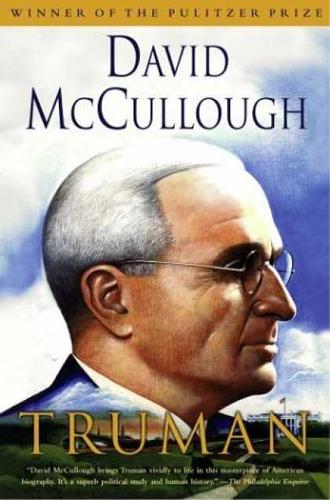
Truman
Simon & Schuster · 1992 · 1117 pages
ISBN: 9780671869205
Review Editor
Thomas Calloway
David McCullough spent years researching Harry S. Truman before writing a word of this biography. It shows. Published in 1992 and running to over eleven hundred pages, Truman covers the full arc of its subject’s life: the Missouri farm childhood, the failed haberdasher years, the rise through the Pendergast political machine in Kansas City, three terms in the United States Senate, eighty-three days as vice president, and then, without preparation or meaningful briefing, the presidency of the United States. McCullough worked from letters, diaries, government documents, and interviews with people who knew Truman personally, and the result is a portrait so detailed and warm that the man himself seems to breathe off the page.
Truman is one of American history’s great surprises. He was nobody’s first choice for the vice presidency in 1944 and could easily have been passed over entirely. When Franklin Roosevelt died on April 12, 1945, Harry Truman had been vice president for less than three months and had not been briefed on the Manhattan Project. Within weeks he would be deciding whether to use atomic weapons against Japan. Within a few years he would launch the Marshall Plan, order the Berlin Airlift, desegregate the military, recognize the state of Israel, intervene in Korea, and fire the most celebrated general in the country. McCullough’s biography places all of these decisions in their full context, not as the acts of a figure in a history textbook but as choices made by a real man under enormous pressure.
The book won the 1993 Pulitzer Prize for Biography or Autobiography, and it has remained the definitive account of Truman’s life. For readers who want to understand how a farmer’s son from Independence, Missouri became one of the more consequential presidents of the twentieth century, this is the place to start and very likely the place to stop.
Character Arcs and Development
Truman’s life unfolds in this biography as a long education in character. The young man McCullough introduces in the early chapters is curious and serious, a reader who wore thick glasses and spent more time with books than with other boys. He wanted to attend West Point but his eyesight disqualified him. He wanted to study at a proper university but his family had no money. He farmed for years, tried the oil business, tried haberdashery, and failed at most of it. McCullough never lets these early setbacks feel like mere prologue. They explain the man who eventually arrived in Washington: someone who had been tested by ordinary life and hadn’t broken.
The relationship with Tom Pendergast is one of the book’s most delicate passages. Pendergast ran Kansas City’s Democratic machine with the combination of generosity and corruption that such machines required. He supported Truman’s campaigns for county judge and then for the Senate, and Truman was loyal to him in return. When Pendergast went to prison for tax evasion in 1939, many expected the association to end Truman’s career. McCullough shows how Truman navigated it: by being scrupulously honest in his own conduct, by delivering real results for constituents, and by refusing to abandon a mentor simply because it had become inconvenient to know him. It is not a simple moral picture, and McCullough doesn’t pretend it is.
Bess Truman is one of the biography’s most important figures, and McCullough does her justice. She could be cold and she hated Washington, and her relationship with Harry was not without strain. But McCullough uses the letters, which Truman wrote to her almost every day when they were apart, to show something more complex: a marriage of genuine depth between two very different people who needed each other. By the time Truman is in the White House and Bess is retreating to Independence at every opportunity, you understand what it costs both of them, and why the partnership holds anyway. Secondary figures like Dean Acheson and General MacArthur are drawn with similar care. Even the villains have their reasons.
Pacing
There is no way around the length. At more than eleven hundred pages, Truman asks for a real commitment, and the early chapters on Missouri, farming, and county politics will test readers whose interest is primarily in the presidency. McCullough is a skilled enough writer to keep even the less dramatic material from dragging, but readers should know what they’re signing up for: the first third of the book covers the years before Truman was anyone that history cared about, and it requires patience. The payoff is real, because by the time Roosevelt dies and Truman walks into the Oval Office, you know the man so well that the weight of what happens next lands properly.
Once the book reaches the Senate years and especially the presidency, it accelerates considerably. The chapters covering the decision to use atomic bombs against Japan, the 1948 election (which Truman won while nearly every newspaper in the country predicted otherwise), and the firing of General MacArthur are among the best-paced sections in American biographical writing. McCullough builds each of these episodes across multiple chapters, filling in the cast of characters and the competing pressures so that when the decisions come, they feel genuinely hard rather than inevitable in hindsight. The second half of the book rewards the patience the first half demands.
Deeper Thematic Exploration
The book’s core argument, made through accumulation of evidence rather than explicit statement, is that character and power are separable problems. You can have one without the other, and when you have both, it is because someone worked at them deliberately. Truman is McCullough’s case study in what it looks like when an ordinary person, through discipline and stubbornness and a fundamental seriousness about institutions, rises to a position that would destroy a vainer or more insecure man. The biography is ultimately a book about the possibility of American democratic life, and about what it means for the machinery of government to land in hands that actually respect it.
The atomic bomb sections carry the book’s most difficult weight. McCullough does not simplify what happened. He shows the pressures from advisors who urged the use of the bombs and from others who counseled alternatives. He shows what Truman knew about projected casualties from a land invasion of Japan and what he did not know about the condition of the Japanese government’s willingness to negotiate. The portrait that emerges is of a man who made a decision of unprecedented consequence in good faith, without certainty, and then carried it without public agonizing for the rest of his life. Whether that self-possession was admirable or troubling is a question the book leaves appropriately open.
McCullough is also attentive to the larger architecture of the Truman presidency: the Truman Doctrine, the Marshall Plan, NATO, the recognition of Israel, the Korean intervention, the MacArthur firing. These were not isolated episodes but pieces of a contested vision of American power and responsibility in the post-war world. The book treats this vision seriously rather than celebrating it uncritically, and it is honest about the critics who argued Truman was overreaching or setting dangerous precedents.
One theme that runs quietly through the entire biography is the relationship between how presidents are judged in office and how they are judged by history. Truman left the presidency in 1953 with an approval rating of 22 percent. Within two decades, historians were consistently ranking him among the near-great presidents. McCullough’s biography arrived at a moment when that rehabilitation was still relatively fresh, and contributed to cementing it. The book makes the implicit argument that patience is required to judge a presidency fairly, and that the people closest to events are often the worst judges of their significance.
Style and Voice
McCullough writes accessible narrative history. He builds scenes from letters and diaries and period accounts, but he keeps the apparatus of scholarship invisible, so the reading experience is closer to a novel than to a textbook. His prose is clear and warm without being soft. He has a talent for physical description: the smell and texture of Truman’s Missouri, the crowded corridors of the Senate Office Building, the night Eleanor Roosevelt told Truman that the president was dead. You feel the weight and reality of the past without having to work for it, which is rarer in this genre than it should be.
The voice is admiring of its subject without being hagiographic. McCullough found Truman genuinely compelling, and it shows. But he does not flinch from the complications: Truman’s racial politics were genuinely mixed, a man who desegregated the military and still told racist jokes in private, who was ahead of his time on civil rights legislation and products of his time in his private habits of speech. The book presents this honestly rather than resolving it in either direction, which is more integrity than most biographies manage when they’re clearly rooting for their subject.
Verdict
If you have any interest in the American presidency, in the post-World War II world, or in what it looks like when someone grows into a role larger than anyone expected, this book deserves your time. It rewards the patience invested in the Missouri chapters; by the time you reach the atomic bomb decision and the MacArthur firing, you know Truman well enough for those episodes to carry their full weight. The length is earned. It is not a book you can rush, and it is not a book you should try to.
The ideal reader is someone who wants narrative history that takes serious subjects seriously without requiring prior background in Cold War policy. McCullough is a patient, generous guide. If you want the personal portrait alongside the political history, you get that too, particularly in the letters to Bess. Readers who have little patience for the slow accumulation of a life before it becomes historically significant may find the early going slow. But if you stay, the book pays back everything it asks for, and then some.
Frequently Asked Questions about Truman by David McCullough
What is Truman by David McCullough about?
David McCullough’s Truman is a comprehensive biography of Harry S. Truman, the 33rd President of the United States. It follows Truman’s life from his Missouri childhood through his years as a farmer, failed businessman, county judge, and senator, to his sudden ascent to the presidency on Franklin Roosevelt’s death in April 1945 and his two terms in office. The book covers major decisions including the use of atomic bombs against Japan, the Marshall Plan, the Berlin Airlift, desegregation of the military, and the Korean War, as well as the personal life behind the public figure.
Did David McCullough win any awards for Truman?
Yes. Truman won the Pulitzer Prize for Biography or Autobiography in 1993, one of the most prestigious awards in American letters. The book was also a major commercial success, spending many weeks on the New York Times bestseller list. McCullough had previously won a Pulitzer Prize for his biography of Theodore Roosevelt, Mornings on Horseback, making him one of a small number of authors to win the prize twice.
How long is Truman by McCullough and is it a difficult read?
Truman runs to over 1,100 pages, which makes it one of the longer single-volume presidential biographies in American publishing. McCullough writes in accessible, narrative-driven prose rather than academic register, so the book is not technically difficult to read; the challenge is the commitment it requires. Readers who enjoy narrative nonfiction and history told as story will find it very readable. Those looking for a shorter introduction to Truman might start with McCullough’s abridged version, which covers the presidency without the full life.
What are the main themes in Truman by David McCullough?
The central themes are character under pressure, the demands of democratic leadership, and the gap between how historical figures are judged in their own time versus how they are judged later. The book also explores the weight of unprecedented decisions, particularly the atomic bomb; the relationship between loyalty and principle; the transformation of American power in the post-war world; and the contrast between Truman’s private humility and his public decisiveness. Running through all of it is a quiet argument that ordinary people, given the right character, can rise to extraordinary moments.
What decision in Truman by McCullough gets the most attention?
The decision to use atomic bombs against Japan in August 1945 receives the most sustained treatment, but McCullough also devotes considerable attention to the firing of General Douglas MacArthur in April 1951. MacArthur had publicly undermined Truman’s Korea policy, and Truman’s decision to relieve him of command was deeply unpopular at the time. McCullough’s account of both decisions shows Truman at his most decisive and most isolated, acting on principle against nearly universal political pressure.
Is there a movie or TV adaptation of Truman by McCullough?
There is no direct film adaptation of McCullough’s biography, but Gary Sinise played Harry Truman in the 1995 HBO film Truman, which drew on McCullough’s research and was released in the same period as the book’s peak popularity. The film was well-regarded and Sinise received a Golden Globe Award for his performance. McCullough himself has been a frequent documentary narrator and has appeared in numerous historical programs covering the Truman era.
How does David McCullough’s Truman compare to his other biographies?
McCullough is best known for three major biographical works: The Path Between the Seas (about the Panama Canal), John Adams (2001), and Truman. Many readers consider John Adams the more emotionally intimate portrait, since the Adams-Jefferson correspondence gives McCullough extraordinary personal material to work with. Truman is generally regarded as the more complete and ambitious work, given its length and scope. Both won the Pulitzer Prize. Readers who enjoy one tend to love the other; the signature McCullough style, warm, narrative-driven, heavily sourced in primary documents, is consistent across both books.
Should I read Truman by David McCullough and is it worth it?
Yes, with a clear-eyed understanding of what you’re committing to. If you enjoy long, deeply researched biographies that read like narrative nonfiction rather than academic history, Truman is among the best of the form. The book asks for patience in the early chapters but rewards it fully in the presidential years. Readers primarily interested in the atomic bomb decision, the Cold War, or the specific events of Truman’s presidency may want to start with the second half. Those who want to understand the full person, including the man he was before history required anything of him, should start from the beginning.
Book Details
- Title
- Truman
- Author
- David McCullough
- Genre
- History
- Publisher
- Simon & Schuster
- Year Published
- 1992
- Pages
- 1117
- ISBN
- 9780671869205
- WritersReview Rating
- 4.7 / 5