
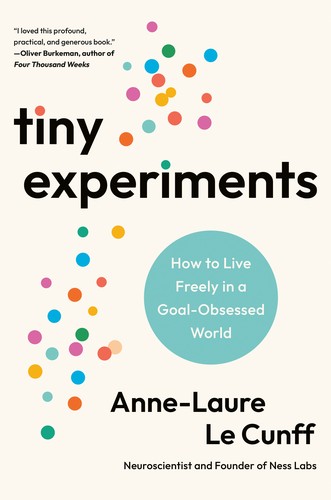
Tiny Experiments: How to Live Freely in a Goal-Obsessed World
Portfolio/Penguin · 2025 · 304 pages
ISBN: 9780593715130
Review Editor
Self-Help Editor
Anne-Laure Le Cunff wants you to stop setting goals. Or, more precisely, she wants you to reconsider why you set them, how you pursue them, and what happens to you when they fail. In Tiny Experiments, the neuroscientist, entrepreneur, and Ness Labs founder makes a persuasive case that our collective obsession with linear goal-setting is not just unproductive but actively harmful to creativity, well-being, and personal growth. Her alternative: treat your life as a series of small, low-stakes experiments designed to help you learn what actually works for you.
The book arrives at a moment when the self-help genre is saturated with productivity frameworks, morning routines, and five-year plans. Le Cunff’s contribution stands apart because it is rooted in neuroscience rather than anecdote. Drawing on her doctoral research at King’s College London and her experience building a newsletter community of over 100,000 subscribers, she offers a framework that feels both scientifically grounded and genuinely practical. The core insight is simple but powerful: you cannot plan your way to a meaningful life. You have to experiment your way there.
This is not a book that promises transformation through discipline. Instead, it invites curiosity, tolerates failure, and suggests that the most interesting paths are the ones you did not plan. For readers tired of being told to optimize every hour of their day, Tiny Experiments offers something refreshing: permission to not know where you are going.
Central Ideas and Development
Le Cunff builds her argument around three interconnected ideas. First, she challenges the assumption that clear goals lead to better outcomes. She draws on research showing that rigid goal-setting can produce tunnel vision, ethical shortcuts, and a narrowed sense of possibility. When you define success as hitting a specific target, you stop noticing the interesting detours that might lead somewhere better. Second, she introduces the concept of “tiny experiments,” small, time-bounded actions designed to test a hypothesis about what you enjoy, what you are good at, or what matters to you. These experiments are deliberately low-stakes: the point is not to succeed but to learn. Third, she argues for what she calls “planned serendipity,” the practice of creating conditions where unexpected discoveries become more likely.
The development of these ideas is methodical without being dry. Le Cunff moves between neuroscience research, personal stories, and practical exercises with a rhythm that keeps the reader engaged. She is particularly effective when explaining why our brains resist uncertainty and how that resistance can be gently overcome. Her discussion of the “default mode network,” the brain system active during mind-wandering, is one of the book’s highlights: she explains how unstructured time is not wasted time but a necessary condition for creative insight.
Where many self-help authors pile on strategies, Le Cunff exercises restraint. Each chapter introduces one concept and gives you a concrete way to try it. The experiments she suggests are genuinely small: journaling for five minutes, having a conversation with someone outside your usual circle, trying a creative activity you have never attempted. This modesty is strategic. By lowering the barrier to action, she makes it harder for readers to defer change to some future moment of readiness.
Structure and Pacing
The book is organized into three parts that mirror the experimental process: questioning assumptions, running experiments, and reflecting on results. At 304 pages, it is compact enough to read in a few sittings but dense enough to reward slower, more deliberate engagement. Le Cunff uses short chapters, which creates a sense of forward momentum even when the material is conceptually rich. Each chapter ends with a practical “experiment” the reader can try, and these exercises are well-designed: specific enough to be actionable, open-ended enough to produce genuine discovery.
The pacing is well-calibrated. Le Cunff does not front-load the book with theory; she interweaves research findings with stories and exercises throughout. If there is a slight lull, it comes in the middle section, where some of the experiments begin to feel repetitive in their framing. But this is a minor issue in an otherwise well-paced book.
Deeper Thematic Exploration
Beneath the practical advice, Tiny Experiments engages with a deeper philosophical question: what does it mean to live a good life when you cannot predict the future? Le Cunff draws on existentialist philosophy (without using that label) to argue that meaning is not discovered but constructed through action. You do not find your purpose by thinking about it. You find it by doing things, noticing what resonates, and doing more of that. This is a fundamentally pragmatic worldview, and Le Cunff wears it comfortably.
The book also makes a quiet but important argument about privilege and access. Le Cunff acknowledges that the freedom to experiment is not equally distributed. Financial security, social support, and physical safety all affect a person’s capacity to take even small risks. She does not pretend that her framework solves structural problems, but she does argue that experiments can be scaled to almost any circumstance. Even in constrained situations, she suggests, there is room to question assumptions and try something slightly different.
There is also an interesting tension in the book between its anti-goal stance and the fact that it is, itself, a self-help book with a clear structure and intended outcome. Le Cunff handles this tension with humor and self-awareness, occasionally stepping back to acknowledge the irony of writing a guide to not following guides. This reflexive quality makes the book feel honest rather than prescriptive.
Style and Voice
Le Cunff writes with warmth and clarity. Her sentences are clean and direct, free of the jargon that sometimes clutters books by academics writing for general audiences. She uses the second person (“you”) frequently and effectively, creating a conversational tone that feels like advice from a smart friend rather than instruction from a distant expert. Her examples are drawn from a wide range of fields, including art, science, business, and her own life, which gives the book a cosmopolitan feel without making it scattered. The voice is optimistic but not naive; she acknowledges difficulty without dwelling on it, and she celebrates small wins without inflating them.
Verdict
Tiny Experiments is one of the most genuinely useful self-help books published in recent years. Le Cunff has managed something difficult: she has written a book about productivity and purpose that does not feel like another entry in the productivity-industrial complex. The neuroscience is solid, the advice is practical, and the underlying philosophy is humane. If you have ever felt paralyzed by the pressure to have a plan, or guilty about not knowing what you want, this book will feel like a relief. It will not tell you what to do with your life. It will, however, give you a thoughtful, evidence-based process for figuring that out on your own terms.
Frequently Asked Questions about Tiny Experiments by Anne-Laure Le Cunff
What is Tiny Experiments by Anne-Laure Le Cunff about?
Tiny Experiments is a self-help book that challenges the conventional approach to goal-setting and life planning. Le Cunff, a neuroscientist and founder of Ness Labs, argues that instead of setting rigid goals, you should treat your life as a series of small, low-stakes experiments designed to help you discover what genuinely works for you. The book combines neuroscience research with practical exercises.
Who is Anne-Laure Le Cunff, the author of Tiny Experiments?
Anne-Laure Le Cunff is a neuroscientist, entrepreneur, and doctoral researcher at King’s College London. She is the founder of Ness Labs, a platform focused on mindful productivity that has grown to over 100,000 subscribers. Before pursuing neuroscience, she worked in the tech industry at Google. Tiny Experiments is her first book.
Is Tiny Experiments based on scientific research?
Yes, Tiny Experiments draws heavily on neuroscience research, including studies on the default mode network, neuroplasticity, and decision-making under uncertainty. Le Cunff’s background as a doctoral researcher at King’s College London gives her framework a scientific foundation that distinguishes it from many other self-help books. She translates complex research into accessible, practical advice.
How is Tiny Experiments different from other self-help books about goals?
Unlike most self-help books that teach you to set better goals, Tiny Experiments questions whether rigid goal-setting is the right approach at all. Le Cunff argues that linear planning creates tunnel vision and anxiety. Instead, she proposes running small experiments to discover what resonates with you. The book emphasizes curiosity and learning over achievement and optimization.
What are the main exercises in Tiny Experiments by Anne-Laure Le Cunff?
Each chapter of Tiny Experiments ends with a practical experiment readers can try. These exercises are deliberately small and low-stakes: five-minute journaling sessions, conversations with people outside your usual circle, trying unfamiliar creative activities, and structured reflection on what you learned. The modesty of these exercises is intentional, designed to lower the barrier to action.
How long is Tiny Experiments and how is it structured?
Tiny Experiments is 304 pages and is organized into three parts that mirror the experimental process: questioning assumptions, running experiments, and reflecting on results. The chapters are short and each builds on the previous one. The book is compact enough to read in a few sittings but rich enough to reward slower engagement with the exercises.
Is Tiny Experiments worth reading if you already read a lot of self-help books?
Tiny Experiments is especially worth reading if you are saturated with self-help books, because it challenges many of the assumptions those books share. Le Cunff’s anti-goal framework offers a genuine alternative to the productivity-focused approach that dominates the genre. Experienced self-help readers will appreciate her neuroscience-backed reasoning and her willingness to question the entire category.
What is the “planned serendipity” concept in Tiny Experiments?
Planned serendipity is Le Cunff’s term for deliberately creating conditions where unexpected discoveries become more likely. Rather than trying to control outcomes, you design situations that increase the chances of stumbling onto something interesting. This might mean attending events outside your field, starting conversations with strangers, or varying your routine. The concept reflects Le Cunff’s broader argument that the best opportunities often come from unplanned encounters.
Book Details
- Title
- Tiny Experiments: How to Live Freely in a Goal-Obsessed World
- Author
- Anne-Laure Le Cunff
- Genre
- Self-Help
- Publisher
- Portfolio/Penguin
- Year Published
- 2025
- Pages
- 304
- ISBN
- 9780593715130
- WritersReview Rating
- 4.5 / 5