
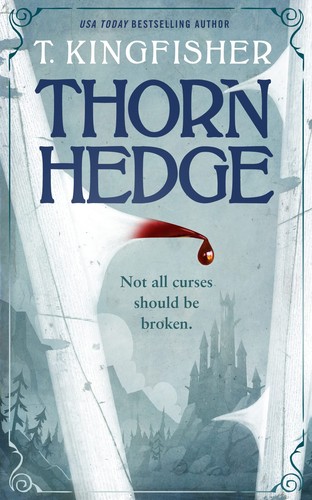
Thornhedge
Tor Books · 2023 · 128 pages
ISBN: 9781250244093
🏆 Hugo Award for Best Novella (2024)
Locus Award for Best Novella (2024)
Review Editor
Marcus Webb
Thornhedge is a 2023 novella by T. Kingfisher, the pen name of Ursula Vernon, published by Tor.com in August of that year. At 128 pages, it is a slim book with an ambitious premise: a reimagining of the Sleeping Beauty fairy tale told entirely from the perspective of the creature who put the princess to sleep. This is not a story about a prince waking someone who was wrongly cursed. It is a story about someone who deserved to be put to sleep, the person who had to make that call, and the centuries of loneliness that followed.
The setting is medieval Europe, somewhere in the era of the Crusades. A hedge of thorns surrounds a ruined tower, and inside that tower a young woman has been sleeping for a very long time. Toadling guards the hedge. She was born human but swapped at birth for a changeling and raised among the greenteeth, frog-like faerie creatures who live in warm faerie waters outside of human time. When she returned to the human world as an adult to attend the christening of the changeling, Fayette, she was given a task: offer the infant a blessing. She fumbled the words. The blessing failed. Fayette grew up into someone genuinely dangerous, and Toadling, unable to bring herself to do what the situation perhaps required, chose instead to put her to sleep and grow a hedge around her tower, hoping that eventually the world would forget the tower existed.
It does not work. A knight named Halim arrives, well-traveled and thoughtful, searching for the lost princess of the local kingdom. What follows is the account, told by Toadling to this patient stranger, of how she became a guardian, what she was guarding against, and why waking Fayette would be a serious mistake. The book is one of the quietest fairy tale inversions in recent memory, and one of the most carefully observed.
Character Arcs and Development
Toadling is one of T. Kingfisher’s most fully realized protagonists in any length of fiction. When we first meet her, she is worn down by solitude. She has watched generations of human lives from behind her hedge, and the centuries have given her a patient sadness rather than bitterness. That absence of bitterness is doing a lot of work in this book. Toadling was taken from her family before she knew them, raised in a place she could never quite belong to, given a task she failed, and condemned to an isolation she chose but did not entirely want. She is not angry about any of it. She is embarrassed about the failure, fond of the greenteeth who raised her, and almost immediately fond of Halim, in the way someone lonely might be fond of a stray cat that wanders into the yard and stays.
The arc Toadling traces is quiet but real. She begins the novella resigned to her vigil, her entire purpose organized around containment. By the end, she has told her truth out loud for the first time in centuries, been believed, and been released. Kingfisher does not give her a triumphant ending. She gives her a return, which is the more interesting and honest choice. The resolution feels earned rather than imposed.
Halim is precisely the right foil for a character like Toadling. He is curious and unhurried in a story that could easily have made him an impatient obstacle. He listens. He asks questions rather than issuing demands. His historical grounding, his references to the Byzantine conflicts of his era and to the specifics of his own faith, gives the story weight it would otherwise lack. Where most fairy tale heroes would have charged straight through the hedge, Halim sits down across from the guardian and actually pays attention to what she is saying. His decency is rendered practically rather than sentimentally, which makes it convincing.
Fayette, the sleeping princess, has very little presence on the page, which is deliberate but creates some imbalance. When she finally appears, her danger is clearly established, and the brief flashback scenes from Toadling’s backstory are vivid and genuinely unsettling. Readers who want a more fully realized antagonist may find themselves wishing for more. The novella’s brevity means Fayette functions more as a consequence than a character, and while this serves the story’s moral architecture, it can feel like a limitation.
Pacing
At 128 pages, Thornhedge has no room to drag, and it does not. The opening sections establish the hedge, the waiting, and Halim’s arrival with efficient economy. Kingfisher moves quickly from introducing the narrator to giving her a voice worth trusting, and she accomplishes this through behavior rather than backstory. Toadling tries to frighten Halim away using faerie tricks, fails, and decides to try honesty instead. That pivot tells you everything you need to know about her character before she has said a word about herself.
The flashback structure, where Toadling narrates her past to Halim as a present-tense audience, gives the pacing a natural rhythm. The Faerie sequences are stranger and warmer; the tower sequences are quieter and more tense. The contrast keeps the story from feeling static despite its single-location setup. The novella arrives at its climax faster than a full-length novel would, but this feels appropriate rather than rushed. Kingfisher has a reliable sense of when a story needs to end, and Thornhedge ends at exactly the right moment.
Deeper Thematic Exploration
The central inversion that Thornhedge performs is not a new one in contemporary fairy tale fiction: the guardian is not a villain, and the sleeping princess is not an innocent. What Kingfisher does with this familiar premise is more interesting than the premise itself. Toadling does not resent Fayette. She pities her, which is the more complicated and honest response. Fayette was not twisted into dangerousness by a curse or a bad childhood; she was simply dangerous, from very young, in a way that the people around her kept refusing to acknowledge. Toadling’s failure was a failure of compassion, or perhaps a failure of nerve. She saw a child and could not do what needed to be done, and she spent centuries living with that choice.
The novella asks a genuine moral question that it does not resolve tidily: how much harm can be justified by love for the person causing it? Toadling chose to protect Fayette rather than the people Fayette would eventually hurt, and that choice cost her everything for a very long time. The book does not condemn her for it. It does not congratulate her either. The hare goddess’s final revelation, that Toadling’s original botched blessing would have achieved the same outcome anyway, lands as something closer to gentle irony than absolution. The result was the same, but Toadling still made the choice she made, and the centuries were still real.
There is also a quieter thread running through the book about belonging, and it is handled with unusual care. Toadling was taken from her human family before she could know them. She was raised in Faerie but is not fully fae. She spent centuries in the human world but was never human in the way required to actually live there. The story does not resolve this into a neat identity. It gives Toadling permission to go where she feels most at home, and to leave again when she chooses. That kind of ending, where the resolution is motion rather than arrival, suits the character well.
Halim adds another dimension to this. He is an outsider in Crusade-era Europe, moving through a landscape defined by a conflict that frames him as an enemy. His willingness to sit with strangeness, to hear an account of faerie magic and centuries-long vigils without immediately reaching for his sword, is not just characterization. It rhymes with Toadling’s own situation in ways the book never makes explicit, which is how good thematic work operates.
Style and Voice
T. Kingfisher’s prose register is recognizable across her work: warm, precise, capable of moving from dark humor to genuine dread without breaking its tone. Thornhedge runs more melancholy than her horror novels and more restrained than her comedic work, and the restraint suits the material. Toadling’s narration is the whole of the book’s texture, and it is a texture worth spending time in.
Toadling uses short, practical sentences when she is describing the day-to-day of her existence, how she eats, how she passes time when nothing is happening, what the hedge smells like in different seasons. When she is trying to explain something she does not quite understand herself, the sentences lengthen and qualify. The effect is an interior voice that feels inhabited rather than constructed. The descriptions of Faerie are particularly good: warm-water strangeness, a world that moves at a different speed, creatures who are genuinely alien without being hostile. The greenteeth are written with real affection.
The historical groundedness of Halim’s sections gives the fairy tale elements more force by contrast. When the impossible appears alongside specific references to real wars and real geography, it becomes stranger than it would in the usual fairy tale setting of Somewhere-Long-Ago. Kingfisher uses this tension well without calling attention to it.
Verdict
Thornhedge is a novella that earns its Hugo Award, though it asks something specific of its reader. If you arrive expecting the scope of a full-length novel, you will find the world smaller than you want. If you arrive looking for a tightly constructed fairy tale that asks a genuine moral question and answers it with honesty rather than comfort, this is exactly the book you were looking for.
The right reader for Thornhedge is someone who loves retellings that complicate the original rather than simply reassigning the villain role. Toadling is sympathetic but not without fault. The ending is satisfying without being triumphant. The antagonist is genuinely frightening without becoming a monster in the flat, symbolic sense. These are marks of craft rather than formula. Readers who prefer their fantasy longer and more expansive will find themselves wanting more, and that wanting is, in its own way, part of what makes the book work.
Frequently Asked Questions about Thornhedge
What is Thornhedge by T. Kingfisher about?
Thornhedge is a Sleeping Beauty retelling told from the perspective of Toadling, a changeling raised in Faerie who has spent centuries guarding a hedge of thorns around a sleeping princess. When a knight named Halim arrives seeking the princess, Toadling must explain why waking her would be a terrible idea. The novella turns the classic fairy tale inside out by asking who the real danger in the story actually is.
What fairy tale is Thornhedge based on?
Thornhedge is a retelling of Sleeping Beauty, the story of a princess cursed to sleep until a prince breaks the spell. Kingfisher’s version inverts the premise by making the sleeping princess dangerous rather than innocent, and by giving the “villain” (the one who cast the sleep) a sympathetic and entirely reasonable motive. The book draws on the fairy tale’s older versions as well as the familiar Disney-era version.
Did Thornhedge win the Hugo Award?
Yes. Thornhedge won the 2024 Hugo Award for Best Novella and the 2024 Locus Award for Best Novella. Both awards recognized it as one of the standout shorter fiction works of its year. T. Kingfisher has won multiple Hugo Awards across her career, including for the novel A Psalm for the Wild-Built.
How long is Thornhedge and is it a quick read?
Thornhedge is 128 pages in its hardcover edition, making it a novella rather than a full novel. Most readers finish it in two to three hours. The prose is clear and the pacing is brisk, so it reads even faster than its page count suggests. It is a good option if you want a complete, satisfying fantasy story in a single sitting.
Is Thornhedge part of a series by T. Kingfisher?
No, Thornhedge is a standalone novella. It does not share characters or a setting with any of T. Kingfisher’s other books. If you enjoy it, Kingfisher’s other standalone novellas from Tor.com, including A Psalm for the Wild-Built and What Feasts at Night, offer a similar combination of strong narrative voice and fairy tale or horror atmosphere.
Is Thornhedge appropriate for young adult readers?
Thornhedge is published as adult fantasy, but older teens who enjoy fairy tale retellings and literary fantasy will find it very accessible. The content is dark in places (there are scenes involving a child who causes harm to animals and adults around her) but there is no graphic violence or explicit content. Readers aged 14 and up who enjoy authors like Naomi Novik or Susanna Clarke would likely enjoy it.
How does Thornhedge compare to T. Kingfisher’s other novellas?
Thornhedge is quieter and more melancholy than most of Kingfisher’s horror novellas, which tend to blend dread with dark humor. It is closer in tone to A Psalm for the Wild-Built, which also features an exhausted protagonist finding unexpected company and an ending that offers rest rather than triumph. Readers who liked the warmth and gentle philosophical weight of A Psalm will likely respond well to Thornhedge. Readers who came for the horror of What Moves the Dead may find Thornhedge too gentle.
Is Thornhedge worth reading if you have already read a lot of Sleeping Beauty retellings?
Yes, and specifically because it does something different with the premise. Rather than making the usual move of giving the sleeping princess more agency or the prince more depth, Thornhedge asks what would happen if the princess was the actual threat. The moral question at the center of the book, about mercy and its costs, gives it substance beyond genre novelty. If you have read Spindle’s End or Briar Rose or similar retellings, you will still find something new here.
Book Details
- Title
- Thornhedge
- Author
- T. Kingfisher
- Genre
- Science Fiction
- Publisher
- Tor Books
- Year Published
- 2023
- Pages
- 128
- ISBN
- 9781250244093
- Awards
- 🏆 Hugo Award for Best Novella (2024) Locus Award for Best Novella (2024)
- WritersReview Rating
- 4.9 / 5