
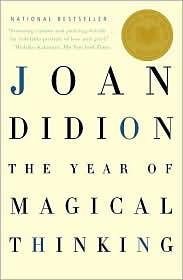
The Year of Magical Thinking
Vintage International · 2005 · 227 pages
ISBN: 9781400078431
Review Editor
Sofia Reyes
Joan Didion’s The Year of Magical Thinking begins with a sentence that reorders everything that comes after it: “Life changes fast. Life changes in the instant. You sit down to dinner and life as you know it ends.” On the night of December 30, 2003, that sentence became literal. Didion and her husband of forty years, the novelist John Gregory Dunne, sat down to dinner in their New York apartment, and John put down his glass, stopped mid-sentence, and was gone. A coronary occlusion, the doctors said. Sudden. Unsurvivable.
Didion spent the next twelve months trying to understand what had happened. What she did during that year, which was essentially to apply her lifelong habits as a reporter to the experience of losing the person she had structured her entire adult life around, produced this book. Published by Alfred A. Knopf in October 2005, it won the National Book Award for Nonfiction that same year and received finalist nominations for both the National Book Critics Circle Award and the Pulitzer Prize for Biography. In 2024, the New York Times ranked it twelfth on its list of the 100 best books of the 21st century. Those are credentials, but they do not fully capture what the book is. At its core, it is an investigation. Didion orders herself to account for everything, even when, especially when, accounting makes no difference.
The backdrop compounds the central loss. Their daughter Quintana Roo Dunne had been hospitalized four days before John died, with pneumonia that had tipped into septic shock. She was still unconscious when her father was buried. She recovered, then fell again in the spring of 2004, hitting her head at the airport and suffering a brain bleed. Didion’s year of magical thinking unfolds against the sound of her daughter’s uncertain prognosis, her daughter’s irregular breathing. One grief does not wait for the other to resolve.
Character Arcs and Development
In a conventional memoir, the protagonist changes in legible ways. Didion changes too, but what this book charts is more elemental than growth: it is the slow, unwilling recognition that John is not coming back. This sounds obvious. It turns out not to be obvious at all, at least not to a person in the middle of grief, and Didion’s willingness to document the self-deception without flinching is part of what makes the book so precise.
John Gregory Dunne appears on every page despite being absent from every scene. Didion conjures him through specificity: his particular manner of marking up her drafts, the restaurants they returned to throughout their marriage, the shorthand that forty years of close conversation produces. They were professionally as well as personally intertwined. Both worked in film and in journalism; they read each other’s pages at every stage of every project. When Didion writes that she cannot imagine finishing a piece of writing without John to read it first, you understand she has not simply lost a husband. She has lost her primary reader, the person who knew her work and her fears and her habits more intimately than anyone. She is left finishing sentences in empty rooms.
Quintana Roo Dunne functions as a secondary center of gravity throughout the book. Her hospitalizations are not subplots; they run in parallel to Didion’s grief in a way that keeps the reader from any settled emotional position. Just as one crisis seems to stabilize, the other escalates. Quintana’s presence in the narrative also raises a question Didion cannot answer: how much can one person hold at once? The book does not resolve that question. It holds it open, which is its own kind of honesty.
Pacing
The structure of The Year of Magical Thinking is recursive rather than linear. Didion returns again and again to the same events, particularly the night John died, each time approaching from a slightly different angle, finding some new detail to examine, some new implication to turn over. She asks the same questions repeatedly, knowing they are unanswerable: could something have been done differently, was there a warning she missed, did he sense it coming? The repetition is deliberate, and it is doing real structural work.
For some readers this circularity feels frustrating. For others, it is the book’s most honest quality. Grief does not move forward cleanly. It circles. It returns to the same images in the small hours that it returned to the night before. The middle section of the book, in which Didion is simultaneously processing John’s death and managing Quintana’s hospitalizations, is the most demanding. The pace of inquiry feels almost feverish there, and anyone who wants resolution will find none on offer. That is exactly the point.
Deeper Thematic Exploration
“Magical thinking” in the anthropological sense refers to the belief that one’s own thoughts, rituals, or actions can affect external reality in ways that defy ordinary cause and effect. Didion identifies it in herself with the clarity of someone who knows she is being irrational and cannot stop. She cannot give away John’s shoes: he will need them when he comes back. She avoids certain chains of thought because thinking them might make them true. She orders emergency medicine textbooks online and reads the cardiac physiology sections, searching for the moment when a different decision might have changed everything.
This is grief in its acute stage, mapped with near-scientific rigor. Didion has read Freud on mourning, Geoffrey Gorer’s sociological study of death in Britain, Philippe Aries on the history of Western attitudes toward dying, and Emily Post’s chapter on mourning etiquette. She cites them not to be scholarly but because she cannot help herself: she is a reporter, and reporting is how she processes experience. The incongruity of applying journalistic method to the most private material imaginable gives the book its particular texture. The distance she establishes never quite holds. The grief keeps coming through.
One of the book’s central tensions is between Didion’s long public reputation for coolness and the magnitude of what she is describing. She was known, long before this book, for a particular kind of prose: controlled, stylish, shot through with a slightly detached irony. Here that method creates unusual effects. The detachment keeps giving way. The moments when the clinical surface breaks are the moments that have made this book last twenty years without aging.
The deepest theme is identity and interdependence. Didion and Dunne were not merely companions; they were professionally and personally fused in ways that most marriages are not. They read each other’s drafts at every stage. They argued through each other’s problems. They had, over four decades, become something like a single extended mind. Months after John’s death, Didion keeps finding she does not know how to do things that seem simple, not practical tasks so much as more intimate ones: who she is writing for, how she knows when a sentence is right, what she thinks about the work she is doing. Marriage at that depth is not addition but fusion. Losing the other person is losing the part of yourself that knew you best.
Style and Voice
Didion’s prose style is instantly recognizable and entirely suited to this subject. Her sentences are often short, declarative, stripped of subordinate clauses. They accumulate rather than elaborate. Meaning builds through placement and sequence rather than through explanation. The rhythm produces a sense of forward momentum alongside circularity, which is an unusual combination and serves the subject well: you feel both that you are going somewhere and that you have been here before.
She uses repetition as a structural device throughout. Key phrases return with variations, sometimes changing meaning as the context shifts around them. There is beauty in the book, though it is a restrained beauty. Didion never reaches for comfort. Her account of the shock that followed John’s death, the inability to cry at expected moments and the crying at unexpected ones, captures the disjunction between what grief is supposed to look like and what it actually does to a person. No consolations are offered. No reassurances about the dead being somewhere better or the living eventually finding peace. What she offers instead is witness: someone sitting with you in the room and confirming that what you are experiencing is real.
Verdict
The Year of Magical Thinking is not for every reader, and it does not pretend to be. If you want catharsis, or a narrative that resolves, or the reassurance that loss leads somewhere brighter, this is the wrong book. If you want a writer of the highest order turning the full force of her attention on one of the experiences that all of us will eventually face, it is the right one.
If you have lost someone central to your life and found yourself doing things that make no rational sense, keeping their phone number in your contacts out of habit, dreaming them alive and then experiencing their death again upon waking, you will recognize what Didion is describing. Not because she says comforting things (she does not), but because she describes the experience with such fidelity that you stop feeling alone in it. The New York Review of Books said simply: “I can’t imagine dying without this book.” That sounds like hyperbole. After you have read it, you will know it is not.
Frequently Asked Questions about The Year of Magical Thinking
What is The Year of Magical Thinking by Joan Didion about?
The Year of Magical Thinking is Joan Didion’s memoir of the year following the sudden death of her husband, novelist John Gregory Dunne, who died of a coronary at their dinner table in December 2003. Didion chronicles the experience of acute grief while simultaneously managing her daughter Quintana’s serious illness. The book examines the irrational behaviors and thought patterns that grief produces, drawing on Didion’s lifelong habits as a reporter and her research into psychological and medical literature on mourning.
Is The Year of Magical Thinking by Joan Didion a true story?
Yes. Didion wrote the book as a direct account of her own experience following the real death of her husband John Gregory Dunne on December 30, 2003. She completed the manuscript by the end of 2004, and the book was published by Alfred A. Knopf in October 2005. All the events and people in the book are real, including her daughter Quintana Roo Dunne, who died of pancreatitis in August 2005, just weeks before publication.
What are the main themes in The Year of Magical Thinking?
The book’s central themes are grief and mourning, the irrational responses the mind generates when facing catastrophic loss, and the nature of long marriage as something that shapes identity rather than merely providing companionship. The book also explores memory, the role of narrative in making sense of lives that resist clean explanation, and the limits of rationality when extreme emotion enters the picture. Running beneath all of it is an examination of dependency: what it means to structure your life so completely around another person that their absence dissolves your sense of self.
How long is The Year of Magical Thinking and is it a difficult read?
The book runs 227 pages in the Vintage International paperback edition. It is not difficult in terms of vocabulary or sentence complexity; Didion’s prose is clear and controlled throughout. What makes it demanding is the subject matter and the recursive structure: she returns to the same events repeatedly, which can test patience in readers looking for forward movement. Most readers finish it in two or three sittings. It rewards being read in one sustained stretch rather than in small pieces.
Is there a movie or TV adaptation of The Year of Magical Thinking?
There is no film adaptation. Didion adapted the book into a stage play, which opened on Broadway in March 2007 with Vanessa Redgrave as the sole cast member, directed by David Hare. The production ran for 24 weeks at the Booth Theatre in New York and later toured internationally, including a run at London’s National Theatre. An audio version narrated by Redgrave was released on Audible in 2020.
What does “magical thinking” mean in Joan Didion’s book title?
“Magical thinking” is an anthropological term for the belief that one’s own thoughts, rituals, or actions can influence external reality in ways that ordinary cause and effect cannot explain. Didion uses it to name her own grief responses: she cannot give away her husband’s shoes because some part of her mind insists he will return and need them. She avoids certain thoughts to prevent them from becoming real. She rereads medical reports searching for the decision that, made differently, might have changed the outcome. The title names the irrational logic of acute grief without condemning it.
How does The Year of Magical Thinking compare to Joan Didion’s other books?
Didion wrote a follow-up memoir, Blue Nights (2011), about the death of her daughter Quintana Roo, who died shortly before The Year of Magical Thinking was published. Most readers find The Year of Magical Thinking the stronger work, more tightly structured and emotionally direct. Her earlier essay collections, particularly The White Album and Slouching Towards Bethlehem, show the same controlled prose style applied to cultural and political subjects rather than personal loss. For readers who love those collections, this is the most personal and, in many ways, the most fully realized work of her career.
Should I read The Year of Magical Thinking and is it worth it?
If you have lost someone important to you, or are close to someone who has, the answer is yes. The book does not offer comfort in any traditional sense, but it offers something more useful: the sensation of being fully understood in an experience that most people find impossible to describe. If you want a narrative with resolution or uplift, this is the wrong book. If you want to understand what loss actually does to a person, written by one of the finest prose stylists of the past century, it is worth every page.
Book Details
- Title
- The Year of Magical Thinking
- Author
- Joan Didion
- Genre
- Self-Help
- Publisher
- Vintage International
- Year Published
- 2005
- Pages
- 227
- ISBN
- 9781400078431
- WritersReview Rating
- 4.5 / 5