
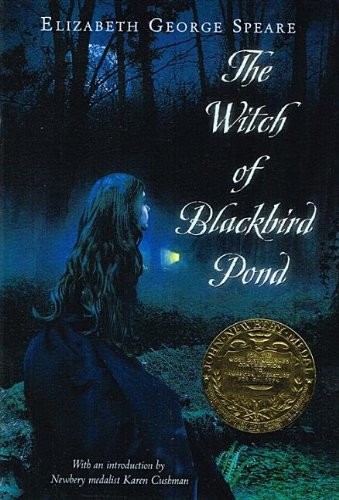
The Witch of Blackbird Pond
Houghton Mifflin · 1958 · 249 pages
ISBN: 9780395071144
Review Editor
Hannah Bright
Elizabeth George Speare published The Witch of Blackbird Pond in 1958, and it won the Newbery Medal the following year. The book has stayed in print, in classrooms, and on recommended reading lists ever since, which is either a tribute to its lasting power or a sign that curriculum committees are conservative. Having read it as both a child and an adult, the answer is clearly the former. This is a genuinely good novel that earns its reputation on almost every page.
The story takes place in 1687 in the Connecticut Colony. Kit Tyler, sixteen years old, has grown up in Barbados on her grandfather’s plantation. When her grandfather dies and the estate must be sold to settle his debts, Kit boards a ship for Connecticut to find her only living relatives: her mother’s sister Rachel, who married a Puritan farmer named Matthew Wood, and their two daughters, Judith and Mercy. Kit has never met any of them. She arrives expecting something, though she cannot say what, and finds a life entirely unlike the warm, easy, sunlit one she left behind.
Kit’s first few weeks in Wethersfield read like a study in culture shock. The work is relentless, the religion is all-consuming, the neighbors are watchful, and Kit keeps doing the wrong thing at the wrong moment. She wades into the river to retrieve a child’s doll, and the colonists stare at her as if she has committed something indecent. She admits she can read for pleasure, and it is more than one woman can believe. The community tolerates her, barely, while Kit quietly befriends an old Quaker widow named Hannah Tupper who lives near a meadow by Blackbird Pond, tending her herb garden and her geese. Hannah is kind and warm and already regarded with deep suspicion by everyone who matters in Wethersfield. When a sickness sweeps through the town and someone needs to bear the blame, the connection between Kit and the supposed witch puts both of them in danger.
Character Arcs and Development
Kit Tyler is the kind of protagonist who makes a book work or fall apart, and Speare makes her work. She is not cautious, not obedient, and not very skilled at hiding either quality. She resents the drudgery of colonial life and says so, at least to herself. She forms attachments based on warmth rather than status, which puts her friendship with Hannah Tupper at the center of the story. The book’s central question is not whether Kit will survive the witchcraft accusation but whether she will grow into someone worth saving, and Speare handles this arc with genuine restraint. Kit does not transform into a Puritan or capitulate to the community. She grows up, which means learning that her own affections can carry serious consequences for other people.
The secondary characters are well-drawn, especially Mercy, Kit’s gentle cousin, who turns out to have a spine made of something quieter but no less strong than Kit’s defiance. Judith, the prettier sister, gets a slightly less generous treatment, but Speare gives her enough humanity to avoid the obvious trap of making her a pure foil. Nat Eaton, the young sailor who gradually becomes Kit’s love interest, comes and goes through the story in a way that feels organic rather than plotted. He is stubborn in ways that echo Kit’s own stubbornness, and the tension between them works precisely because they are so similar. The real emotional center of the book, though, is Hannah Tupper. She is one of those rare minor characters who carry more weight than their page count, and the sections Kit spends with her in the meadow by Blackbird Pond have a different quality from the rest of the novel: slower, more vivid, and somehow more honest.
Matthew Wood, the Puritan uncle, could easily have become a villain. Speare refuses that easy version. He is rigid and sometimes cruel in his judgments, but the book treats his rigidity as a product of his faith and his fear, not as simple meanness. By the end, the reader understands something about him that Kit herself does not, which is a small but notable piece of craft on Speare’s part.
Pacing
The book moves steadily for roughly the first two thirds. The early chapters establish Kit’s displacement with enough specificity that the reader feels the friction of colonial life rather than simply being told it exists. The middle section slows somewhat as Kit juggles suitors and domestic chores and her visits to Hannah, and there are a few chapters where the plot seems to be marking time rather than moving forward. This is a minor complaint. The final third, which deals with the witchcraft accusation and its fallout, picks up speed and does not let go. Speare structures the trial scene with a patience that makes it more unsettling than any amount of dramatic acceleration would have achieved.
At 249 pages, the book does not overstay its welcome. The chapters are short and organized around scenes rather than narrative summaries, which keeps the reading experience active. Young readers who find historical fiction slow to start should push through the first three chapters, after which the book finds its footing and carries its own momentum to the finish.
Deeper Thematic Exploration
The most direct thing The Witch of Blackbird Pond is about is belonging: who gets to belong to a community, on what terms, and at what cost. Kit cannot belong to Puritan Wethersfield because she is too sunny, too free, too accustomed to a life built on the labor of enslaved people in Barbados. This last detail, the plantation and what it implies, is handled very lightly by Speare, almost too lightly for a contemporary reading. But it sits beneath the story asking to be noticed. Kit’s ideas about freedom were funded by someone else’s captivity. Speare does not develop this thread, but attentive readers will catch it, and any teacher using this book in a classroom would be wise to address it directly.
Beyond Kit’s specific circumstances, the book is about what communities do to women who fall outside acceptable limits. Hannah Tupper has lived alone after her Quaker husband was executed, and she has survived by being useful and largely invisible. She grows herbs, keeps geese, and bothers nobody. It is not enough. The fear and ignorance that label her a witch are not particular to 1687, and Speare knew they were not. The witchcraft accusation is terrifying not because of any supernatural element but because of how quickly the community coalesces around a story that serves their collective anxiety. The actual offense of the so-called witch is being different, being visible, and being low-status enough that no one loses anything by targeting her.
There is also something worth noting about the book’s treatment of religious difference. Puritans, Quakers, and Kit’s Barbadian background represent competing ideas about how to organize a life, and Speare never settles the argument. Kit does not convert. She does not become secular. She finds a way to exist inside a world she cannot fully endorse, and Speare presents this hard-won capacity as the available wisdom rather than as a failure of nerve. That is a more adult conclusion than most children’s novels allow themselves.
Style and Voice
Speare writes in third-person close, tracking Kit’s perceptions with enough distance to allow occasional irony. The prose is clean without being spare. She has a good ear for dialogue that sounds period-appropriate without becoming so archaic that it turns into an obstacle. The descriptions of colonial life, including the work of keeping a household, the rhythms of planting and harvest and Sabbath observance, feel thoroughly researched but not displayed. Speare puts the research into the texture of the world rather than into expository summaries, which is harder than it sounds and rarer than it should be.
The meadow scenes near Blackbird Pond are the finest writing in the book. They carry a stillness and a sensory quality that the village scenes lack, and they serve a structural purpose: each time Kit returns to the meadow, the reader understands something the colonists cannot see, which is that a gentle woman living quietly with her geese is not a danger to anyone. The contrast between what Kit knows and what the town believes creates the book’s central tension more effectively than any dramatic confrontation could have managed.
Verdict
The Witch of Blackbird Pond has earned its place in the canon. It is the kind of historical fiction that trusts readers to care about daily life, about small injustices, about the slow work of becoming a person. Kit Tyler is a worthy protagonist because she is genuinely flawed and genuinely brave, not brave in spite of her flaws but partly because of them. The book does not condescend to its readers, and it does not resolve its tensions too cleanly. Hannah gets to live, but the community that threatened her remains unchanged, and Speare lets that sit.
This is a book for readers who respond to character and atmosphere rather than relentless plot momentum, which describes most readers who love historical fiction. Adults who read it as children will find it holds up. Readers coming to it fresh in middle school or high school will find a story that takes them seriously. Anyone hoping for supernatural content should look elsewhere; the witch in the title is a woman, and that is the whole point. If you read one children’s novel set in colonial America, read this one.
Frequently Asked Questions about The Witch of Blackbird Pond
What is The Witch of Blackbird Pond by Elizabeth George Speare about?
The Witch of Blackbird Pond is a 1958 historical novel set in 1687 Connecticut. It follows sixteen-year-old Kit Tyler, who leaves Barbados after her grandfather’s death and moves in with her Puritan relatives in the Colony of Connecticut. When Kit befriends an elderly Quaker widow who is suspected of witchcraft, she soon finds herself accused of the same. The novel explores how Kit navigates a culture that has no patience for her independence or her warmth toward outsiders.
Did The Witch of Blackbird Pond win any major awards?
Yes. Elizabeth George Speare won the Newbery Medal in 1959 for The Witch of Blackbird Pond, one of the most prestigious awards in American children’s literature. The honor cemented the book’s place on school reading lists, where it has stayed for over six decades. Speare later won a second Newbery Medal in 1962 for The Bronze Bow, making her one of only a handful of authors to win the award twice.
What are the main themes in The Witch of Blackbird Pond?
The central themes are belonging and exclusion, religious intolerance, and the cost of female independence. The novel also deals with the danger of mob thinking: a community decides a woman is a witch not because of evidence but because fear needs a target. A quieter theme runs beneath all of this, involving the legacy of colonial slavery and the contradictions in Kit’s background as someone who associates freedom with a plantation life she never fully examined.
Is The Witch of Blackbird Pond based on a true story?
No, the novel is fiction, but it draws on real history. Witchcraft accusations were common in Puritan New England in the seventeenth century, most famously in the Salem witch trials of 1692, just a few years after the book is set. The town of Wethersfield, Connecticut, is a real place, and Quakers were genuinely persecuted in the Connecticut Colony. Elizabeth George Speare conducted extensive historical research, and the daily life in the novel reflects authentic details of the period.
How long is The Witch of Blackbird Pond and is it a difficult read?
The novel is 249 pages and reads at a comfortable pace for most readers at or above fifth grade. The vocabulary is not especially demanding, but the sentences are more complex than typical middle-grade fiction, which makes it a good stretch for younger readers. The historical context may require some background knowledge of Puritan culture and colonial American history to fully appreciate, but the story works on its own terms even without it.
What age group is The Witch of Blackbird Pond appropriate for?
The book is typically recommended for readers ages ten and up, corresponding to grades five through eight. The content is appropriate for that range: there is no graphic violence, no explicit romance, and the difficult subject matter, including a witchcraft trial and themes of persecution, is handled with restraint. Many adults who read it as children return to it and find it richer than they remembered, which is a reliable sign of good writing.
How does The Witch of Blackbird Pond compare to Elizabeth George Speare’s other books?
Speare wrote four novels, and The Witch of Blackbird Pond and The Bronze Bow (1961) are her most celebrated, each winning the Newbery Medal. The Bronze Bow is set in first-century Judea and shares the same interest in religious conviction and moral courage, but it is somewhat more serious in tone and aimed at slightly older readers. Calico Captive (1957) is an earlier, faster-paced adventure based on a real captivity narrative. The Sign of the Beaver (1983), her final novel, is a quieter story about cross-cultural friendship in colonial Maine. Readers who love The Witch of Blackbird Pond will likely enjoy all four, though The Bronze Bow is the most ambitious companion piece.
Is there a movie or TV adaptation of The Witch of Blackbird Pond?
No major film or television adaptation of The Witch of Blackbird Pond has been produced as of this writing, which is surprising given how frequently the book appears on school reading lists and how well its plot would translate to the screen. Stage adaptations have been produced by theater companies, and the book has been adapted as an audiobook with a full-cast performance. If you want the story in a different format, the audiobook narrated by Mary Beth Hurt is the most accessible option.
Book Details
- Title
- The Witch of Blackbird Pond
- Author
- Elizabeth George Speare
- Genre
- Children's
- Publisher
- Houghton Mifflin
- Year Published
- 1958
- Pages
- 249
- ISBN
- 9780395071144
- WritersReview Rating
- 4.5 / 5