
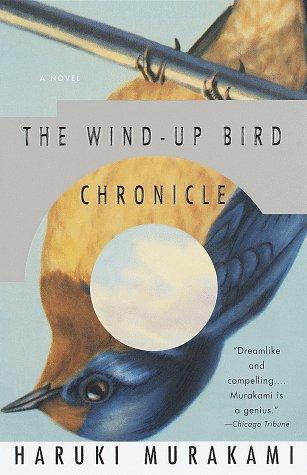
The Wind-Up Bird Chronicle
Vintage Books · 1997 · 611 pages
ISBN: 9780679775430
Review Editor
admin
Haruki Murakami published The Wind-Up Bird Chronicle in Japanese in 1994-1995 and in English translation in 1997, and it announced something that his earlier novels had suggested: that he was capable of a sustained ambition that exceeded the charming, melancholic registers of Norwegian Wood and the playful surrealism of A Wild Sheep Chase. The novel is his longest and most fully realized work, a book that uses a missing cat as the starting point for an investigation into the nature of identity, violence, and the relationship between postwar Japan and the century that produced it. It is one of the essential novels of the 1990s in any language.
Toru Okada and His Missing Cat
Toru Okada is thirty, unemployed, and living in a suburb of Tokyo with his wife Kumiko when their cat goes missing. He spends his days looking for the cat, cooking, listening to music, and waiting for something to change. Then Kumiko disappears too – first emotionally, then physically – and Toru’s search for the cat becomes a search for his wife, which becomes a search for himself, which becomes an investigation into a past and a darkness he did not know existed.
The novel’s plot, in summary, sounds absurd: Toru descends into a dry well in his neighbor’s abandoned garden, where he has visions; he encounters a series of strange women who may or may not be connected to forces operating beyond the visible world; he battles a politician named Noboru Wataya who has an inexplicable hold over Kumiko; he discovers that his face has acquired a large blue birthmark. What the summary cannot capture is how consistently right the novel feels, how each apparently irrational development follows with dream-logic from what precedes it.
The Well
The abandoned garden and the dry well at its center are the novel’s spatial heart. Toru climbs into the well voluntarily, sits in the darkness at the bottom, and waits – for understanding, for vision, for some access to what he cannot find on the surface. What he encounters in the well is not always comprehensible, but it is always meaningful: the darkness is where the novel does its deepest work.
Murakami uses the well as both a literal and symbolic space with a naturalness that the best magical realist writing achieves and the worst struggles toward. The well is a place of genuine encounter – with the past, with the self, with the forces that operate below the rational surface of daily life. Toru’s descents into it are the novel’s most concentrated passages, and they earn their difficulty.
Lieutenant Mamiya and the War
One of the novel’s most extraordinary achievements is the interpolated narrative of Lieutenant Mamiya, a Japanese soldier who encountered atrocity in Manchuria during World War II and who carries the memory of it into a diminished peacetime life. Mamiya’s account of what he witnessed – the killing of the intelligence officer Yamamoto, the pit in the Mongolian desert – is rendered with a precision and restraint that makes it among the most powerful war writing in postwar Japanese fiction.
These sections are not digressions. They are the novel’s historical foundation: the argument that the violence Toru encounters in his domestic life in 1980s Tokyo is continuous with the violence Japan enacted in its imperial adventures, and that the postwar prosperity and amnesia that Toru’s generation inherited did not cancel the debt. Noboru Wataya, the politician-antagonist, is a figure of that amnesia – charming, empty, and in command of a violence he never has to perform personally.
The Women in the Novel
Murakami has been criticized throughout his career for the passivity of his female characters, and the criticism has some justice in his earlier work. In The Wind-Up Bird Chronicle, the women who surround Toru are among the novel’s most active and consequential figures. Malta and Creta Kano, the two sisters who enter Toru’s life early, operate at the boundary between the visible and invisible worlds with a purposeful intelligence. May Kasahara, the teenage neighbor who talks with Toru over the garden wall, provides some of the novel’s funniest and most honest exchanges. Kumiko’s absence is itself a form of action.
Whether these women are fully realized in the way that Toru is fully realized is a fair question. Murakami renders the interior of male consciousness with more confidence than he renders female consciousness, and this asymmetry is visible in the novel. The women are vivid without always being deep in the same way.
Murakami’s Style
Murakami writes in a style that is recognizable across his work: clean, unhurried, attentive to the textures of ordinary life (food, music, brand names), and capable of pivoting from domestic realism to surrealism without announcing the transition. The style functions as a guarantee – Murakami’s prose has a consistency that makes the reader trust the novel even when events become inexplicable. The inexplicable things feel like they make sense; the translation by Jay Rubin preserves this quality with remarkable fidelity.
A Novel in Full
The Wind-Up Bird Chronicle is Murakami at his most ambitious and most fully achieved. It contains everything he does best – the loneliness, the music, the food, the cats, the mysterious women, the descent into darkness, the return – and adds something his earlier books rarely achieve: a genuine historical reckoning, a willingness to situate the contemporary Japanese self within a history that the Japanese self would prefer to forget. The novel is long and demands patience and surrender. What it offers in return is among the most complete fictional experiences in postwar world literature.
- Is this the best Murakami novel to start with?
- Not typically recommended as a first Murakami. Most readers find Norwegian Wood or Kafka on the Shore more accessible entry points – they are shorter, their surrealism is less dense, and they introduce his characteristic voice and concerns without the full complexity that The Wind-Up Bird Chronicle requires. Readers who have already encountered Murakami’s style will find this novel the richest expression of it; those new to his work should start somewhere else and return.
- What is the wind-up bird?
- The wind-up bird is an unseen creature whose sound Toru hears occasionally from the alley behind his house – a strange, mechanical winding sound that has no visible source. It functions as an omen or signal, marking moments when the novel’s hidden dimensions press close to the surface. Murakami does not explain it, and the explanation would reduce it. It is one of those images that the novel generates to indicate something real without being able to say precisely what.
- What is Noboru Wataya, and what does he represent?
- Noboru Wataya is Kumiko’s brother, a television personality who has built a public career on the ability to say nothing with great apparent confidence. He is Toru’s antagonist and, in the novel’s terms, the embodiment of a certain kind of contemporary Japanese public life: hollow, manipulative, and commanding through the appearance of certainty rather than any genuine understanding. His name connects him to the Wataya Noboru who appears in Mamiya’s wartime narrative, and this connection places the contemporary politician within a lineage of Japanese violence and self-deception that stretches back to the imperial period.
- Why does Toru’s face acquire a birthmark?
- The birthmark appears after Toru’s first descent into the well, and it functions as a mark of passage – an outward sign of an inward change, a kind of badge of the encounters he has had in the darkness. It is also practically useful in the novel’s plot in ways that reveal themselves as the story progresses. Murakami treats it with characteristic matter-of-factness: it is extraordinary, and it is also simply there, requiring adjustment and occasionally proving useful. The birthmark is one of the novel’s most successful magical realist devices precisely because it is handled so casually.
- What is the relationship between the personal and political in the novel?
- The novel argues, through structure more than through statement, that the personal and political are the same darkness viewed from different angles. Toru’s search for his missing wife, Mamiya’s account of wartime Manchuria, and the novel’s portrait of contemporary Japanese public life through Noboru Wataya are all variations on the same investigation: into what violence is, where it comes from, and how it persists beneath the surfaces of ordinary life. The personal story does not symbolize the political one; they are both expressions of the same underlying reality that the novel moves between.
- Are the Malta and Creta Kano sisters supernatural?
- The novel does not resolve this question, and the ambiguity is deliberate. Malta and Creta operate at the boundary between the natural and the supernatural – they have abilities that cannot be explained conventionally, but they are not presented as simply magical beings either. They exist in a zone of ambiguity that Murakami maintains throughout, offering explanations that are internally consistent without being scientifically verifiable. Whether they are supernatural or simply extraordinary people with unusual knowledge is a question the novel leaves to the reader’s inclination.
- How does the novel relate to Japanese history?
- The Mamiya sections of the novel engage directly with Japan’s conduct in Manchuria and Mongolia during the 1930s and 1940s – the atrocities committed there, the specific violence that Mamiya witnesses, and the silence that descended over Japanese war memory after 1945. This historical engagement is unusual for Murakami, who has been criticized in Japan for the relative absence of historical consciousness in his earlier work. The Wind-Up Bird Chronicle is his most direct engagement with the question of what postwar Japanese prosperity was built on, and it gives the novel a moral weight that his lighter books do not carry.
- What should I read after this novel?
- Within Murakami’s work, 1Q84 is the closest in scale and ambition, though many readers find it more diffuse. Kafka on the Shore is more tightly constructed and almost as rich. For writers working in similar territory – Japanese domestic life meeting historical darkness – Kenzaburo Oe’s work offers the most direct parallel; his novel A Personal Matter shares Murakami’s interest in a man whose ordinary life is interrupted by something he cannot manage with ordinary tools. Internationally, readers interested in the combination of domestic realism and magical surrealism might also find resonance in Jose Saramago and in the later work of Peter Carey.
Book Details
- Title
- The Wind-Up Bird Chronicle
- Author
- Haruki Murakami
- Genre
- Literary Fiction
- Publisher
- Vintage Books
- Year Published
- 1997
- Pages
- 611
- ISBN
- 9780679775430
- WritersReview Rating
- 5.0 / 5