
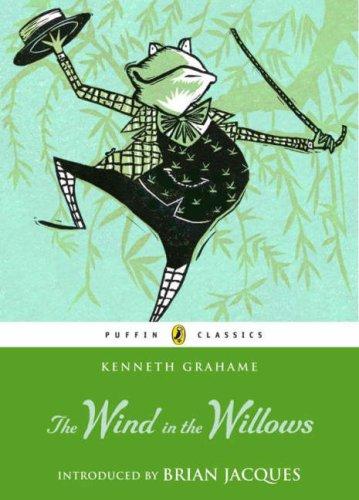
The Wind in the Willows
Puffin Books · 1908 · 288 pages
ISBN: 9780141321134
Review Editor
Hannah Bright
Kenneth Grahame published The Wind in the Willows in 1908, and it has not stopped delighting readers since. Grahame was a senior official at the Bank of England who had been telling bedtime stories to his young son Alastair, and those stories became the foundation for this book. What he produced was something genuinely unusual: a novel that works simultaneously as a pastoral idyll, a comedy of manners, and a quiet meditation on the meaning of home.
The story opens with Mole (never given a surname; simply Mole) scrubbing his underground burrow when spring restlessness overtakes him. He abandons his brush, bolts upward through the earth, and emerges into daylight for the first time. On the nearby riverbank, he meets Water Rat, and the two strike up a friendship that forms the book’s emotional center. Through Rat’s easy companionship, Mole enters the world of the meadows, the open water, and eventually the Wild Wood. He also meets the other two principals: Badger, the ancient and unflappable hermit of the forest, and Mr. Toad of Toad Hall, a wealthy landowner of spectacularly poor judgment and boundless enthusiasm for whatever new obsession has seized him this week.
The plot falls roughly into two halves. The first follows Mole and Rat through a year of riverbank life, punctuated by a terrifying night in the Wild Wood, a memorable winter picnic rescue, and one extraordinary midnight encounter I will leave for you to find on your own. The second half belongs entirely to Toad, whose passion for motorcars lands him in prison after he steals one, from which he escapes through a series of increasingly improbable adventures. The two halves reunite for a climactic showdown at Toad Hall. It is a satisfying structure even if it is not a tight one.
Character Arcs and Development
Mole gets the book’s best arc, and the most human one. He starts literally underground, a small creature of habit and limited horizons, and emerges into a larger world. What makes his journey touching rather than merely cute is that Grahame gives Mole genuine courage alongside real vulnerability. He charges into the Wild Wood alone to prove something to himself, and very nearly dies for it. Later, in the chapter called “Dulce Domum,” Mole is out in the winter snow when he catches the faint smell of his old underground home. The sensation hits him like a punch: the shabby little burrow, the humble furniture, everything he had abandoned so eagerly in April. His grief is immediate and devastating. When Rat finally understands what is happening and turns back with him to find that little house, the scene is one of the most emotionally precise passages in English children’s literature. Grahame is making a serious point: home is not just a location but a part of who you are. You do not get to outgrow it completely.
Rat (Ratty, as Mole calls him) is contentment given animal form. He loves the river, he loves poetry, he loves a well-stocked picnic basket, and he cannot imagine why anyone would want to be anywhere else. The character note most readers miss is a brief, extraordinary chapter in which Rat nearly abandons all of this, drawn south by the tales of a wandering sailor otter and the imagined call of Mediterranean shores. Grahame puts Rat through a genuine crisis of purpose, then pulls him back. That chapter exists, I think, to show us that Ratty’s happiness is not small-mindedness. It is a real choice, made with open eyes.
Mr. Toad is the character everyone remembers, and for good reason. He is pure self-regard in action: grandiose, reckless, magnificently incapable of learning from experience, and absolutely convinced of his own importance at all times. Grahame plays him almost entirely for comedy, and the comedy never stops being funny. Toad in a washerwoman’s dress. Toad commandeering a locomotive. Toad composing triumphant songs about himself and performing them to captive audiences. And yet the portrait is also strangely affectionate. When his friends finally force Toad to confront what his behavior has cost them all, there is a flicker of genuine shame. Whether it changes him is left intentionally, and wisely, open.
Badger is the book’s moral gravity: ancient, gruff, and indifferent to social opinion. He appears sparingly, which is exactly right. His underground home, built through the foundations of a lost human city, is one of the book’s finest images. Too much Badger would make the whole thing feel like a sermon.
Pacing
Readers who come expecting a tight narrative will find the book’s structure frustrating. The early riverbank chapters move at the pace of a summer afternoon. Grahame describes picnic food at considerable length. He lingers over the sounds of water. He is in no hurry. If you surrender to this rhythm, it becomes deeply pleasurable and oddly restorative; if you resist it, the book will feel shapeless and slow.
The Toad chapters (the second half) move faster and with more conventional plot mechanics. The contrast works because by that point you have spent enough time on the riverbank to feel what Toad’s chaos costs. One chapter breaks entirely with the rest of the book’s tone: “The Piper at the Gates of Dawn,” in which Mole and Rat search through a summer night for a missing otter cub and, at dawn, encounter something ancient and overwhelming. It is slow, mystical, and written in prose that approaches religious verse. Some readers find it the most moving chapter in the book; others find it completely out of place. Both reactions are understandable. It sits in the middle of everything like a piece of music in the wrong key, and Grahame makes no apology for it.
Deeper Thematic Exploration
Home is the book’s central preoccupation. Every major character has a specific relationship with it: Mole grieves for his modest burrow even after finding something better, Rat would never dream of leaving the riverbank, Badger has built his fortress from the foundations of human history, and Toad inherits Toad Hall without ever quite deserving it. Grahame keeps circling a single question: what does it mean to belong to a place, and what do you owe it?
The book also carries a significant layer about the English pastoral tradition and its collision with modernity. Grahame wrote this in the final years of the Edwardian period, and his river countryside is deliberately archaic: willows and watermills, hay barges and ferryboats, a world being displaced by the very motorcars Toad worships so destructively. The tension between the open road (speed, novelty, self-invention) and the home fire (continuity, contentment, loyalty) runs through every chapter. The book comes down firmly on one side, though it acknowledges the genuine appeal of the other.
The class dynamics are the book’s most uncomfortable layer for a contemporary reader. Toad is landed gentry, Badger is something older and more patrician, Rat and Mole occupy a comfortable middle-class domesticity, and the stoats and weasels who seize Toad Hall during the trouble are portrayed as invading riff-raff with no rightful claim on anything. Grahame is not satirizing this hierarchy; he accepts it as natural order and expects readers to share his relief when it is restored. Whether that bothers you will affect how much you enjoy the book’s resolution. It is worth naming rather than ignoring.
What still works, across all that period distance, is the portrait of friendship between men who love each other without reservation or embarrassment. Rat and Mole are devoted to each other from their first meeting, and Grahame describes that devotion with an openness that later decades would find harder to write. Badger and Toad have a relationship built on exasperated affection that rings entirely true. The book trusts friendship the way it trusts home: as one of the few things that actually holds.
Style and Voice
Grahame’s prose is warm and occasionally beautiful. He writes Mole’s first sight of the river from the inside, as pure sensation, and the passage is genuinely exciting. The dialogue is class-specific without tipping into satire: Toad’s magnificent self-congratulation, Rat’s easy warmth, Badger’s granite directness, Mole’s slightly anxious politeness as he figures out what kind of creature he wants to be. The book’s tone is difficult to pin down precisely. It is not quite comic, not quite sentimental, not quite satirical, though it has real elements of all three. “Fond” might be the best word: Grahame is enormously fond of these four, and that feeling crosses the page.
The prose does occasionally tip into Victorian lushness, particularly in the Pan chapter, where subordinate clauses accumulate like rooms in an old house. That style can feel overripe to readers who prefer plain sentences. But the domestic scenes and the river descriptions are clear and exact, and the book’s funniest passages (most of them involving Toad) have a timing that holds up perfectly.
Verdict
This book rewards different readers at different ages in different ways. Children who encounter it at seven or eight, especially read aloud, will remember Toad their whole lives: the motorcar, the disguise, the escape, the self-glorifying songs. Adults who return to it, or find it for the first time, tend to discover Mole instead, and the “Dulce Domum” chapter, and find it unexpectedly moving in ways the Toad comedy does not prepare you for.
The episodic structure means not every chapter earns its place. A few sections feel slight, and the otter subplot that sets up the Pan chapter remains somewhat mysterious even after you have read it twice. The class politics are reactionary in ways that go beyond period flavor. These are real limitations. But what the book does unmistakably well is make you want to be on that riverbank, or in Badger’s underground hall by a winter fire, or floating on a summer river with a packed lunch and nowhere particular to be. That is a considerable achievement for a book of any era. You will read faster than it wants you to, then slow down, then slow down again. That is the right response.
Frequently Asked Questions about The Wind in the Willows
What is The Wind in the Willows by Kenneth Grahame about?
The Wind in the Willows follows four animal friends in the English countryside: Mole, Water Rat, Badger, and the irrepressible Mr. Toad. The book divides roughly into two halves: a quieter section tracing Mole’s first year on the riverbank, and a more plot-driven second half in which Toad’s obsession with motorcars leads to prison, escape, and the eventual recovery of his ancestral home. At its core, the book is about friendship, the pull of home, and the tension between contentment and restlessness.
How old do you have to be to read The Wind in the Willows?
The book is traditionally recommended for children ages 7 to 12 and works especially well as a read-aloud. The vocabulary and some of the humor are pitched at a level that rewards adult help and discussion. Older readers and adults find it entirely worthwhile on its own terms, particularly the quieter Mole-centered chapters, which carry more emotional weight than they might appear to.
What are the main themes in The Wind in the Willows?
The central themes are home, friendship, and the conflict between adventure and contentment. The book also works as a pastoral elegy for a pre-industrial English countryside, and it carries a strong undertone of class and social order that is worth noticing even if you choose to look past it. The mysterious Pan chapter adds a layer of nature mysticism that sits somewhat apart from the rest.
How long is The Wind in the Willows and is it a difficult read?
Most editions run between 200 and 288 pages depending on formatting and illustrations. The Puffin Classics edition used here has 288 pages. The prose is Victorian in some of its rhythms, with longer sentences and occasional archaic vocabulary, but nothing that makes it genuinely difficult. The main demand the book makes is patience: it moves slowly in the early chapters, by design, and rewards readers who don’t try to rush it.
Is there a movie or TV adaptation of The Wind in the Willows?
Yes, several. Disney adapted the Toad chapters in 1949 as part of The Adventures of Ichabod and Mr. Toad. Terry Jones (of Monty Python) directed a live-action film in 1996 with Steve Coogan as Mole, Eric Idle as Rat, and Terry Jones himself as Toad. A well-regarded BBC animated series ran from 1984 to 1990. There have also been multiple stage adaptations. The 1996 Jones film is the most accessible entry point for adults; the 1984 animated series remains the best version for children.
Is The Wind in the Willows a classic children’s book worth reading today?
Yes, though with some caveats. The book’s class politics are dated and not subtle, and readers who expect a tight plot will find the episodic structure frustrating. But the emotional core, particularly Mole’s arc and the friendship between the four characters, holds up fully. The comedy of Mr. Toad has not aged at all. If you can give the book its own pace, you will find it genuinely rewarding.
How does The Wind in the Willows compare to other Edwardian children’s classics?
It sits alongside Peter Pan (1904), The Railway Children (1906), and A Little Princess (1905) as one of the defining children’s books of the Edwardian period. It shares with those books a fascination with found families and the security of belonging, but it is more openly pastoral and more interested in adult male friendship than any of them. It is less plot-driven than most of its contemporaries, which makes it unusual and somewhat demanding for modern young readers accustomed to faster narratives.
Should I read The Wind in the Willows as an adult if I missed it as a child?
Absolutely, though you may want to set aside the expectation that it will feel like a children’s book. Adults tend to respond most strongly to Mole’s homesickness chapter and the Rat-nearly-leaves chapter, both of which carry a weight that the Toad comedy does not. Read it slowly, in chunks, ideally somewhere comfortable. The book is partly about the value of slowing down, and it helps to approach it that way.
Book Details
- Title
- The Wind in the Willows
- Author
- Kenneth Grahame
- Genre
- Children's
- Publisher
- Puffin Books
- Year Published
- 1908
- Pages
- 288
- ISBN
- 9780141321134
- WritersReview Rating
- 4.4 / 5