
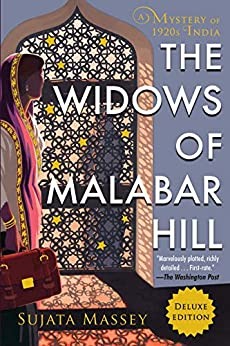
The Widows of Malabar Hill, published by Soho Crime in 2018, opens a historical mystery series with a protagonist who earns her place among the most compelling figures in contemporary crime fiction. Perveen Mistry is one of India’s first female lawyers, working in Bombay in 1921, a city of layered beauties and daily injustices where a woman with a law degree and her own desk at her father’s firm is still an anomaly that makes male colleagues uneasy and potential clients uncertain. When three widows of a recently deceased Muslim merchant contact the Mistry firm to address questions about their inheritance, Perveen takes the case. The widows live in purdah, sequestered in their household and unable to meet with a male solicitor — but they can meet with Perveen. What begins as a probate matter becomes a murder investigation, and Perveen finds herself navigating the mesh of communal politics, colonial law, and personal loyalty that defines Bombay’s social order in the years before independence.
Sujata Massey spent years researching this book, and the research shows in every paragraph — not as the kind of accumulated detail that weighs a novel down, but as the kind that makes a world feel inhabited and specific. The 1920s Bombay of The Widows of Malabar Hill is not a backdrop. It is a character: the street sounds, the legal culture, the architecture, the negotiations between Hindu, Muslim, Parsi, and British communities, the particular quality of a city that is enormous and cosmopolitan and deeply stratified all at once. Massey, who has Parsi heritage herself, writes the Mistry family’s Zoroastrian culture with an intimacy that no amount of secondary research could manufacture.
The novel won the Agatha Award and the Mary Higgins Clark Award and was a finalist for the Edgar Award, the most prestigious prize in American crime fiction. The 2018 Meridian Award for Mystery and Thriller recognizes a book that did something rare: it opened a new kind of historical mystery, set outside the Anglo-American tradition, centered on a protagonist whose gender and community made her a genuine outsider in her own world, and it did so without condescension toward any of the cultures it depicted.
Character Arcs and Development
Perveen Mistry is one of those rare fictional detectives who feels fully three-dimensional from the first chapter. She is confident in her legal knowledge and genuinely uncertain about her social footing; she is warm toward her family and prickly toward condescension; she carries the consequences of a failed early marriage that the novel reveals in a parallel narrative running through the story. That backstory — Perveen’s years studying law in England, her disastrous marriage to a man whose family controls him, the legal battle to dissolve that marriage — is not a detour from the main plot. It illuminates why Perveen understands the widows’ situation with such urgency. She knows what it means to be a woman inside a legal system that treats women’s autonomy as an afterthought.
The three widows — Razia, Sakina, and Mumtaz — are not interchangeable victims. Each has her own relationship to the household, her own history with the deceased merchant, her own reasons for the decision they collectively face about their inheritance. Massey gives each of them enough interiority that the mystery of which widow might be in danger, or complicit in danger, remains genuinely open. The revelation of what happened and why lands with the weight of something that grew organically from character rather than being imposed on it from outside.
Perveen’s family — her father Jamshedji, who takes her seriously as a colleague, and her mother, who worries about her — provide the warmth and grounding that the novel’s darker elements require. Jamshedji is one of the most appealing father figures in recent mystery fiction: principled, occasionally exasperating, deeply proud of his daughter without making his pride a burden she must carry. The father-daughter dynamic is rendered without sentimentality, which makes it more moving than sentimentality would allow.
Pacing
The Widows of Malabar Hill runs about 384 pages and manages its dual time structure — Perveen’s present investigation in 1921 and her backstory chapters set during her student years and failed marriage — with confidence. The backstory never feels like an interruption because Massey times its appearances precisely: each backstory section arrives when the reader needs to understand something about Perveen’s present choices, deepening rather than pausing the investigation.
The mystery itself unfolds at a measured pace that suits its legal and social complexity. This is not a thriller in the high-velocity sense; no one is running from assassins. The danger builds through accumulation of legal detail, social pressure, and the slow realization that Perveen has walked into a situation more lethal than a probate dispute. Readers who prefer relentless action pacing may find the middle section — where Massey lays out the inheritance law and the widows’ individual circumstances in necessary detail — tests their patience. That detail pays off in the final third, where the stakes of the legal situation and the stakes of the murder investigation converge. Massey earns her ending by doing the patient work first.
Deeper Thematic Exploration
The novel is a sustained meditation on what it means to practice law on behalf of people the legal system was not designed to protect. The three widows of Malabar Hill are wealthy by any ordinary measure, but their wealth is meaningless if it passes out of their control entirely upon their husband’s death, as colonial and religious law in combination might allow. Perveen’s legal work on their behalf is not pro bono charity; it is the application of expertise to a situation where expertise is genuinely needed and genuinely rare. Massey takes the law seriously — its language, its procedures, its possibilities and its failures — in ways that most legal thrillers do not.
Gender is the novel’s sharpest preoccupation, but Massey handles it with specificity rather than abstraction. The question is not “were women oppressed in 1920s Bombay?” The question is how specific women in specific circumstances with specific resources navigated the constraints on their lives, and what it cost them when navigation failed. Perveen herself is a success story, but her success required extraordinary family support, the privilege of her Parsi community’s relative openness to women’s education, and the willingness to absorb the social costs of a scandalous marriage and a scandalous divorce. The widows’ situations are different — differently constrained, differently resourced — and Massey never suggests their choices are simply wrong because they differ from Perveen’s.
Communal politics in Bombay add complexity to every scene. The tension among Hindu, Muslim, Parsi, and British communities shapes who trusts whom, who can go where, who has access to which institutions. Massey handles this with tact and accuracy; she does not flatten any of these communities into a monolith or into a symbol. The murder, when its solution arrives, is rooted in character and circumstance rather than in the crude clash of cultures.
Style and Voice
Massey writes in close third-person from Perveen’s perspective, and the voice is precise, lively, and unshowy. Perveen notices what a lawyer trained to notice evidence would notice: the details of rooms, the quality of paper in a document, the way someone answers a question slightly differently the second time. The period detail never tips into costume drama; Massey integrates the historical specificity into Perveen’s point of view rather than decorating the surface of scenes with period furniture.
Dialogue is one of the novel’s consistent strengths. Conversations among Perveen, her father, the widows, and the various men who make her work difficult all carry the specific rhythms of their speakers. The legal exchanges are accurate without becoming tedious. The scenes between Perveen and the widows carry a particular delicacy — Massey is writing across both a class difference and a difference of religious community, in conversations that both speakers understand to be freighted with implications beyond the immediate subject — and she handles that delicacy without self-congratulation.
Verdict
The Widows of Malabar Hill is the kind of series opener that makes you want to read the sequel immediately, not because it ends on a cliffhanger but because Perveen Mistry is so fully realized that spending more time in her world feels like a genuine pleasure rather than an obligation. It is also a serious work of historical fiction that happens to be structured as a mystery: the research is meticulous, the social portrait of 1920s Bombay is vivid and specific, and the legal and communal dynamics that drive the plot are handled with real intelligence. There is no equivalent in American crime fiction to what Massey has built here, and that distinctiveness is part of what makes it essential reading for anyone interested in what the historical mystery can do.
Frequently Asked Questions about The Widows of Malabar Hill
What is The Widows of Malabar Hill about?
Set in Bombay in 1921, the novel follows Perveen Mistry, one of India’s first female lawyers, as she investigates the suspicious circumstances surrounding three widows of a wealthy Muslim merchant. The widows live in purdah and cannot meet with male solicitors — but they can meet with Perveen. What begins as a probate dispute about the women’s inheritance becomes a murder investigation rooted in the complex intersection of religious law, colonial law, and the specific social world of 1920s Bombay. The novel also carries a parallel storyline about Perveen’s own disastrous early marriage, which illuminates why she brings particular urgency to the widows’ situation.
Is The Widows of Malabar Hill part of a series?
Yes. The Widows of Malabar Hill is the first book in the Perveen Mistry series by Sujata Massey. The series continues with The Satapur Moonstone (2019), The Bombay Prince (2021), and The Mistress of Bhatia House (2023), each set in 1920s Bombay and following Perveen as she takes on cases that intersect with the major legal and social pressures of pre-independence India. The series has been praised uniformly for its historical research, its complex protagonist, and its thoughtful handling of the communal dynamics of the period.
What awards did The Widows of Malabar Hill win?
The novel won the Agatha Award for Best Novel and the Mary Higgins Clark Award. It was also a finalist for the Edgar Award from the Mystery Writers of America, which is considered the highest honor in American crime fiction. It received the 2018 WritersReview Meridian Award for Mystery and Thriller, recognizing it as one of the decade’s most accomplished and distinctive entries in literary historical mystery. It appeared on numerous Best Books of 2018 lists and is regularly cited as one of the most important debuts in the historical mystery genre of the past decade.
How accurate is the historical research in The Widows of Malabar Hill?
The research is genuinely meticulous. Sujata Massey spent years preparing for the novel, and she has Parsi heritage that gave her particular access to the culture of Perveen’s family. The legal details — including the specific provisions of Muslim personal law regarding inheritance and purdah, the structure of the Bombay legal profession, and the constraints facing female lawyers in British India — are accurately rendered. The novel’s social portrait of Bombay in the early 1920s, including the dynamics among Hindu, Muslim, Parsi, and British communities, is specific and grounded rather than impressionistic.
Who is Perveen Mistry and what makes her a distinctive detective?
Perveen Mistry is a Parsi woman practicing law in Bombay in 1921, one of the first women to hold a law degree in India. What makes her distinctive as a detective figure is that her legal training is not a quirky hobby — it is her actual professional expertise, and Massey uses it seriously throughout the novel. Perveen investigates through the application of legal knowledge and careful attention to evidence, not through instinct or supernatural intuition. She also carries personal history that deepens her investment in her clients’ situations: her own failed marriage gave her first-hand knowledge of what it means for a woman to be trapped inside a legal system that treats her interests as secondary.
What is purdah and how does it affect the plot?
Purdah is the practice of seclusion observed by women in certain Muslim (and some Hindu) communities, which restricted women’s interactions with men outside their immediate household. In the context of the novel, it means that the three widows of the Malabar Hill household cannot meet with a male solicitor — a practical problem that has serious legal implications for their ability to manage their own inheritance. Perveen’s gender makes her the one person who can speak with them directly, which is what brings her into the investigation. Massey handles the practice with care, neither condemning it wholesale nor sentimentalizing the women who live within it.
Is The Widows of Malabar Hill suitable for readers who do not usually read mysteries?
Yes, for the right kind of reader. The novel is first and foremost a work of historical fiction — a detailed, sympathetic portrait of Bombay in the early 1920s, driven by a protagonist whose legal and social world is rendered with real specificity. The mystery structure gives the story its forward momentum and its satisfying resolution, but readers who approach it primarily as historical fiction will find it rewarding on those terms. It is not a thriller in the high-action sense; readers expecting car chases and assassins will be disappointed. Readers interested in social history, legal history, and character-driven fiction set in South Asia will find it essential.
Where should I start if I want to read more by Sujata Massey?
The Perveen Mistry series should be read in order, starting with The Widows of Malabar Hill. Before the Perveen series, Massey wrote a nine-book mystery series set in Japan featuring a Japanese-American antiques dealer named Rei Shimura; that series is excellent and tonally somewhat different — lighter, with more contemporary settings — and provides a useful counterpoint to the Mistry novels’ historical gravity. Massey has also written standalone fiction. Any of these make excellent starting points, but The Widows of Malabar Hill is where her most sustained and ambitious work begins.
Book Details
- Title
- The Widows of Malabar Hill
- Genre
- Mystery & Thriller
- WritersReview Rating
- 5.0 / 5