
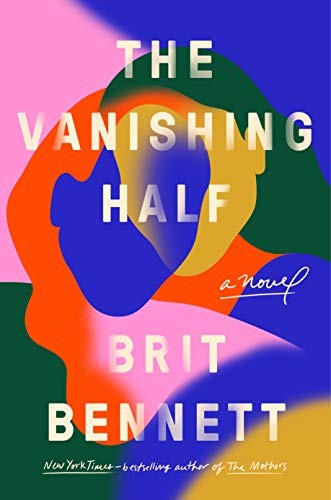
The Vanishing Half
🏆 New York Times 10 Best Books of 2020
Goodreads Choice Award for Best Historical Fiction (2020)
Book of the Month Book of the Year (2020)
Women's Prize for Fiction Shortlist (2021)
National Book Award Longlist (2020)
NAACP Image Award Nominee for Fiction (2021)
Aspen Words Literary Prize Longlist (2021)
Review Editor
Eleanor Marsh
Brit Bennett’s The Vanishing Half opens in 1968, when Desiree Vignes returns to Mallard, Louisiana, the small, insular community where she and her identical twin sister Stella grew up. She has been gone fourteen years. She brings with her a dark-skinned daughter named Jude and the wreckage of a marriage to a violent man. Her twin sister Stella is nowhere to be found.
From there, Bennett pulls the story backward and forward across four decades, tracing the lives of the Vignes twins from their shared childhood in the 1950s through their eventual, separate paths. Mallard is a town founded by and for light-skinned Black people, a place obsessed with color and complexion. The twins’ father was murdered by white men when they were young, and the girls witnessed it. When they flee to New Orleans at sixteen, their lives diverge completely. Desiree returns south. Stella, who could pass for white, does exactly that: she becomes a white woman, marries a wealthy white man named Blake, and builds an entirely new life in the suburbs of Los Angeles. She never looks back. Or tries not to.
The novel follows four perspectives across the decades: Desiree, Stella, and their daughters Jude and Kennedy. It moves between Mallard, New Orleans, Los Angeles, and other American cities, assembling a portrait of two families shaped by a single, life-altering choice. Published in 2020, The Vanishing Half is Bennett’s second novel, following her debut The Mothers. It debuted at number one on the New York Times bestseller list and was named one of the paper’s ten best books of the year.
Character Arcs and Development
Stella is the character you will think about long after you finish reading. Her decision to pass for white starts as a practical choice: a white-looking girl gets a better secretarial job in 1950s New Orleans. But what begins as a temporary arrangement calcifies into a permanent identity. Bennett traces how the lie takes on its own weight over the years, how it poisons Stella’s relationships and distorts her sense of self. There is a scene at a neighborhood pool in the Los Angeles suburbs where Stella, terrified of being exposed, becomes the loudest voice arguing against a Black family moving into the neighborhood. It is an ugly, complicated moment, and Bennett handles it without flinching or moralizing. Stella does not become a villain. She becomes a woman trapped by the architecture of her own deception, someone who has performed whiteness so thoroughly that the performance has consumed the performer.
Desiree’s arc is quieter but carries its own weight. She is the twin who stays Black, who returns to Mallard, who faces down the judgment of a community that values light skin above everything. Her daughter Jude, dark-skinned and bullied relentlessly in Mallard, eventually leaves for college in Los Angeles, where she falls in love with Reese, a trans man navigating his own transformation. Jude’s storyline gives the novel its most tender relationship. Bennett writes their love with warmth and specificity; you believe in them because she gives them small, lived-in moments (a shared meal, an argument about money, the careful negotiation of physical intimacy) rather than grand declarations.
Kennedy, Stella’s white-raised daughter, is the weakest of the four perspectives. She drifts through acting classes and brief relationships, and her sections sometimes feel underwritten compared to the rich interior lives Bennett builds for Stella and Jude. But even Kennedy serves the novel’s larger argument: that identity is not something you inherit whole but something you construct, often clumsily, and the construction leaves marks whether you acknowledge them or not.
Pacing
Bennett moves between decades and cities with a confidence that keeps the novel’s nearly forty-year timeline from feeling scattered. The early Mallard chapters establish the world quickly and vividly: you understand the town’s obsession with lightness, its smallness, its particular cruelties within the first thirty pages. The jump to New Orleans in the 1950s carries real momentum as the twins separate and Stella begins her transformation. The middle sections, particularly Stella’s years building her life in a Los Angeles suburb, slow down as Bennett constructs the architecture of a double life. This is deliberate and mostly effective, though readers who want constant forward motion will find these chapters more meditative than propulsive.
The real energy picks up in the novel’s second half, when Jude and Kennedy’s paths cross in Los Angeles. Bennett handles their convergence with restraint, avoiding the melodramatic confrontation you might expect from a novel about hidden identities. If anything, some readers will want more from the climactic encounters between the characters. The novel’s ending is quiet, almost muted, which feels right for a book that argues the consequences of “passing” play out daily rather than resolve in a single dramatic scene. Bennett trusts the reader to sit with ambiguity, and that trust mostly pays off.
Deeper Thematic Exploration
The Vanishing Half is fundamentally about the lie at the heart of race in America: that it is a fixed, biological fact rather than a social performance everyone agrees to maintain. Mallard itself embodies this contradiction. It is a Black town that prizes lightness, a community built on the same colorist logic that white supremacy enforces from the outside. Bennett does not let anyone off the hook here. The people of Mallard are as invested in skin-color hierarchies as the white suburbs Stella eventually moves into. The difference is one of scale, not kind. By opening the novel in this particular town, Bennett collapses the distance between Black colorism and white racism, revealing them as branches of the same poisoned tree.
Stella’s story pushes this further. Passing is not just about fooling white people; it requires Stella to erase herself entirely. She cannot mention her childhood, her mother’s cooking, the hymns she grew up singing, anything that might connect her to Blackness. Bennett explores what this erasure costs over decades: Stella develops anxiety, paranoia, a reflexive hostility toward Black people that she deploys as camouflage. The novel asks whether Stella has “become” white or whether whiteness has simply swallowed her. The answer, Bennett suggests, is that the question itself misses the point. Race was never a stable thing to become or leave behind. It was always a performance, and Stella’s tragedy is that she gave her entire life to performing something that was never real in the first place.
The novel also examines transformation through Reese’s gender transition and Jude’s journey from bullied girl to self-possessed young woman. Bennett places these storylines alongside Stella’s racial passing not to equate them but to examine the broader question: how much of identity is chosen, how much is imposed, and what happens in the gap between who you are and who the world allows you to be? The inclusion of Reese’s story adds a dimension of bodily transformation that complements the racial transformation at the book’s center, and Bennett treats both with the same unflinching attention to the daily, practical costs of living as someone the world did not expect you to be.
Style and Voice
Bennett writes in close third person, shifting between her four main characters with a controlled, assured voice. Her prose is clean and direct, favoring concrete detail over lyrical flights. She can build a scene with a few well-chosen specifics: the chemical smell of a hair-straightening salon, the way sunlight hits a suburban swimming pool, the particular silence of a small town watching someone return in disgrace. This restraint serves the story well. A more ornate style would risk turning Stella’s story into melodrama, and Bennett’s even-handed narration keeps the emotional register honest. Comparisons to Toni Morrison are inevitable and only partly fair; Bennett’s voice is her own, less poetic than Morrison’s but more accessible, with a directness that suits this particular story.
Where the prose occasionally stumbles is in its transitions. Bennett covers so much temporal ground that some time jumps feel rushed, with a single paragraph bridging years that could have used a scene or two. The Los Angeles sections have the most fully realized settings; Mallard, despite its importance to the novel’s argument, sometimes feels more like a concept than a place with physical texture. These are minor complaints about a novel that sustains its ambitions across 352 pages with very few missteps. Bennett knows how to end a chapter on a line that pulls you forward, and that skill keeps the novel moving even when its pace dips.
Verdict
The Vanishing Half is a smart, absorbing novel about race, identity, and the stories people tell themselves to survive. It takes a premise that could easily become schematic (twins, one Black and one passing for white) and fills it with enough complexity and human messiness to avoid easy conclusions. If you care about contemporary American fiction that engages with race without preaching, this belongs on your list. It is the kind of novel that makes you reconsider assumptions you did not know you held.
Not every thread lands with equal force. Kennedy’s sections never quite match the depth of Stella’s or Jude’s, and the ending may feel too quiet for readers who want a cathartic confrontation. But Bennett earns that restraint. This is a novel that argues the hardest reckonings happen internally, in the private negotiations between who you are and who you pretend to be. If you are looking for fiction that takes the American color line seriously without simplifying it, and if you want characters who feel like real people making impossible choices, The Vanishing Half will stay with you.
Frequently Asked Questions about The Vanishing Half
What is The Vanishing Half by Brit Bennett about?
The Vanishing Half follows identical twin sisters, Desiree and Stella Vignes, who grow up in Mallard, Louisiana, a small community of light-skinned Black people. After running away together at sixteen, their lives diverge dramatically: Desiree lives as a Black woman and returns to Mallard, while Stella passes for white and builds a new life in Los Angeles. The novel spans from the 1950s to the 1990s and also follows the twins’ daughters, Jude and Kennedy, whose paths eventually cross.
Is The Vanishing Half based on a true story?
The Vanishing Half is a work of fiction, but it draws on the real history of racial passing in America and the real phenomenon of light-skinned Black communities in the South. Mallard is a fictional town, though Bennett has said it was inspired by real places in Louisiana where light-skinned Black families settled. The novel’s exploration of passing reflects documented experiences of Black Americans who lived as white, particularly during the Jim Crow era.
What are the main themes in The Vanishing Half?
The novel explores four major themes. First, racial identity and the social construction of race, particularly through Stella’s decision to pass as white. Second, colorism within the Black community, embodied by Mallard’s obsession with light skin. Third, the cost of secrets and deception, as Stella’s lie shapes every relationship in her life. Fourth, transformation and authenticity, examined through Jude’s self-discovery and Reese’s gender transition alongside Stella’s racial transformation.
How long is The Vanishing Half and is it a difficult read?
The Vanishing Half is 352 pages in its paperback edition. The prose is accessible and direct, making it a smooth read despite its serious subject matter. Bennett writes in a straightforward style without heavy literary experimentation. The novel does jump between time periods and four different perspectives, which requires some attention, but most readers find it easy to follow. You could comfortably finish it in a week of casual reading.
Is there a movie or TV adaptation of The Vanishing Half?
HBO acquired the rights to The Vanishing Half in 2020 for a reported low seven figures, with plans for a limited series. Playwright Jeremy O. Harris and poet Aziza Barnes were announced as writers, with Issa Rae and Stephanie Allain attached as executive producers. As of mid-2026, the project remains in development with no confirmed premiere date or cast announcements.
What age group or reading level is The Vanishing Half for?
The Vanishing Half is written for adult readers. It contains mature themes including domestic violence, racial violence, sexuality, and the psychological toll of living a double life. The language and prose style are suitable for readers sixteen and older, and it is commonly assigned in college literature courses. It is not a young adult novel, though older teens who enjoy literary fiction would find it accessible.
How does The Vanishing Half compare to Brit Bennett’s first novel The Mothers?
The Vanishing Half is widely considered a significant leap forward from Bennett’s debut. The Mothers (2016) focused on a tight community and a smaller cast of characters in a single timeline. The Vanishing Half is more ambitious in scope, spanning four decades, multiple cities, and four main perspectives. Critics and readers generally agree that Bennett’s prose became more confident and her thematic reach deeper between the two books, though some readers prefer the more focused intimacy of The Mothers.
Should I read The Vanishing Half and is it worth it?
If you enjoy literary fiction that explores race, identity, and family with nuance and emotional honesty, The Vanishing Half is well worth your time. It rewards readers who appreciate character-driven storytelling over plot-driven suspense. The novel is strongest for readers interested in American racial history and the personal costs of living between identities. If you prefer fast-paced plots with neat resolutions, the novel’s quieter, more reflective approach may not be for you, but most readers find it deeply engaging.
Book Details
- Title
- The Vanishing Half
- Awards
- 🏆 New York Times 10 Best Books of 2020 Goodreads Choice Award for Best Historical Fiction (2020) Book of the Month Book of the Year (2020) Women's Prize for Fiction Shortlist (2021) National Book Award Longlist (2020) NAACP Image Award Nominee for Fiction (2021) Aspen Words Literary Prize Longlist (2021)
- WritersReview Rating
- 4.9 / 5