
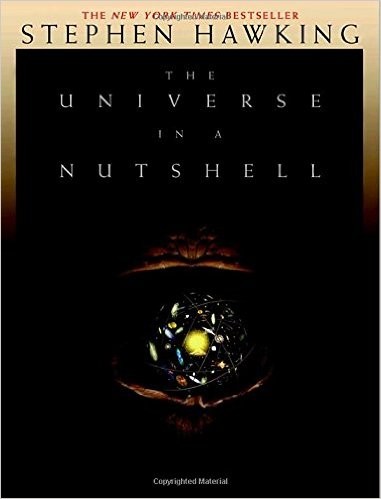
The Universe in a Nutshell
Bantam Books · 2001 · 224 pages
ISBN: 9780553802023
Review Editor
Lena Park
A Sequel That Earns Its Place
Stephen Hawking published The Universe in a Nutshell in 2001, thirteen years after A Brief History of Time made him the world’s most famous scientist. The earlier book had sold over 10 million copies but was notoriously cited as one of the least-finished books on educated people’s shelves – widely purchased, rarely completed, more cultural object than reading experience. The Universe in a Nutshell is partly a response to this reputation. It is heavily illustrated, with graphics on nearly every spread designed to make abstract physical concepts visually accessible. It covers some of the same ground as its predecessor but extends the story to include developments of the 1990s: string theory, M-theory, the holographic principle, and the accelerating expansion of the universe.
The result is a book that succeeds on its own terms as a piece of science communication, though it is less intellectually demanding and less ambitious than A Brief History of Time. Readers who found the earlier book too dense will find this one more navigable; readers who have read the earlier book and want an update will find genuine new material. As a standalone introduction to contemporary cosmology, it works well.
What the Book Covers
The opening chapters revisit the foundations laid in the earlier book: special relativity, general relativity, the expanding universe, and the big bang. Hawking presents these topics more briefly than before, clearly expecting some prior familiarity from readers who have encountered popular physics. The discussion of Einstein’s theories is particularly well handled – the visual representation of curved spacetime as a rubber sheet with masses creating depressions is a cliche, but Hawking uses it carefully and supplements it with better analogies.
The middle chapters move into territory not covered in A Brief History of Time. Hawking discusses superstrings and M-theory at length, presenting these as the leading candidates for the unified theory of physics. M-theory posits eleven dimensions of space-time (ten of space, one of time) and encompasses several earlier string theories as limiting cases. Hawking presents this not as a completed theory – it was and remains incomplete – but as the most promising research direction in fundamental physics.
The chapters on branes are particularly interesting. Brane theory, emerging from M-theory, posits that our four-dimensional universe (three space, one time) is a membrane embedded in higher-dimensional space. Other branes might exist nearby in this higher-dimensional space. This leads to intriguing speculations about the structure of the universe and the possibility of contact between branes. Hawking presents these ideas with appropriate hedging about their speculative status.
The Illustrations and Their Role
The book’s most distinctive feature is its visual design. Unlike A Brief History of Time, which was essentially text with a few diagrams, The Universe in a Nutshell was designed from the ground up as an illustrated work. The graphics were produced by a team working with Hawking and are remarkable for their quality – they are not mere decoration but genuine attempts to visualize abstract physical ideas.
Some of the illustrations are genuinely illuminating. The representation of Feynman path integrals – the sum over all possible histories that quantum mechanics assigns to particles – as a branching tree of paths is clearer than any verbal description. The visual treatment of the holographic principle, showing how information in a volume of space can be encoded on the surface enclosing it, is similarly effective. The problem is that some of the more complex ideas cannot be adequately conveyed visually, and the illustrations occasionally give the impression of comprehension without providing the substance of it.
Where It Falls Short of Its Predecessor
The Universe in a Nutshell is a less demanding book than A Brief History of Time, and this is not entirely a virtue. Hawking compressed the most important ideas in physics into 212 pages in the earlier book by being willing to let readers struggle with genuine difficulty. The newer book is more comfortable and more visual, but it covers some topics at a level that leaves readers with the impression of understanding without providing the conceptual depth that makes the impression accurate.
The treatment of M-theory and string theory is particularly susceptible to this criticism. These are technical subjects whose difficulties are largely mathematical, and presenting them in a format that emphasizes visual accessibility necessarily sacrifices rigor. Readers who want to understand why physicists take these approaches seriously, not just what they claim, need a more technical treatment.
The book also suffers slightly from the difficulty of writing about frontier physics that is rapidly moving. Some of what seemed promising about string theory and M-theory in 2001 has proven less promising since, and some developments since the book’s publication – the detection of gravitational waves, the imaging of black holes, the discovery of the accelerating expansion – have changed the context in which these theoretical ideas are evaluated.
What It Gets Right About Contemporary Physics
Despite these limitations, the book captures something genuine about the state of theoretical physics at the turn of the millennium. The proliferation of dimensions, the possibility of multiple universes implied by eternal inflation, the holographic principle, the fundamental role of information in physics – these are real developments in how physicists think about the universe, and Hawking presents them with the authority of someone who has contributed to their development.
The discussion of the anthropic principle – the idea that the universe must have the properties necessary for observers to exist in it, because otherwise there would be no one to observe it – is handled with more care than is usual in popular science. Hawking neither dismisses it as a tautology nor embraces it as an explanation, but presents it as a constraint that any complete theory must satisfy while acknowledging that it cannot substitute for the kind of mechanistic understanding physics aims at.
A Book Worth Reading Alongside Its Predecessor
The Universe in a Nutshell is best understood as a supplement to A Brief History of Time rather than a replacement for it. Readers who have worked through the earlier book will find genuine value in the update – the discussion of M-theory, the holographic principle, and the implications of the accelerating expansion adds substantially to the picture Hawking had drawn in 1988. Readers who have not read the earlier book will find this one accessible but may feel that they are missing context.
The book is also an implicit argument about what popular science writing can and should do – an argument that general readers can engage with frontier physics if the presentation is honest about uncertainty and clear about the distinction between established science and active speculation. Whether the visual format serves this argument as well as Hawking hoped is debatable, but the underlying commitment to intellectual honesty is consistent with everything he wrote.
Frequently Asked Questions
Do I need to read A Brief History of Time before this book?
Not strictly required, but helpful. The Universe in a Nutshell covers some of the same foundational material more briefly, assuming readers have some prior exposure to relativity and quantum mechanics. Readers who start here will understand the book, but readers who have worked through A Brief History of Time will find the connections to the earlier discussion illuminating.
What is M-theory and is it still considered promising?
M-theory is a proposed framework that unifies several earlier string theories by positing eleven spacetime dimensions. It was the leading candidate for a unified theory of physics in the late 1990s and early 2000s. Its status in contemporary physics is complex – the mathematical framework continues to be developed, but its connection to testable predictions has proven difficult to establish. Many physicists remain engaged with it; some have become skeptical that it is genuinely a theory of nature rather than a mathematical framework.
Is the book appropriate for younger readers?
Yes. The visual format and accessible prose make it suitable for motivated readers from about 14 upward. The concepts require concentration but are presented without technical prerequisites. It is an effective introduction to contemporary cosmology for readers who want to understand the current state of thinking about the universe’s structure.
How does the book handle the possibility of multiple universes?
Hawking presents the multiverse as a consequence of various theoretical frameworks – eternal inflation, string theory’s landscape, and quantum cosmology – and treats it as a genuine scientific possibility rather than speculation. He is careful to note that the idea is currently untestable, but he does not dismiss it on those grounds. The discussion is more nuanced than either the enthusiastic embrace of the multiverse found in some popular writing or the dismissal of it as pseudo-science found in others.
What scientific developments since 2001 are relevant to this book?
Several. The detection of gravitational waves by LIGO in 2015 confirmed general relativity’s predictions about merging black holes and opened a new observational window on the universe. The Event Horizon Telescope’s first image of a black hole’s shadow in 2019 confirmed the qualitative picture Hawking described. The continued failure to detect supersymmetric particles at the Large Hadron Collider has complicated the supersymmetry predictions that string theory made. These developments don’t overturn the book’s arguments but substantially update its context.
Is this a good book to give as a gift to someone interested in physics?
Yes, especially for younger readers or people who are curious but not committed to working through A Brief History of Time. The visual format is engaging and the book is shorter and more accessible than its predecessor. For readers who have already encountered A Brief History of Time, it is a valuable update and complement.
What is the holographic principle?
The holographic principle, proposed by Gerard ‘t Hooft and Leonard Susskind in the 1990s, suggests that the information content of a region of space is encoded on its boundary (a surface with one fewer dimension) rather than in the volume itself. This is analogous to the way a two-dimensional hologram encodes a three-dimensional image. The principle emerged from studies of black hole thermodynamics and has become central to the AdS/CFT correspondence in string theory. Its physical meaning and implications remain active areas of research.
How reliable are Hawking’s predictions in this book?
Hawking was careful to distinguish established science from speculation and prediction, and his track record was good. The broad claims about the big bang, black holes, and the structure of spacetime have been well supported by subsequent observation. The more speculative claims about M-theory and multiple universes remain speculative. Hawking’s specific prediction about black hole information loss – that information falling into a black hole is permanently destroyed – he later retracted, concluding that information must be preserved in some form.
Book Details
- Title
- The Universe in a Nutshell
- Author
- Stephen Hawking
- Genre
- Science & Nature
- Publisher
- Bantam Books
- Year Published
- 2001
- Pages
- 224
- ISBN
- 9780553802023
- WritersReview Rating
- 4.0 / 5