
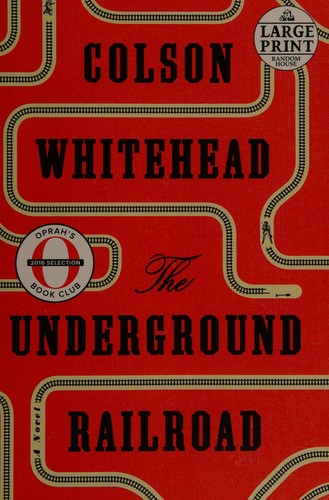
The Underground Railroad
Doubleday · 2016 · 306 pages
ISBN: 9781524736309
Review Editor
Eleanor Marsh
Summary
Colson Whitehead’s The Underground Railroad begins with a simple premise that immediately ruptures the reader’s sense of the familiar: what if the underground railroad were a real railroad, with actual tracks and tunnels running beneath the soil of the antebellum South? From that single speculative pivot, Whitehead constructs a novel that is simultaneously a slave narrative, a genre thriller, an alternate history, and a work of profound moral reckoning with the founding crimes of the United States.
Cora is a young enslaved woman living on a cotton plantation in Georgia. Her mother, Mabel, escaped years ago without taking her daughter, a wound that has never healed. When Caesar, a recently arrived slave from Virginia, proposes that they run together, Cora agrees. Their escape leads them to a hidden station beneath a barn, where a conductor puts them on a train heading into the unknown. Each state they pass through represents a different face of American racism: South Carolina’s paternalistic medical experiments, North Carolina’s brutal white supremacy dressed as civic order, Tennessee’s scorched desolation. The slave catcher Ridgeway, a man of terrifying ideological certainty, pursues Cora across the novel’s entire length.
Published in 2016, the novel won the Pulitzer Prize for Fiction and the National Book Award. It is Whitehead’s sixth novel and the one that established him, beyond any argument, as one of the essential American novelists of his generation.
Character Arcs and Development
Cora is one of the most fully realized protagonists in recent American fiction. She begins the novel as someone who has learned to survive by keeping her head down, tending her small plot of garden with a fierceness that is really a fierceness about selfhood and dignity. She is not heroic in the conventional sense when we first meet her; she is strategic, guarded, and carrying the specific grief of abandonment. The escape does not transform her in a clean arc so much as it reveals, crisis by crisis, the depth of her resilience and the ferocity of her desire to be free and to live on her own terms.
What makes Cora genuinely compelling is that Whitehead doesn’t romanticize her survival. She does things that are morally difficult. She witnesses things she cannot fully process. She fails people she cares about. Her relationship with her absent mother, which resurfaces at the novel’s end in a way that reframes everything that came before, is handled with remarkable restraint and emotional precision.
Ridgeway, the slave catcher, is the novel’s other great creation. He is not a monster in the cartoonish sense; he is a man of coherent, sincere belief in what he calls the American imperative. His scenes are among the most intellectually unsettling in the book, because Whitehead gives him arguments that are not easily dismissed. The America Ridgeway embodies is one that was built on the logic he serves, and the novel refuses to let that logic remain safely in the past.
Pacing
The novel moves in a staccato rhythm that mirrors Cora’s experience: long stretches of terrible stillness in hiding, punctuated by eruptions of violence and flight. Each state functions as a self-contained episode with its own tone and terror, which keeps the novel from feeling repetitive even as the underlying pursuit never lets up. The South Carolina section is the longest and most psychologically complex; it risks slowing the momentum but earns its length by establishing the full range of what white control over Black bodies could look like.
Some readers have found the novel’s deliberate mythic quality leaves them at a slight remove from Cora’s emotional interiority. This is a fair observation. Whitehead is writing in a mode closer to allegory than conventional realism in some sections, and the choice to shift perspectives occasionally to characters who are not Cora creates brief interruptions in the pursuit narrative. But these are stylistic choices in service of the book’s ambitions, not failures of craft.
Deeper Thematic Exploration
The railroad conceit does more than provide narrative propulsion. By making the metaphor literal, Whitehead invites us to think about what it actually means to escape, to move from one state to another, and to discover that each next place carries its own version of the same fundamental violence. Freedom in this novel is never a destination you arrive at and stay; it is something that must be won again and again, always against the same structuring logic of white supremacy in new disguise.
The novel engages deeply with the question of complicity. Nearly every system Cora encounters that appears to offer safety or improvement is compromised, whether by the medical experimentation performed on Black patients in South Carolina’s hospitals, the incentivized informants in abolitionist communities, or the violence done in the name of progress. Whitehead is asking what it means to trust institutions that were built by and for people who did not include you in the category of persons.
The America Whitehead depicts is not a past America that has been cleanly transcended. The novel’s states move through different historical periods in a non-linear way, compressing slavery, Jim Crow, forced sterilization, and racial terror into a single geography. This is a deliberate choice: the accumulated history of anti-Black violence is not sequential but simultaneous, and Whitehead refuses to let the reader locate any of it safely in the past. The book was published during the Obama administration but reads as though it knew exactly what was coming.
Style and Voice
Whitehead’s prose in this novel is spare and controlled in a way that amplifies the horror rather than distancing it. He does not use ornamentation to describe atrocity; he describes it plainly, and the plainness is devastating. There is a long tradition of this approach in African American literature, and Whitehead knows it deeply. His sentences are clean without being cold.
The speculative elements are introduced without fanfare, which is exactly right. The railroad is just there, running underground, as though it always was. This matter-of-fact surrealism keeps the novel in the mode of myth rather than science fiction, and it allows the alternate-history elements to function as commentary rather than as distraction. Whitehead has spoken about the influence of magical realism on this book, and that lineage is legible on the page.
What distinguishes the novel stylistically from much recent literary fiction is its lack of sentimentality. Whitehead is not in the business of providing emotional comfort. The book earns its moments of tenderness precisely because they are so rare and so threatened.
Verdict
The Underground Railroad is essential reading: a novel that is painful and important in equal measure, one that does not flinch from the full weight of what it is about and does not offer the reader an easy release into the comfort of historical distance. It is a thriller in the most urgent sense of the word, because the thing being threatened is a human life, and because the forces hunting that life are not historical curiosities but the persistent shape of American racial violence in new clothes.
Readers who want to understand American history through fiction, who can tolerate violence on the page when it is in service of serious moral inquiry, and who are looking for a novel that rewards re-reading will find this one of the most significant American novels of the twenty-first century. It is not comfortable reading. It is necessary reading.
Frequently Asked Questions about The Underground Railroad
What is The Underground Railroad by Colson Whitehead about?
The Underground Railroad follows Cora, an enslaved woman on a Georgia cotton plantation, who escapes with another slave named Caesar. The twist is that the underground railroad in this novel is a real, literal railroad running beneath the ground, and Cora travels through a series of states, each with its own distinct form of racial oppression, while a relentless slave catcher pursues her.
Is The Underground Railroad a true story?
No, it is a work of fiction with speculative elements. The historical underground railroad was a network of safe houses and secret routes, not a literal railway. Whitehead takes that metaphor and makes it real, using it to explore the history and ongoing legacy of American slavery. The general history of slavery, slave catchers, and racial violence is grounded in documented fact.
Did The Underground Railroad win any awards?
Yes, it won both the Pulitzer Prize for Fiction and the National Book Award in 2016, making it one of the most decorated American novels of recent years. It was also a finalist for the Man Booker Prize and won numerous other awards. A television adaptation directed by Barry Jenkins was released on Amazon Prime Video in 2021.
How does The Underground Railroad compare to other slave narratives?
It sits in a tradition that includes Frederick Douglass’s autobiography and Toni Morrison’s Beloved, but its use of speculative fiction sets it apart. Where Morrison’s supernatural elements are psychological, Whitehead’s alternate history is geopolitical, using different imagined American states to anatomize different historical forms of racism simultaneously rather than sequentially.
Is The Underground Railroad difficult to read?
It is emotionally difficult in parts, dealing directly with the violence of slavery. Whitehead’s prose is clear and controlled rather than sensationalistic, but scenes of brutality are not softened. The novel is about 300 pages and reads quickly thanks to its thriller structure; the difficulty is emotional rather than linguistic.
What are the main themes in The Underground Railroad?
The central themes are freedom and its cost, the persistence of white supremacy across different historical periods, bodily autonomy and who controls Black bodies, complicity within systems of oppression, and the question of what it means to belong somewhere. The novel also explores motherhood and abandonment through Cora’s relationship with her escaped mother, Mabel.
Does The Underground Railroad have a happy ending?
The ending is open rather than triumphant. Cora survives and reaches a place of relative freedom, but the novel refuses easy catharsis. The final pages are deliberately ambiguous, leaving Cora in motion rather than at rest. This is thematically consistent: freedom in this book is never a final destination but an ongoing act.
Should I read The Underground Railroad?
If you want serious, beautifully written fiction that takes American history seriously, yes. It is one of the most important American novels of the last decade. It is not light reading, but it is not gratuitous; the darkness is purposeful. Readers who loved Beloved or Homegoing will find it deeply rewarding, as will anyone who wants to understand the structural roots of American racial inequality through the lens of a gripping, inventive story.
Book Details
- Title
- The Underground Railroad
- Author
- Colson Whitehead
- Genre
- Literary Fiction
- Publisher
- Doubleday
- Year Published
- 2016
- Pages
- 306
- ISBN
- 9781524736309
- WritersReview Rating
- 5.0 / 5