
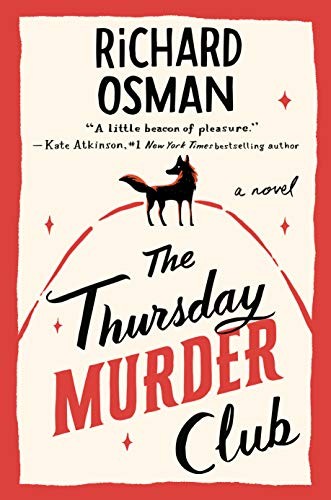
The Thursday Murder Club
Pamela Dorman Books · 2020 · 384 pages
ISBN: 9781984880963
Review Editor
James Voss
Four Retirees and a Body
Richard Osman is a British television presenter who wrote The Thursday Murder Club while between commitments, fully expecting, he has said, that it would sell modestly and be forgotten. It became one of the bestselling British novels of the past decade, launched a series, and was adapted for film. The book’s success reflects something genuine: it is warm, witty, and smartly plotted, and its four protagonists – septuagenarians living in a retirement community who meet weekly to examine cold cases – are the most charming collection of amateur detectives since Christie’s heyday.
Elizabeth, Joyce, Ibrahim, and Ron live at Coopers Chase, a luxury retirement village in Kent. Elizabeth is a former intelligence operative of deliberate vagueness about exactly what she did; Joyce was a nurse and is now an enthusiastic diarist; Ibrahim is a retired psychiatrist; Ron is a former trade union activist. Their Thursday Murder Club meets to look at unsolved cases supplied by a sympathetic former detective. When a local property developer turns up dead – a man with enemies among the residents – the Club finds itself with a real case to investigate.
The Characters
The four protagonists are individually delightful and collectively irresistible. Osman understands that people in their seventies are not diminished versions of their younger selves; they are the same people with additional experience, additional loss, and additional freedom from the social constraints that governed their earlier lives. Elizabeth, in particular, is one of the best fictional elderly protagonists since Miss Marple: formidable, funny, and harboring depths that the novel only partially reveals.
Joyce’s diary entries, scattered through the novel, provide a second narrative voice that is perfectly calibrated – naive in some ways, shrewd in others, and consistently funny. The relationship between the four characters is the book’s greatest pleasure: they argue, they look after each other, they are each other’s family in the way that chosen families are.
The Mystery
The mystery itself is competently constructed if not exceptional. The clues are fair, the suspects are reasonably interesting, and the solution is satisfying without being revelatory. Osman is more interested in his characters than in his puzzle, which puts him closer to the tradition of Christie’s Marple novels (which are really about the communities they depict) than to the pure puzzle tradition of And Then There Were None.
The subplot involving two local police officers – one young and ambitious, one older and world-weary – adds a second perspective on the investigation and provides some of the novel’s funniest scenes. The interplay between the Club’s unorthodox methods and the police’s attempts to manage them is a reliable source of comic energy throughout.
The Emotional Register
The novel is funnier than most contemporary crime fiction and more emotionally honest than its cozy surface might suggest. The residents of Coopers Chase are dealing with death – their friends’ deaths, their partners’ deaths, their own approaching deaths – and Osman handles this with a lightness of touch that neither trivializes the subject nor allows it to overwhelm the comic tone. The balance is delicate and he largely maintains it.
Verdict
The Thursday Murder Club is exactly what the best light entertainment should be: smarter than it needs to be, warmer than you expected, and difficult to put down. It is not attempting to be Gone Girl or In Cold Blood; it is attempting to be a perfect cozy mystery with more heart than the genre usually manages. It succeeds.
Frequently Asked Questions
Is The Thursday Murder Club a cozy mystery?
Yes, firmly within the cozy tradition – no graphic violence, amateur investigators, a community-centered setting, and a predominantly comic tone. It is a sophisticated cozy mystery rather than a simplistic one, but readers who dislike the genre’s constraints may find it too gentle.
Do I need to read the series in order?
The books work as standalones in terms of mystery plot, but the character development is cumulative. Starting with the first book is recommended for the full experience of the characters’ relationships.
Is the film adaptation good?
The Netflix adaptation, starring Helen Mirren, Ben Kingsley, Pierce Brosnan, and Celia Imrie, was released in 2025 and received warm if not effusive reviews. The casting is inspired, though the film inevitably loses some of the novel’s interior warmth.
What is Joyce’s role in the mystery?
Joyce functions partly as a comic figure – her diary entries record the mysteries of modern life alongside the murder investigation – and partly as the emotional center of the book. Her warmth and directness complement Elizabeth’s inscrutability, and she often notices things the others miss.
How does the book handle the subject of aging?
With more honesty and less sentimentality than most books about elderly characters. Osman acknowledges the losses of aging – friends who have died, capacities that have diminished, the approach of death – without making the book morbid. The characters are fully themselves, not diminished versions of younger selves.
Is the mystery challenging to solve?
It is fairly clued but not especially challenging for experienced mystery readers. Osman’s strengths lie more in character and comedy than in puzzle construction. Readers primarily interested in difficult mysteries should look elsewhere; readers who want excellent characters within a satisfying mystery structure will be well-served.
What other books are similar?
The Thursday Murder Club sits in the tradition of Christie’s Marple novels and the classic British cozy. Contemporary comparisons include M.C. Beaton’s Hamish Macbeth and Agatha Raisin series and Alexander McCall Smith’s No. 1 Ladies’ Detective Agency series, all of which prioritize character and community over puzzle difficulty.
Who should read The Thursday Murder Club?
Readers who enjoy cozy mysteries, anyone who wants a smart, funny, and warm novel that does not demand emotional difficulty, and those who enjoy fiction featuring older protagonists with full inner lives. Also recommended for readers who found the Agatha Christie tradition too puzzle-focused and want more character.
Book Details
- Title
- The Thursday Murder Club
- Author
- Richard Osman
- Genre
- Mystery & Thriller
- Publisher
- Pamela Dorman Books
- Year Published
- 2020
- Pages
- 384
- ISBN
- 9781984880963
- WritersReview Rating
- 4.0 / 5