
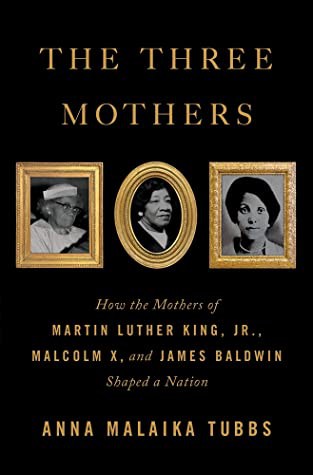
The Three Mothers
Flatiron Books · 2021 · 272 pages
ISBN: 9781250756121
Review Editor
Priya Nair
Three women shaped three men who changed America. Alberta Christine Williams King raised the son who would lead the Montgomery bus boycott. Louise Norton Little raised the son who would challenge America to confront its racial violence with its own. Berdis Baldwin raised the son who would write The Fire Next Time and tell the country what it refused to hear. You probably know all three sons. You probably know very little about their mothers. That is exactly what Anna Malaika Tubbs wants to fix.
The Three Mothers: How the Mothers of Martin Luther King, Jr., Malcolm X, and James Baldwin Shaped a Nation, published by Flatiron Books in February 2021, is part biography, part social history, and part argument. Tubbs, a Cambridge-trained sociologist and activist, reconstructs the lives of Alberta King, Louise Little, and Berdis Baldwin from archival records, letters, interviews, and secondary sources. She follows each woman from childhood through the decades that shaped their sons, asking a question that turns out to be more radical than it first appears: what if the women who raised these men were not background figures but primary ones?
The book covers roughly a century of American life, from the late nineteenth century into the 1960s. Alberta grew up in Atlanta, the daughter of a prominent minister, and became a schoolteacher with exacting standards for faith and self-worth. Louise grew up in Grenada before immigrating to the United States, where she became a committed Garveyite activist who joined the Universal Negro Improvement Association and raised her children inside a tradition of Black nationalism that would survive her institutionalization and reach her son in prison decades later. Berdis grew up poor, moved to Harlem, survived a difficult first marriage, raised nine children in a crowded apartment, and wrote privately her whole life. Three different women, three different regions, three different relationships to the Black church and to Black radicalism, and all three mothers of men who would transform American thought.
Character Arcs and Development
Each of the three women arrives in the book as a young person navigating a country designed to limit her, and Tubbs follows each with patient attention through the decades. Alberta King is the most clearly defined of the three. Educated, devout, and deliberate about the emotional education she gave her children, she taught Martin Luther King Jr. that his worth could not be determined by the judgment of a racist society. Tubbs draws on King family letters and accounts to show how Alberta’s composed, unshakeable faith became the foundation her son stood on when Birmingham got violent and when his leadership became a target. The emotional core of Alberta’s arc is her insistence that love and dignity were political acts, not private comforts.
Louise Little is the most heartbreaking arc in the book. Sharp, politically active, and outspoken, she raised her children inside a tradition of Pan-African consciousness that her son Malcolm would later develop into a philosophy that frightened a nation. When her husband Earl was killed in what the family believed was a politically motivated attack, Michigan authorities watched the household closely. They eventually declared Louise mentally ill and had her committed to a state institution, separating her from her children for decades. Tubbs handles this section with both anger and precision, showing how Louise’s political visibility made her a target and how her institutionalization removed a mother from her children’s lives at the exact moment they most needed her. The adult Malcolm X’s deep suspicion of white institutions begins to look less like ideology and more like inheritance.
Berdis Baldwin is the quietest of the three, and Tubbs acknowledges that the archival record is thinnest for her. What she builds from James Baldwin’s letters, essays, and published interviews is a portrait of a woman who nurtured her son’s imagination through books, conversation, and a household culture that treated language as a serious thing. Baldwin wrote about his mother with extraordinary tenderness throughout his life, and Tubbs uses those passages carefully, reading them not as a son’s tribute but as evidence of a specific intellectual relationship. The asymmetry between the three women’s documentary records is itself a kind of argument: the more politically visible a woman was, the more the historical record tried to contain or erase her.
Pacing
The book moves well through its first two thirds, weaving the three women’s stories together by time period rather than by individual chapter. You might move from 1920s Atlanta to 1920s Grenada to 1920s Harlem within a few pages. The structural choice emphasizes the parallel forces shaping all three lives simultaneously, and Tubbs handles the transitions cleanly. The middle section, covering the 1930s and 1940s, has the most energy: the Great Migration, the rise of the Garvey movement, the New Deal years, and the widening rift between Black church culture and Black radicalism all give the women’s stories a specific, charged backdrop.
The book slows in its final quarter, where Tubbs moves into more explicit social analysis and pulls back from scene-level narrative. The shift from biography to argument is not disorienting, but readers who came for the women’s personal stories may notice that the last fifty pages function more like an essay than a narrative. This is a deliberate choice, and it suits the book’s advocacy purpose. But anyone who wishes Tubbs had stayed closer to the ground for the full arc will feel it here.
Deeper Thematic Exploration
At its core, The Three Mothers is a book about who gets to be a historical subject. Tubbs is not interested in Alberta, Louise, and Berdis as footnotes in their sons’ stories. She wants to restore them as primary subjects: women with intellectual and political lives, with ambitions and wounds and convictions that were their own before they were anyone’s mother. The book does not argue that these women deserve credit for their sons’ achievements, exactly. It argues that they were historically significant on their own terms, and that the discipline of biography has consistently failed to see that.
The concept of “othermother” runs through Tubbs’s analysis, drawn from sociologist Patricia Hill Collins’s framework of Black maternal community-making. Tubbs argues that Alberta, Louise, and Berdis did not merely raise children; they practiced caregiving as a form of political action. Alberta King taught her children that segregation was a moral wrong before any Supreme Court decision said so. Louise Little politicized her children inside a tradition of Pan-African resistance that the American state actively tried to suppress. Berdis Baldwin created a home culture that treated the written word as sacred in a neighborhood and an era that offered Black children very little reason to believe that mattered. Tubbs insists that this labor is historical evidence, not background noise.
Beneath all of that runs a harder argument, which Tubbs makes with increasing directness as the book progresses: the erasure of Black women from civil rights history is not an oversight but a pattern. When history organizes itself around heroic individual men, the women who shaped those men disappear. Tubbs does not present this as a new discovery, but she makes it newly legible through these three specific lives. Reading about Louise Little’s institutionalization, in particular, gives the argument a weight that no abstraction could. Her removal from her family was not incidental. It was systematic. And her son knew it.
Style and Voice
Tubbs writes with the rigor of a trained sociologist and the conviction of someone with something personal at stake. The prose is clear and direct without being cold. She uses the second person occasionally in her framing passages, which creates a sense of direct address that suits the book’s stated purpose. You are being asked to pay attention. You are being told this matters and told why.
Where the book is strongest, the writing becomes almost archival in its precision: specific dates, names, places, and primary sources all doing their quiet work without calling attention to themselves. Where it is weaker, the language tips into assertion rather than demonstration, particularly in the final sections where Tubbs makes broader claims about American cultural memory that outrun the specific evidence she has provided. These passages read more like manifesto than biography. That is not entirely a criticism: the book earns its anger, and the argument is not wrong. But readers who want their claims rooted in scene and document will occasionally wish Tubbs had stayed closer to the particular.
Verdict
The Three Mothers is a serious and necessary book, and it succeeds on its own terms. If you have ever read a biography of Martin Luther King Jr., Malcolm X, or James Baldwin and found yourself curious about the people who first handed them books and told them who they were, this is the book for that. Tubbs writes with the care of someone who knows these women’s lives matter and has done the sustained archival work to make the case.
Not every reader will love the balance between biography and argument. Those who want full, scene-rich lives will get something closer to scholarly profiles in places, particularly for Berdis Baldwin, whose thinner archival record limits how deep Tubbs can go. But that limitation is part of the book’s point: the gaps are not accidental. They are what happens when history decides whose life is worth recording. If you care about whose stories get told and why, The Three Mothers belongs on your shelf.
Frequently Asked Questions about The Three Mothers
What is The Three Mothers by Anna Malaika Tubbs about?
The Three Mothers focuses on three women whose lives shaped three of the most important figures of the civil rights era: Alberta Christine Williams King, mother of Martin Luther King Jr.; Louise Norton Little, mother of Malcolm X; and Berdis Baldwin, mother of James Baldwin. Tubbs argues that these women were historically significant in their own right and that their intellectual, spiritual, and political lives directly influenced their sons’ worldviews, yet American history has largely overlooked them.
Who are the three mothers in The Three Mothers by Anna Malaika Tubbs?
The three mothers are Alberta King, an Atlanta-born educator and devout churchwoman who grounded Martin Luther King Jr. in a theology of human dignity; Louise Little, a Grenada-born Garveyite activist who raised Malcolm X in a tradition of Black nationalism before the state institutionalized her; and Berdis Baldwin, a Harlem-based writer and mother of nine who nurtured James Baldwin’s love of language and literature from an early age.
What are the main themes in The Three Mothers?
The central themes include the erasure of Black women from American historical narratives, the political dimensions of Black motherhood during the Jim Crow era, and the ways that caregiving functions as a form of historical action rather than private life. Tubbs also explores the relationship between individual biography and systemic racism, the Garvey movement and its influence on family life, and the gap between whose stories get documented and whose get lost.
How long is The Three Mothers and is it a difficult read?
The Three Mothers runs 272 pages, making it a moderately compact read for a work of social history. The writing is clear and accessible, aimed at a general audience rather than academic readers, though Tubbs draws on sociological frameworks like Patricia Hill Collins’s concept of “othermothering.” Most readers with an interest in American history or biography will find the pacing manageable, though the final section shifts into more analytical territory.
Is The Three Mothers by Anna Malaika Tubbs a New York Times bestseller?
Yes, The Three Mothers became a New York Times bestseller after its February 2021 publication. It was also named an Amazon Best Book of February 2021 and appeared on NPR’s Books We Love list for 2021. The book received praise from major publications including the Washington Post, Kirkus Reviews, and Publishers Weekly, which gave it a starred review.
How does The Three Mothers compare to other civil rights biographies?
Most civil rights biographies center on male leaders: King, Malcolm X, Baldwin, John Lewis. The Three Mothers explicitly addresses that gap by treating the women who raised those leaders as the primary subjects. Compared to a conventional biography, Tubbs’s book reads more like a parallel social history, following three separate lives across decades rather than a single subject’s arc. Readers who loved Taylor Branch’s King trilogy or Manning Marable’s biography of Malcolm X will find The Three Mothers a useful and corrective companion.
Is there a movie or TV adaptation of The Three Mothers?
As of publication, no major film or television adaptation of The Three Mothers has been announced or released. Given the book’s subject matter and its focus on three distinct but interwoven lives, an adaptation would likely take the form of a docuseries or prestige drama rather than a single film. Anna Malaika Tubbs has spoken publicly about the book in interviews and cultural conversations but has not announced any screen project.
Should I read The Three Mothers and is it worth it?
If you have any interest in civil rights history, American biography, or the history of Black women’s intellectual and political life, yes. Tubbs makes a compelling case that three women most readers know only as names in footnotes were historically significant on their own terms. The book is not a complete substitute for full individual biographies of each woman, and some readers will wish for more scene-level detail, particularly around Berdis Baldwin. But as a corrective to a long-standing gap in how American history gets told, it is well worth the few hours it takes to read.
Book Details
- Title
- The Three Mothers
- Author
- Anna Malaika Tubbs
- Genre
- Biography
- Publisher
- Flatiron Books
- Year Published
- 2021
- Pages
- 272
- ISBN
- 9781250756121
- WritersReview Rating
- 4.0 / 5