
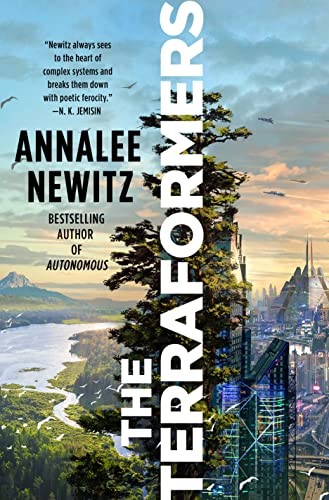
The Terraformers
Tordotcom · 2023 · 352 pages
ISBN: 9781250228017
Review Editor
Marcus Webb
Published on January 31, 2023, Annalee Newitz’s third novel takes on the kind of question science fiction does best: what do we owe the world we inherit, and who gets to decide? The Terraformers is set roughly 60,000 years in the future, on a privately owned planet called Sask-E that has been undergoing terraforming by the interstellar real estate corporation Verdance. The process has taken tens of thousands of years and required the labor of engineered workers: humans, bots, animals modified for intelligence, and beings adapted for conditions that would kill an ordinary person. The workers were promised extinction when their job was finished. Some refused.
Newitz structures the novel in three sections separated by roughly 700 years each, letting readers watch the consequences of a single act of defiance ripple forward through time. In the first section, Destry, a Ranger for Verdance, stumbles upon Spider, a secret city built by workers who escaped their scheduled deaths and built something the company never intended: a community with its own governance, its own culture, and its own insistence on personhood. In the second, a mixed team of Verdance employees and Spider residents conducts an environmental survey and wrestles with competing visions for Sask-E’s future. In the third, a flying train named Scrubjay (yes, the trains are people now, and this section is the most joyful of the three) teams up with a journalist cat named Moose to challenge the corporate landowner that has come to dominate the planet.
The premise sounds dense, and the world-building is genuinely intricate, but Newitz keeps the prose moving. This is not hard science fiction in the technical-manual tradition. The science is plausible and clearly researched (Newitz has worked as a science journalist), but it lives in the background. What fills the foreground is an argument, passionately and often playfully made, about labor, ownership, and who gets to count as a person worth protecting.
Character Arcs and Development
Destry, the first section’s central figure, works best as a character precisely because she starts complicit. She believes in her work for Verdance. She has absorbed the company’s framing of the engineered workers as assets rather than citizens. Her transformation comes not through dramatic revelation but through accumulation: small moments of recognition, conversations with beings who do not fit her categories, a water crisis that forces her team into secret alliance with the community they were supposed to overlook. By the end of Part One, Destry has not abandoned her competence or her care for Sask-E, but she has stopped pretending that good work in service of a bad system is neutral.
The challenge Newitz faces is that the structural choice of three sections and three essentially new casts of characters works against the kind of deep investment that comes from following one person through a transformation. Sulfur, the archaean scientist at the center of Part Two, is interesting and warm, but we meet them mid-life and leave before their story fully settles. Scrubjay in Part Three benefits from being genuinely unusual (a train-person who grew up without a body, who had to learn what feet are) and from being paired with Moose, whose journalist’s skepticism and feline pragmatism provide an excellent counterweight. The friendship between Scrubjay and Moose is the most purely enjoyable relationship in the book.
The secondary cast across all three sections is large, and Newitz treats even minor figures with care: a moose who serves on an environmental advisory board, a lava-dwelling community of bots who maintain the planet’s tectonic infrastructure, a cow named Lou who is one of the finest environmental scientists on the planet. These characters push against any assumption that personhood is fixed or obvious, which is precisely the point.
Pacing
The three-section structure creates a specific rhythm: each part moves forward with reasonable momentum, then resets completely. Readers who invest in the characters of Part One will feel the loss when they step offstage, and the first twenty pages of Part Two require a re-orientation that can feel abrupt. Part Two is also, frankly, the slowest section, heavy on environmental survey and political maneuvering in ways that read more educational than narrative at times.
Part Three recovers well. Scrubjay’s story has the most urgency, partly because the stakes are clearest and partly because Moose is a funny, grounding presence who keeps things from tipping into earnestness. A sequence involving an eviction, a train uprising, and an orbital strike reads with real propulsion. The novel earns its ending by making the conclusion feel not like a victory so much as a beginning, which is the right note for a story about processes that unfold over thousands of years.
Deeper Thematic Exploration
The most powerful idea in The Terraformers is also the most transferable: you cannot separate the question of environmental stewardship from the question of who counts as a person. Verdance’s exploitation of Sask-E is inseparable from its refusal to recognize the personhood of its workers. The planet’s ecosystems can only be treated as resources to be extracted and sold because the beings who built those ecosystems have been classified as tools rather than citizens. Newitz makes this argument not through essays inserted into the narrative but through plot: every ecological crisis in the novel has a human (or post-human, or non-human) cause rooted in the same failure of recognition.
The book is also, in ways that feel genuinely contemporary, a story about housing and gentrification. The third section is explicit about this: Emerald, the private landowner who controls much of Sask-E, systematically evicts low-income residents and replaces neighborhoods with luxury developments, using orbital laser strikes when the legal process proves too slow. This is not subtle, but it is not supposed to be. Newitz wants readers to draw the line from fictional corporate terraforming to familiar patterns of displacement and dispossession, and they draw it with care and without apology.
What keeps the politics from becoming a lecture is the book’s genuine affection for its world. The Flying Train Fleet runs as a worker cooperative. The trains genuinely enjoy their work. Spider has developed rituals and art forms over centuries of hidden existence. This is not a dystopia. It is a story about the ongoing, contested, incremental work of building something better, and Newitz makes that work feel worthwhile and specific rather than abstract and preachy.
Style and Voice
Newitz’s prose is clear and functional, warming into something more in the descriptive passages: volcanic ribbons of artificial tectonic infrastructure, underground cities lit by bioluminescent organisms, the particular quality of a sky seen from a planet sculpted by intention rather than accident. The humor is genuine and well-timed, delivered without italicizing the punchlines. Newitz trusts readers to find the comedy in a cow presenting environmental impact data to a city council, or a train discovering that legs are actually quite inefficient.
The novel uses gender-neutral they/them pronouns throughout for characters of ambiguous or non-binary gender, including many of the non-human persons who populate Sask-E, and this is handled naturally, with no special attention drawn to it. The structural ambition does come at a stylistic cost: with three casts and hundreds of years between sections, the prose stays somewhat close to the surface of each character. There are few moments of deep interiority. Readers who prize sentence-level prose that stops them mid-page may find the book a little flat on that score; readers who come for ideas and world-building will leave satisfied.
Verdict
The Terraformers will most reward readers who love what Becky Chambers does in the Wayfarers series but want something with sharper political edges. If you find cozy science fiction too comfortable, Newitz provides similar warmth alongside genuine urgency: the world is beautiful, and it is also being ruined by people with capital, and there are ways to fight back. This is a book for readers who believe collective action is compelling subject matter for fiction, and who want to see optimism earned rather than assumed.
Readers who require a single protagonist to follow from beginning to end, or who want prose that lingers on beauty, may find the three-part structure frustrating. Part Two asks for patience. But those who stay with it will find a book that takes its ideas seriously without losing its humor, that builds a world worth spending time in, and that ends with the specific satisfaction of a problem not solved but genuinely engaged. You close it believing that things can change, slowly, through accumulated acts of courage and cooperation. That is not a small thing for a novel to do.
Frequently Asked Questions about The Terraformers
What is The Terraformers by Annalee Newitz about?
The Terraformers is a science fiction novel set 60,000 years in the future, on a planet called Sask-E that a corporation named Verdance has been slowly transforming into a habitable world. The story spans three sections separated by roughly 700 years each, following different characters as they fight for the rights of the workers, animals, bots, and engineered beings who built the planet but have never been recognized as people. At its core, it is a story about labor, personhood, and who gets to benefit from the work of building a world.
Did The Terraformers win any awards?
The Terraformers was nominated for the 2024 Nebula Award for Best Novel, one of the most prestigious honors in science fiction. It also received a starred review from Publishers Weekly and was included on numerous best-of lists for 2023, including coverage from The Washington Post and the Los Angeles Times.
What are the main themes in The Terraformers?
The four central themes are personhood (who gets to count as a being with rights), labor rights and worker ownership versus corporate exploitation, environmentalism and long-term ecological responsibility, and housing or the politics of who gets to live where and on whose terms. Newitz weaves these together so that each feeds the others: you cannot protect the environment without first deciding that non-human beings are worth protecting, and you cannot have worker rights without challenging who owns the land.
How long is The Terraformers and is it a difficult read?
The hardcover edition is 352 pages. The prose is accessible rather than demanding: Newitz writes clearly, with humor, and does not require readers to navigate complex technical terminology. The main challenge is structural. The novel restarts with new characters twice, which requires readjustment. Readers comfortable with multi-perspective epic fantasy will find the transitions manageable; readers who prefer to follow a single character through a complete arc may find the transitions frustrating.
How does The Terraformers compare to Becky Chambers’ work?
The comparison to Chambers is apt and appears in several professional reviews. Both authors write science fiction grounded in warmth, cooperation, and optimism about what humans and non-humans might build together. Newitz’s version is more overtly political: where Chambers tends to build communities and let readers draw social conclusions, Newitz names the villains and describes the struggle directly. If Chambers is cozy, Newitz is cozy with a union card.
Is there a movie or TV adaptation of The Terraformers?
As of this writing, no film or television adaptation of The Terraformers has been announced. The novel’s structure, which spans over 1,600 years and features three largely separate casts of characters, would present significant challenges for a linear screen adaptation, though its visual world-building would translate well to television or animation.
What age group or reading level is The Terraformers for?
The Terraformers is adult science fiction, but it is not explicit or gratuitously violent, and the political and environmental themes are accessible to thoughtful teenagers. It reads best for adults who already have some familiarity with science fiction conventions. The most rewarding readers will be those who bring some interest in labor history, environmentalism, or questions of political economy, since the novel engages those topics directly.
Should I read The Terraformers and is it worth it?
If you care about ideas, yes. Newitz packs more intellectual content into 352 pages than most novels twice its length, and the world of Sask-E is genuinely original. If you are a science fiction reader who has felt that the genre too rarely imagines positive futures in specific, workable terms rather than vague utopian gestures, this book is for you. If you need strong emotional attachment to a single character to carry you through a novel, the three-part structure may not work for you. Start with Part One and see if Destry and Spider hook you.
Book Details
- Title
- The Terraformers
- Author
- Annalee Newitz
- Genre
- Science Fiction
- Publisher
- Tordotcom
- Year Published
- 2023
- Pages
- 352
- ISBN
- 9781250228017
- WritersReview Rating
- 3.9 / 5