
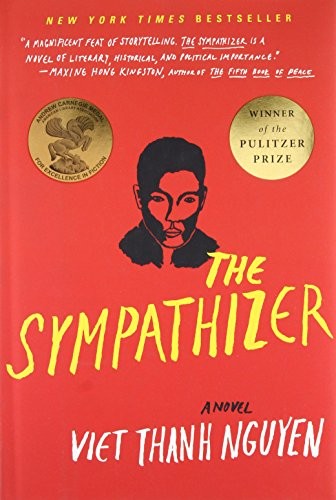
The Sympathizer
Grove Press · 2015 · 384 pages
ISBN: 9780802123459
🏆 Pulitzer Prize for Fiction (2016)
Edgar Award for Best First Novel (2016)
Andrew Carnegie Medal for Excellence in Fiction (2016)
Center for Fiction First Novel Prize (2015)
Dayton Literary Peace Prize (2016)
California Book Awards Gold Medal in First Fiction (2016)
Asian/Pacific American Literature Award (2016)
Review Editor
Eleanor Marsh
Viet Thanh Nguyen’s debut novel, The Sympathizer, published by Grove Press in April 2015, begins where most Vietnam War stories end: with the fall of Saigon. But this is not a story about American soldiers, their traumas, or their homecomings. It is the confession of an unnamed narrator, a half-Vietnamese, half-French communist spy embedded in the South Vietnamese army, who escapes to Los Angeles with his commanding officer and a planeload of refugees in the chaotic final days of the war. What follows is an account of exile, espionage, Hollywood mythmaking, and the slow erosion of a man caught between every possible side of a conflict that refuses to stay in the past. Written in the form of a forced confession to communist captors, the novel upends four decades of American-centric Vietnam War literature and demands we reckon with the voices that have been left out of that canon.
The narrator, known only as the Captain, is a man of two minds, two countries, and two loyalties. Recruited as a communist mole during his student days, he has spent years feeding intelligence to his handler, Man, while maintaining an apparently genuine friendship with Bon, a fiercely anti-communist soldier who has no idea his closest friend has been reporting on him for years. When the General, a high-ranking South Vietnamese intelligence officer, evacuates to America, the Captain goes with him, tasked with monitoring the exile community and any plans for a counter-revolution. The setup is that of a spy thriller, but Nguyen is after something far more ambitious than plot mechanics.
The book spans roughly six years, from the fall of Saigon in 1975 through refugee resettlement in Los Angeles, a stint as a cultural consultant on a thinly veiled Apocalypse Now-style film production in the Philippines, and finally a harrowing return to Vietnam and imprisonment in a reeducation camp. Each setting serves as a different lens through which Nguyen examines what it means to be Vietnamese in a world that treats Vietnam as a symbol, a battlefield, or a punchline.
Character Arcs and Development
The Captain is one of the most fully realized narrators in contemporary fiction. His duality is not a gimmick; it is the engine of every relationship and moral compromise in the novel. Born to a Vietnamese mother and a French Catholic priest who never acknowledged him, he carries the colonial wound in his body. He is brilliant, funny, self-aware to a fault, and capable of startling cruelty when his mission requires it. Over the course of the novel, we watch his certainty about the communist cause erode, not because he stops believing in its ideals, but because he discovers that ideology is just another form of control. By the time he reaches the reeducation camp in the final act, forced to write and rewrite his confession until his captors are satisfied, the Captain has become something far more complicated than a spy: he is a man who has sympathized with everyone and belonged to no one.
Bon is the Captain’s moral counterweight. A true believer in the anti-communist cause, grieving the murder of his wife and child during the evacuation, Bon represents the cost of loyalty that never wavers. Where the Captain sees every situation from multiple angles, Bon sees only one direction forward, and that clarity makes him both admirable and tragic. Their friendship is the emotional core of the novel, built on a lie that the Captain can never confess without destroying the person he loves most.
Man, the third member of the Captain’s childhood trio, remains in Vietnam as the communist handler pulling strings from afar. His transformation from idealistic revolutionary to cold bureaucrat mirrors the revolution’s own trajectory, and when he and the Captain finally meet again, the reunion is anything but warm. The General, meanwhile, is drawn with surprising sympathy for a man who represents the corrupt old regime. Running a liquor store in LA while plotting a doomed guerrilla campaign, he is both ridiculous and dignified, a man who lost everything and refuses to accept it.
Pacing
The Sympathizer is a dense novel, and Nguyen does not make concessions for readers who want a quick ride. The first third moves briskly, carried by the urgency of the evacuation and the disorientation of refugee life in Los Angeles. The middle section, centered on the Hollywood film production, is both the novel’s comic high point and its most expansive stretch. Nguyen uses the film set as a vehicle for satire so precise it stings: the Captain is hired to ensure “authenticity” on a movie that has no interest in actual Vietnamese perspectives, and his increasingly desperate attempts to be heard by an oblivious director land somewhere between farce and fury.
The final third, set in Vietnam’s reeducation camps, shifts into a more philosophical and psychologically intense register. Some readers find these chapters slower, as the action gives way to extended interrogation, forced self-criticism, and the Captain’s internal reckoning with what he has done and failed to do. The pacing here is deliberate; Nguyen wants you to feel the claustrophobia and repetition of the camp, the way time collapses when your captors control even the words you write about yourself. It is not easy reading, but it earns its weight.
Deeper Thematic Exploration
At its core, The Sympathizer is a novel about the impossibility of seeing from both sides and the cost of trying. The Captain’s defining trait, his ability to sympathize with everyone, is presented first as a gift and gradually revealed as a curse. To sympathize with the South Vietnamese exile who mourns his lost country while also sympathizing with the communist revolution that displaced him is not balance; it is paralysis. Nguyen refuses to let the Captain off the hook with easy relativism. Seeing all sides does not make you wise. It makes you complicit in all of them.
The novel is equally sharp about the machinery of representation. The Hollywood section is not just comic relief; it is an argument about who gets to tell whose story and on what terms. When the Captain pleads for a single Vietnamese speaking role in a Vietnam War film, and is told the audience does not want to hear from Vietnamese people, Nguyen is pointing at something that extends well beyond cinema. The entire American literary and cultural apparatus around the Vietnam War has, until recently, treated Vietnamese people as scenery, victims, or villains. This novel exists, in part, to correct that record, and it does so not by offering a noble counter-narrative but by creating a narrator who is as compromised and contradictory as the history he inhabits.
Colonialism haunts every page. The Captain’s mixed heritage is a constant reminder that Vietnam’s identity has been shaped by occupation: French, Japanese, American. His education at an American university gave him the tools to understand both cultures, but it also severed him from full belonging in either. The reeducation camp scenes push this further, suggesting that even the revolution that promised liberation became its own form of colonial thinking, demanding conformity and punishing deviation with the same tools the previous regimes used. Nothing in this novel escapes Nguyen’s scrutiny, including the cause his narrator once believed in.
Style and Voice
Nguyen’s prose is precise, sardonic, and relentlessly intelligent. The confessional frame gives the narration an urgency that never lets up: the Captain is writing for his life, and every sentence carries the awareness that the wrong word could mean another year in the camp, or worse. Critics have compared the voice to Graham Greene and John le Carre, and those comparisons hold, but there is also something distinctly American about the Captain’s rhetoric, a salesman’s fluency that he picked up in California and cannot quite shake even when writing for communist interrogators.
One of the novel’s most distinctive formal choices is its treatment of dialogue. Nguyen largely avoids quotation marks, embedding speech within the narrator’s flowing paragraphs. This technique reinforces the sense that everything in the novel has been filtered through the Captain’s consciousness, that we are never hearing anyone speak directly but only his reconstruction of what was said. It takes some adjustment, but once you settle into the rhythm, it becomes inseparable from the novel’s larger point about the unreliability of memory and narrative.
Verdict
The Sympathizer is the rare novel that manages to be politically urgent, formally inventive, and deeply entertaining all at once. It won the 2016 Pulitzer Prize for Fiction, and it deserved to. This is the book that reshaped how the Vietnam War can be written about in English, not by arguing for a Vietnamese perspective but by embodying one so fully that the old frameworks fall apart on contact. If you have read a dozen American novels about Vietnam and never heard a Vietnamese voice at the center of the story, start here. If you care about espionage fiction, dark comedy, or prose that rewards close attention, start here. The philosophical density of the final act will not be for every reader, and those who prefer clean resolutions should know that Nguyen offers none. But for anyone willing to sit with complexity, to read a narrator who refuses to simplify himself or his history, this is essential.
Frequently Asked Questions about The Sympathizer
What is The Sympathizer by Viet Thanh Nguyen about?
The Sympathizer follows an unnamed narrator, a half-Vietnamese, half-French communist spy embedded in the South Vietnamese army, as he escapes to Los Angeles after the fall of Saigon in 1975. Written as a forced confession to his communist captors, the novel traces his life in exile, his work as a consultant on a Vietnam War film, and his eventual return to Vietnam and imprisonment in a reeducation camp. It is a spy novel, a satire of American culture, and a meditation on identity and loyalty.
Is The Sympathizer by Viet Thanh Nguyen based on a true story?
The Sympathizer is fiction, but it draws heavily on real historical events, including the fall of Saigon in April 1975, the Vietnamese refugee experience in the United States, and the reeducation camps operated by the communist government after the war. Viet Thanh Nguyen himself was born in Vietnam and came to the United States as a refugee at age four, and his family’s experience informs the novel’s emotional authenticity.
What are the main themes in The Sympathizer?
The novel explores cultural duality and the experience of living between two worlds, the lasting damage of colonialism on individual and national identity, the politics of representation (particularly how Hollywood and American culture have depicted the Vietnam War), and the moral compromises demanded by ideology and espionage. It also examines friendship, betrayal, and the question of whether true loyalty is possible when you can see every side of a conflict.
How long is The Sympathizer and is it a difficult read?
The Sympathizer is 384 pages. It is a rewarding but demanding read. The prose is dense and intellectual, dialogue is often embedded without quotation marks, and the final third becomes more philosophical and psychologically intense. Readers comfortable with literary fiction and authors like Graham Greene or John le Carre will find the style familiar. Those expecting a fast-paced thriller may need to adjust their expectations.
Is there a movie or TV adaptation of The Sympathizer?
Yes. HBO released a seven-episode limited series adaptation of The Sympathizer in April 2024, directed by Park Chan-wook (who helmed the first three episodes) and co-created by Don McKellar. Hoa Xuande stars as the Captain, and Robert Downey Jr. plays multiple roles. The series received positive reviews, earning an 89% critics score on Rotten Tomatoes, and Downey was nominated for an Emmy for his performance.
What age group or reading level is The Sympathizer appropriate for?
The Sympathizer is written for adult readers. It contains graphic violence, scenes of torture, sexual content, and sustained psychological intensity. The prose style and thematic complexity make it best suited for readers aged 18 and older. Advanced high school readers studying the Vietnam War in an academic context could engage with it, but it is not a young adult novel.
How does The Sympathizer compare to Viet Thanh Nguyen’s other books?
The Sympathizer is the first in a two-book series. Its sequel, The Committed (2021), follows the same narrator to Paris in the 1980s, where he becomes entangled in the French Vietnamese criminal underworld. Nguyen also published The Refugees (2017), a short story collection about the Vietnamese diaspora, and the nonfiction work Nothing Ever Dies: Vietnam and the Memory of War (2016). The Sympathizer remains his most acclaimed work and the one most readers start with.
Should I read The Sympathizer and is it worth it?
If you have any interest in the Vietnam War, espionage fiction, immigrant narratives, or literary fiction that takes real risks with voice and structure, The Sympathizer is absolutely worth your time. It won the Pulitzer Prize for Fiction and appeared on more than 30 best-of-the-year lists for good reason. Readers who love sharp, darkly comic prose and narrators who challenge them will find it exceptional. Those who prefer straightforward plots and fast pacing may find the middle and final sections demanding, but the payoff is substantial.
Book Details
- Title
- The Sympathizer
- Author
- Viet Thanh Nguyen
- Genre
- Literary Fiction
- Publisher
- Grove Press
- Year Published
- 2015
- Pages
- 384
- ISBN
- 9780802123459
- Awards
- 🏆 Pulitzer Prize for Fiction (2016) Edgar Award for Best First Novel (2016) Andrew Carnegie Medal for Excellence in Fiction (2016) Center for Fiction First Novel Prize (2015) Dayton Literary Peace Prize (2016) California Book Awards Gold Medal in First Fiction (2016) Asian/Pacific American Literature Award (2016)
- WritersReview Rating
- 5.0 / 5