
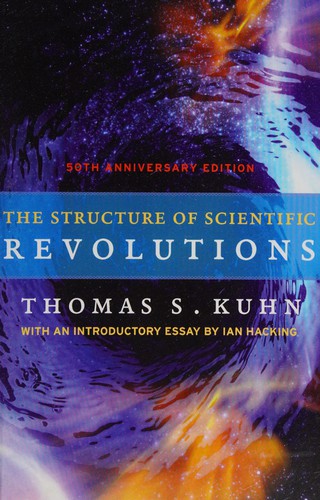
The Structure of Scientific Revolutions
University of Chicago Press · 2012 · 217 pages
ISBN: 9780226458120
Review Editor
Lena Park
Thomas S. Kuhn published The Structure of Scientific Revolutions in 1962 as a monograph in the International Encyclopedia of Unified Science, a project associated with the Vienna Circle’s effort to unify all scientific knowledge. The book’s place in that series was quietly ironic: Kuhn spent every page of it arguing that science is not the tidy, cumulative, progress-toward-truth enterprise that the Vienna Circle envisioned. It became one of the most cited academic books of the twentieth century, gave the phrase “paradigm shift” to the English language, and changed how historians, philosophers, sociologists, and working scientists understood what they were actually doing. The 50th anniversary edition, published in 2012 and bearing an introductory essay by philosopher Ian Hacking, is the standard text in use today.
Kuhn came to the history of science from physics, and his central argument arose from a specific confusion: when he taught science history to non-scientists at Harvard, he found that the old texts he assigned made no sense as records of people trying to discover the truth. They made perfect sense, he realized, as records of people doing competent work within a shared framework of assumptions, methods, and exemplary problems. This insight became the book’s engine. Kuhn proposed that science does not progress by accumulating established facts one by one, gradually clearing away ignorance. Instead, it moves through alternating periods he calls “normal science” and “revolutionary science.” Normal science is the day-to-day work of puzzle-solving within a paradigm. Revolutionary science is the rare, unsettling moment when anomalies pile up beyond the paradigm’s capacity to absorb them, a crisis develops, and the community shifts to a new framework that reorders everything.
The book is short, 217 pages in its original form, though the 50th anniversary edition runs longer due to Hacking’s introduction. Do not let the page count mislead you about the density of the argument. Each chapter builds on the one before it, and Kuhn moves through a clear sequence: what normal science is, how paradigms stabilize it, how anomalies arise, how crises deepen, what revolution feels like from inside, and what the word “progress” can possibly mean after you have accepted his argument. The concrete examples that anchor the theory come from astronomy, chemistry, and physics: Copernicus reordering the heavens, Lavoisier explaining combustion with oxygen in place of phlogiston, Einstein making time and space relative. These are not decorative illustrations. They are the argument.
The Scientists as Characters
Kuhn does not write about abstract forces. He writes about scientists confronting anomalies, resisting implications, arguing past each other, and occasionally converting to a new way of seeing. The practitioners of normal science he describes are not caricatures of blind conformity. They are rational actors within a system where conservatism makes sense: a paradigm is only worth having if you do not abandon it every time an experiment gives a puzzling result. Kuhn is sympathetic to the resistance. He understands why scientists working within a productive framework treat anomalies as puzzles to be solved rather than threats to be taken seriously. The system works, until it does not.
The most psychologically precise passages in the book concern the experience of seeing differently after a revolution. Kuhn uses Gestalt images of the duck-rabbit variety to describe what happens when a scientist moves from one paradigm to another: it is not that the world changes, but that the same phenomena reorganize themselves into a new configuration that the scientist now cannot unsee. Lavoisier did not discover oxygen the way you find a key you have lost. He learned, over time, to see the same experimental results as evidence for a completely different theory of combustion. The phlogiston chemists were not stupid. They were trained to see what their paradigm told them to expect. This portrait of scientists as people whose perception is shaped by their training is the most lasting and the most debated part of Kuhn’s argument.
Kuhn also draws a quiet portrait of the young scientist. Revolutions, he argues, are more often carried out by researchers relatively new to a field, or by outsiders, because they have not yet internalized the paradigm deeply enough to find the anomalies invisible. This is not a romantic story of the brilliant rebel. It is a structural observation about what commitment to a paradigm costs and what ignorance of it occasionally buys.
Pacing
The book builds steadily and rarely wastes a sentence. Kuhn does not write for casual readers, but he writes clearly. The first four chapters on normal science and paradigms are the most accessible, and they do the most to earn the reader’s confidence in the argument that follows. By the time Kuhn reaches the crisis chapters and the discussion of revolutionary perception, the groundwork is solid enough that even the most challenging claims land with some plausibility.
The middle section, where Kuhn discusses anomaly and crisis, can feel slightly repetitive across chapters. He circles back to the same examples from different angles, which serves the argument but occasionally slows the momentum. The final chapters, dealing with the nature of scientific progress and the question of whether science converges on truth, are the most philosophically complex and the section where readers unfamiliar with philosophy of science may need to slow down and reread. The Postscript added to the 1969 second edition, responding to critics who found his concept of “paradigm” hopelessly vague, is essential reading and sharpens arguments that the main text left underspecified.
Deeper Thematic Exploration
The question underneath everything in this book is: what is scientific progress, and is science actually getting closer to the truth? Kuhn’s answer is careful enough to have been misread in two opposite directions. He is not saying that science is arbitrary, that one paradigm is as good as another, or that the shift from phlogiston to oxygen was merely a change in fashion. He is saying that the standard story, which holds that science progresses by adding confirmed truths to a growing pile until we arrive at a complete description of nature, cannot be right. Successive paradigms are not simply more of the same. They reorganize the questions, redefine the key terms, and sometimes abandon problems that the previous paradigm considered central.
The concept of incommensurability is where Kuhn is most provocative and most careful to be misunderstood. He argues that scientists working in different paradigms cannot simply compare their theories term by term because the same word often means different things across paradigms. “Mass” in Newtonian mechanics and “mass” in relativistic mechanics are not interchangeable concepts despite sharing a name. This does not mean scientists cannot communicate across paradigmatic divides; it means that translation is harder than it looks, and that the apparent continuity of scientific vocabulary can mask discontinuities in meaning. The claim is about the difficulty of comparison, not the impossibility of judgment.
The book also has a great deal to say about the social structure of science, even though Kuhn presents it as philosophy. Normal science is only possible because a community of practitioners agrees on what counts as a problem, what counts as a solution, and what counts as a good argument. The paradigm is not just a theory; it is a form of professional life. This means that crises and revolutions are not just intellectual events. They are institutional events in which careers, laboratories, teaching programs, journals, and reputations are all at stake. Kuhn does not dwell on this, but it is present throughout. When he describes why scientists resist anomalies, he is describing people protecting not just their beliefs but their worlds.
The final chapters on progress are where Kuhn is most deliberately unsettling. He suggests that science might be better understood as evolving away from a state of confusion rather than converging toward a final true picture of nature. The analogy he draws is to Darwinian evolution: species become better adapted to their environments without evolving toward some ideal form. Scientific communities develop better tools for puzzle-solving without necessarily getting closer to a complete description of reality. Whether this is a profound reorientation or a way of refusing to commit to a position, readers have disagreed for sixty years. Kuhn himself seemed to believe he was making an epistemically responsible distinction, not denying that science works.
Style and Voice
Kuhn writes with an academic caution that can frustrate readers looking for bolder claims. He hedges, qualifies, and returns to earlier formulations to narrow them. The Postscript reads almost as an apology for having been misunderstood, and parts of it are uncomfortably defensive. But the main text has a clarity and economy that is rare in philosophy of science, and the concrete case studies anchor arguments that could easily float off into abstraction. When Kuhn describes the phlogiston chemists’ encounter with oxygen’s properties, you understand from the inside what it would feel like to be competent and confident in a theory that turns out to be wrong at the level of its most basic terms. That is a significant rhetorical achievement.
Ian Hacking’s introduction to the 50th anniversary edition is a model of what a scholarly introduction should do. It does not summarize the book (you are about to read it), and it does not bury it in academic praise. Instead, Hacking clarifies terms that Kuhn used loosely, situates the book in its historical moment, and asks which of Kuhn’s ideas have held up and which have required revision. Readers new to the book should read Hacking first. It will save them from some of the misreadings that became fashionable in the 1970s and 1980s, particularly the relativist readings that Kuhn spent much of his later career refuting.
Verdict
If you work in any field where knowledge is produced, tested, and revised, this is one of the books that explains how that process actually works, rather than how scientists tend to describe it in grant applications and Nobel lectures. The honest account of paradigms, anomalies, and the social resistance to revolutionary ideas is useful in ways that extend well beyond physics and chemistry. Researchers in medicine, economics, psychology, and any field with a methodology section will recognize themselves in Kuhn’s portrait of normal science. That recognition is uncomfortable and clarifying at the same time.
The book has real weaknesses. The concept of “paradigm” stretched so far under pressure from critics that Kuhn later acknowledged it covered at least two different things, which he tried to distinguish as the disciplinary matrix and the exemplar. Readers who want precise definitions will be frustrated. The book also says relatively little about how revolutions actually succeed, as opposed to how they start, and the question of what justifies accepting a new paradigm rather than simply preferring it gets less attention than the question of why the old one collapses. These are not fatal objections to a 60-year-old work that opened more doors than it closed. If you want to think clearly about how human communities build and protect and occasionally abandon their best explanations of the world, start here.
Frequently Asked Questions about The Structure of Scientific Revolutions
What is The Structure of Scientific Revolutions by Thomas Kuhn about?
The book is a philosophical and historical argument about how science actually changes over time. Kuhn proposes that science does not progress by steadily accumulating facts and correcting errors. Instead, it alternates between long periods of stable “normal science” and rare episodes of revolution, in which an entire framework of assumptions is replaced by a new one. Kuhn calls these frameworks “paradigms” and argues that the shift from one paradigm to another is the central event in the history of science.
What is a paradigm shift according to Thomas Kuhn?
A paradigm shift is Kuhn’s term for the revolutionary replacement of one scientific framework by another. It occurs when anomalies, results that the current paradigm cannot explain, accumulate to the point of crisis, and a new framework emerges that reorders the field’s fundamental assumptions, methods, and questions. Examples include the Copernican revolution in astronomy, Lavoisier’s replacement of phlogiston theory with oxygen theory, and Einstein’s transformation of Newtonian mechanics. The phrase has since spread widely into everyday language to describe any major conceptual change.
What are the main stages of a scientific revolution in Kuhn’s model?
Kuhn describes a roughly sequential process: first, a period of normal science in which a community works productively within a shared paradigm; second, the accumulation of anomalies that the paradigm cannot assimilate; third, a state of crisis in which confidence in the paradigm wavers and alternatives are explored; fourth, the emergence of a new paradigm that resolves the crisis; and fifth, a new period of normal science under the new framework. Kuhn is careful to note that these stages overlap and that the process is rarely as tidy as the outline suggests.
Is The Structure of Scientific Revolutions still considered accurate today?
Kuhn’s core insight, that scientific communities work within shared frameworks that shape what questions they ask and what counts as a good answer, is widely accepted across history, philosophy, and sociology of science. Some specific claims have been revised: the concept of incommensurability has been refined by later philosophers, and the idea of a single dominant paradigm fits some fields better than others. The book is less a settled theory than a set of questions that has reorganized the discipline. Most contemporary historians and philosophers of science engage with Kuhn even when they disagree with him.
How long is The Structure of Scientific Revolutions and is it difficult to read?
The original text runs approximately 210 pages; the 50th anniversary edition, with Ian Hacking’s introduction, is about 264 pages. Kuhn writes clearly for a philosopher, and the case studies from physics and chemistry make the abstract arguments tangible. The book assumes no prior background in philosophy of science, though familiarity with the history of physics helps. Most college-educated readers can work through it in a long weekend, though the final chapters on incommensurability and the nature of progress reward a second reading.
What does incommensurability mean in The Structure of Scientific Revolutions?
Incommensurability is Kuhn’s term for the difficulty of directly comparing theories from different paradigms. He argues that key terms often shift meaning during scientific revolutions: “mass” in Newtonian and Einsteinian physics, for example, refers to different theoretical entities despite sharing a name. This means scientists cannot simply weigh competing theories against a shared neutral set of facts. Kuhn is not saying that rational comparison is impossible, but that it is harder and more interpretive than the standard model of scientific rationality assumes. The claim has been debated and refined extensively since 1962.
How does The Structure of Scientific Revolutions compare to Popper’s philosophy of science?
Popper argued that science progresses by proposing bold theories and subjecting them to the most rigorous attempts at falsification. Kuhn responded that actual scientists do not behave this way. Normal scientists do not treat their paradigm as something to be falsified; they treat it as the framework within which puzzles are solved. Only in crisis does something like Popperian testing come into play, and even then the choice between paradigms is not purely a matter of logic and evidence. Popper and Kuhn represent two major traditions in 20th-century philosophy of science that are still in productive tension, and reading both together gives you a fuller picture than either provides alone.
Should I read The Structure of Scientific Revolutions and who will get the most from it?
Yes, with clear expectations about what kind of book it is. This is not a popular science book about interesting discoveries. It is a philosophical argument about how scientific communities function and change, and it requires engagement rather than passive reading. The people who get the most from it are those who work in or think seriously about any field that produces and revises knowledge: researchers, teachers, policymakers, journalists covering science, and anyone puzzled by why scientific consensus sometimes shifts dramatically. If you have ever wondered why smart, careful people defend a theory that later turns out to be wrong, Kuhn has the best available answer.
Book Details
- Title
- The Structure of Scientific Revolutions
- Author
- Thomas S. Kuhn
- Genre
- Science & Nature
- Publisher
- University of Chicago Press
- Year Published
- 2012
- Pages
- 217
- ISBN
- 9780226458120
- WritersReview Rating
- 4.4 / 5