
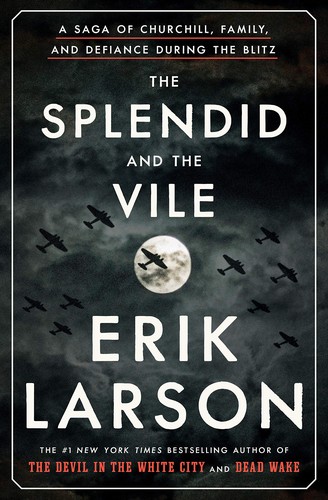
The Splendid and the Vile
Crown · 2020 · 608 pages
ISBN: 9780385348713
Review Editor
Thomas Calloway
The Splendid and the Vile opens on May 10, 1940, the day Winston Churchill became Prime Minister of Great Britain and Germany began its invasion of France and Belgium. Erik Larson, the author of Devil in the White City and Dead Wake, takes readers through the next 366 days: the evacuation of Dunkirk, the fall of France, and the London Blitz, when the German Luftwaffe dropped tens of thousands of tons of bombs on Britain. It is a book about war, but more precisely it is a book about how one man figured out how to make his nation willing to endure war.
Larson spent years working through unpublished diaries, private letters, declassified intelligence reports, and the archives of Churchill’s inner circle. He builds the narrative not just from Churchill’s own perspective but from those of people watching him work: Jack Colville, Churchill’s young private secretary who initially found the new PM boorish and frightening; Lord Beaverbrook, the press baron who ran the Ministry of Aircraft Production with the energy of a man half his age; Churchill’s daughter Mary, whose diary entries give a teenager’s honest view of life inside one of history’s most consequential families. The result is a portrait of wartime Britain that feels nothing like a textbook.
Published in February 2020 and an immediate number-one New York Times bestseller, The Splendid and the Vile was named one of the best books of the year by Time, NPR, the Washington Post, and a dozen other outlets. At 608 pages, it covers a single year in extraordinary detail, ending with Japan’s attack on Pearl Harbor and the American entry into the war: the moment Churchill had been working toward since the day he took office.
Character Arcs and Development
Churchill himself is not a character who changes in any conventional sense. He enters the book already formed: verbose, stubborn, fond of long baths and late nights, powered by brandy and cigars, capable of magnificent cruelty and magnificent kindness within the same hour. What Larson shows instead is Churchill in action, the qualities that had made him seem impossible and dangerous in peacetime suddenly becoming exactly what Britain needed. Churchill walks through bombed neighborhoods in a peacoat and homburg, weeping openly at the destruction, then turns to his staff and dictates a memo about mustard gas production. The contrast is not hypocrisy; it is the full range of a human being under genuine pressure.
Jack Colville’s arc is the clearest in the book. He arrives as a young civil servant who had served Neville Chamberlain and considered Churchill a dangerous warmonger. His diary entries from the early weeks of the new government read as almost hostile; he finds Churchill loud, disorganized, too theatrical. Over the course of the year, Colville becomes one of Churchill’s most devoted admirers, not because Churchill charmed him but because the work itself was undeniable. There is a scene where Colville watches Churchill, sitting in a garden in the English countryside, dictating correspondence in his dressing gown at two in the morning, and you can feel the young man’s confusion curdling into something like awe.
Churchill’s wife Clementine appears throughout as his most honest critic. She wrote him a remarkable letter, which Larson quotes at length, telling him bluntly that his manner had become so overbearing that his staff were afraid to tell him the truth. She asked him to reconsider his behavior before he isolated himself from the people trying to help him. It is the kind of letter that could only come from someone who loved the recipient deeply and feared what power was doing to him. Churchill listened. The secondary figures in the book, including Mary Churchill’s diary of adolescence during wartime and Beaverbrook’s volcanic correspondence, fill in the human texture that official histories skip over.
Pacing
Larson structures the book as a series of vivid set pieces, moving between Churchill’s world and the wider war, dipping into Mary Churchill’s diary for relief before returning to the rubble of the East End. The first half moves quickly; the Blitz begins in September 1940 and the book accelerates into the bombing season with real momentum. The middle section, covering the winter and spring of 1941, sags slightly as the aerial bombardment continues without decisive change. Larson acknowledges the monotony by leaning harder into personal stories and intelligence cables, which keeps the reader engaged but never quite disguises that the strategic situation has stalled.
The final chapters, covering the spring 1941 end of the Blitz and the long wait for American involvement, recover the earlier pace. By the time Pearl Harbor arrives, it lands less as a plot twist than as a release, which is exactly the feeling Churchill himself recorded in his diary. The book is long but rarely feels overlong; the only moments it drags are when Larson follows minor threads that don’t connect back to the central argument about leadership and endurance.
Deeper Thematic Exploration
The book’s deepest subject is the relationship between leadership and language. Churchill did not win the Battle of Britain with weapons alone, though weapons mattered enormously; he won it first with words. Larson is fascinated by the mechanics of Churchill’s rhetoric: the way he revised speeches obsessively, the way he used radio addresses not just to report news but to construct an emotional reality in which defeat was not an option people could access. The famous line about fighting on the beaches was not improvisation. Churchill worked it the way a jeweler works a stone, and Larson traces the revisions in enough detail that you begin to understand the craft behind the effect. Churchill himself understood this: he once told Colville that he had nothing to offer but blood, toil, tears, and sweat, and then he went upstairs to the Cabinet Room and made that plainness sound like poetry.
The book also asks, without moralizing, what the cost of this kind of leadership actually is. Churchill slept erratically, drank heavily, drove his staff to the edge of collapse, and placed unreasonable demands on everyone around him. He was also, on the available evidence, absolutely necessary. Larson simply puts both things in the same frame and lets them coexist: here is the machine Churchill built and what it produced, and here is what the machine required to run. Whether any of it was sustainable is answered by history. What the book offers is the texture of the year itself, the particular quality of living through something that might end civilization and choosing to act as if it won’t.
There is also a thread about ordinary people running beneath the main narrative. Larson pulls frequently from the diaries of Londoners who were not famous, who stayed in the city during the bombing and wrote down what they saw. A woman catalogues the contents of her handbag every morning before leaving the house, so the authorities will know who she was if she doesn’t return. A man keeps a record of the colors of the fires visible from his rooftop. These moments don’t argue anything explicitly, but they accumulate into a portrait of a population that had decided, in a very private and practical way, to keep going. The book suggests that Churchill did not manufacture this resilience; he recognized it and gave it a name.
Style and Voice
Larson writes narrative nonfiction in a mode that borrows from literary fiction without fabricating anything. He does not invent dialogue or interior monologue; every scene is sourced from a document, and the notes section at the back is extensive. What he does is select and arrange, choosing the detail that does the most work and building chapters with momentum, contrast, and the occasional sentence that stops you. The prose is clear, efficient, and occasionally beautiful without calling attention to itself. His description of bombed London at night, the city burning against a dark sky, reads more like poetry than journalism without crossing any line into invention.
The book’s voices are plural: Churchill’s letters and speeches, the diaries of Colville and Mary Churchill, intelligence intercepts from the German side showing what the Luftwaffe actually believed they were accomplishing. Larson moves between these perspectives with confidence, using each one to complicate the others. Churchill sounds more human when you can hear what his secretaries really thought of him. The Blitz feels more frightening when you can see it from both sides of the Channel. It is a structural achievement that keeps 600 pages from feeling repetitive.
Verdict
The Splendid and the Vile makes the past feel inhabited rather than archived. If you have read other Churchill biographies and found them too large and too reverential, this one is something different: smaller in scope, sharper in focus, and far more interested in what it actually felt like to be inside that year than in rendering a verdict on its protagonists. Larson writes for readers who want history to feel like a story, and he delivers without cutting corners on the evidence.
The book will appeal most to readers who enjoy narrative nonfiction written with a novelist’s attention to scene and character. If you want military history with maps, unit movements, and strategic analysis, you will find it thinner than a traditional campaign history. If you want to understand what Churchill’s England actually sounded like, what the people around him were writing in their private diaries, and how a year of near-total destruction could produce something that looks, from a distance, like collective courage, then this book is worth every one of its 608 pages.
Frequently Asked Questions about The Splendid and the Vile
What is The Splendid and the Vile by Erik Larson about?
The Splendid and the Vile covers Winston Churchill’s first year as Prime Minister of Great Britain, from May 1940 to December 1941. Drawing on private diaries, declassified intelligence reports, and family letters, Larson follows Churchill, his family, and his inner circle through the London Blitz, the fall of France, and the long effort to bring the United States into the war. It is as much about how Churchill sustained British morale as it is about the military events themselves.
Is The Splendid and the Vile based on true events?
Yes, it is narrative nonfiction. Larson spent years in archives and draws on primary sources throughout, including the unpublished diaries of Jack Colville, Churchill’s private secretary, and the personal diary of Churchill’s daughter Mary. Every scene is sourced. The book includes extensive endnotes documenting where each detail came from, making it as well-documented as any academic history.
What are the main themes in The Splendid and the Vile?
The book explores how leadership works under extreme pressure, the role of rhetoric and language in sustaining civilian morale, and the personal cost borne by those closest to power. It also examines ordinary resilience: Larson weaves in diaries from average Londoners to show how civilian populations cope when survival is genuinely uncertain. The transatlantic relationship between Churchill and Franklin Roosevelt provides a secondary thread throughout.
How long is The Splendid and the Vile and is it a difficult read?
The hardcover edition runs 608 pages. It is not a difficult read in the academic sense; Larson writes accessibly and structures the book as a series of vivid scenes rather than a dense argument. Readers who don’t usually pick up history books tend to find it engaging, though the sheer volume of names and dates in the middle section requires some attention. Plan for two to three weeks of casual reading or a week if you read quickly.
Did The Splendid and the Vile win any awards?
The book debuted at number one on the New York Times bestseller list in February 2020 and was named one of the best books of the year by the New York Times Book Review, Time, NPR, the Washington Post, the Chicago Tribune, Kirkus Reviews, and several other publications. It did not win a major book prize such as the Pulitzer or the National Book Award, but its commercial and critical reception placed it among the most celebrated history titles of recent years.
Is there a movie or TV adaptation of The Splendid and the Vile?
As of this writing, no film or television adaptation of The Splendid and the Vile has been produced. The subject matter has been covered from other angles: the film Darkest Hour (2017), starring Gary Oldman, focuses on roughly the same period of Churchill’s leadership, and the Netflix series The Crown addresses some of the same historical territory in its earlier seasons.
How does The Splendid and the Vile compare to Erik Larson’s other books?
Larson’s books share a method: rigorous archival research shaped into a fast-moving narrative that reads like a novel. The Splendid and the Vile is more intimate than Devil in the White City or Dead Wake because Larson has access to so many private diaries from people close to Churchill. It is probably his most emotionally engaging book and the one most concerned with interiority and family. Readers who loved Dead Wake for its moment-by-moment tension will find The Splendid and the Vile more expansive; readers who loved the personal texture of Erik Larson’s earlier books will likely prefer this one.
Should I read The Splendid and the Vile and is it worth it?
If you are drawn to well-researched narrative history, or if you have ever wondered how societies function when they are being destroyed from the air, yes, this book is worth your time. It is particularly good for readers who have been curious about Churchill but bounced off longer biographies. Readers who want a comprehensive account of the military and political history of World War II will need to supplement it with other books; Larson keeps the focus narrow and personal. But within those limits, it does exactly what it sets out to do.
Book Details
- Title
- The Splendid and the Vile
- Author
- Erik Larson
- Genre
- History
- Publisher
- Crown
- Year Published
- 2020
- Pages
- 608
- ISBN
- 9780385348713
- WritersReview Rating
- 4.3 / 5