
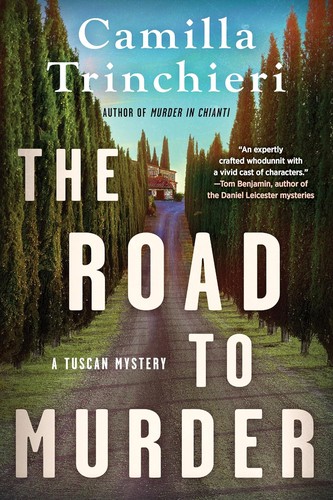
The Road to Murder
Soho Crime · 2024 · 300 pages
ISBN: 9781641295567
Review Editor
James Voss
Camilla Trinchieri’s The Road to Murder, published by Soho Crime in 2024, is the fourth entry in her Tuscan Mystery series featuring Nico Doyle, a retired New York homicide detective who relocated to the small Chianti wine town of Gravigna after the death of his wife. The series has built a devoted readership for its combination of Italian atmosphere, food culture, and thoughtfully plotted mysteries, and this installment delivers on the promise of its predecessors while pushing Nico’s character and personal situation into more demanding territory.
The novel opens with Nico discovering the body of a local man in the vineyard of a nearby estate during the autumn harvest season. The victim is connected to a tangle of old grievances, family disputes over land and inheritance, and a recent influx of outside money that has disrupted the town’s established relationships. Nico, who has been gradually establishing himself as an informal resource for the local carabinieri, finds himself drawn into an investigation that requires him to understand the specific social dynamics of a small Italian community in ways that his New York instincts do not automatically provide.
Trinchieri writes with the insider-outsider perspective of someone who has spent considerable time in Tuscany while retaining the analytical distance of someone who was not born into it. The result is a depiction of Italian provincial life that is affectionate without being sentimental and observant without being condescending.
Character Arcs and Development
Nico Doyle continues to be the kind of series protagonist who becomes more interesting as his history accumulates. His late wife Stella, who was from Gravigna, is present throughout the novel as an absence that shapes what Nico does and how he sees the community: he is here partly out of loyalty to her memory and partly because the town has become, somewhat to his surprise, genuinely his. Trinchieri handles this emotional situation with a light touch: Nico is not defined by his grief, but it informs his perceptions in ways that feel authentic.
The secondary characters in Gravigna are one of the series’ consistent strengths. Trinchieri has built a community cast across four books, and returning readers will find familiar faces who have continued to develop. The carabinieri sergeant who works alongside Nico is given a more prominent role in this installment, and the dynamic between the two men, with their different professional backgrounds and different relationships to the community, drives much of the novel’s investigative momentum.
The victim and the family surrounding him are drawn with enough complexity to make the investigation feel like it matters. Trinchieri is particularly good at the Italian family dynamics she depicts: the specific combinations of loyalty, resentment, and obligation that operate differently from the American family structures Nico knows.
Pacing and Tension
Trinchieri moves the investigation forward at a pace that allows the atmosphere of the harvest season and the Chianti landscape to register without becoming a travelogue. The novel is fundamentally comfortable in its rhythms, which suits the cozy end of the crime fiction spectrum, but it does not shy away from genuine menace when the story requires it. The tension, when it builds, emerges from the specific social pressures of a small community where everyone knows everyone and the stakes of exposure are social as well as criminal.
The pacing is consistent throughout without the sagging middle that can affect series mysteries. Trinchieri keeps the pages turning through a combination of character and landscape that makes the reading experience itself pleasurable rather than just the narrative outcomes.
Deeper Thematic Exploration
The arrival of outside money in a traditional wine-producing community is the novel’s central social preoccupation. The Chianti region has been attractive to wealthy foreign and urban Italian buyers for decades, and the specific tensions this creates, between those with deep roots in the land and those who arrive with capital and different ideas about what the landscape is for, give the murder its context. Trinchieri is interested in what is at stake when communities with specific cultural practices and economic structures come into contact with the pressures of global capital.
The novel also reflects on what it means to belong to a place you were not born into. Nico’s position in Gravigna is permanently that of an outsider who has become a resident: he understands more than a tourist would and less than someone who grew up there. The investigation’s difficulties are partly a function of that position, and Trinchieri uses it to examine how knowledge and trust operate in communities defined by long-established relationships.
Style and Voice
Trinchieri writes in a warm, observational prose style that captures the sensory texture of Tuscan life with genuine pleasure. The food and wine that appear throughout the series are rendered with a specificity that makes them feel essential rather than decorative: they are part of how the community operates and what it values, and the scenes organized around shared meals carry social information alongside the obvious pleasure they provide.
The dialogue is the series’ most demanding technical element: Trinchieri writes characters who speak different versions of Italian, English, and dialect, and the dialogue system she has developed captures the social meanings of those choices without requiring linguistic expertise from the reader. This is harder than it looks, and she does it well.
Verdict
The Road to Murder is exactly what the best series mysteries can be: a novel that satisfies fully as a standalone while enriching the experience of readers who have followed Nico Doyle from the beginning. The mystery is well-constructed, the Italian setting is rendered with genuine love and knowledge, and the character work has deepened across four books into something worth following for its own sake.
Readers new to the series can start here without difficulty, though starting with the first book offers the benefit of watching the community and its relationships build. Anyone who enjoys Italian-set mysteries, atmospheric crime fiction with strong sense of place, or character-driven procedurals with a distinctive protagonist will find this series a consistently rewarding choice.
Frequently Asked Questions about The Road to Murder
What is The Road to Murder by Camilla Trinchieri about?
The Road to Murder is the fourth Nico Doyle mystery, set in the Chianti wine region of Tuscany. Nico, a retired New York homicide detective who relocated to his late wife’s home village, discovers a body during the autumn harvest and is drawn into an investigation involving land disputes, family grievances, and the tensions created by outside money entering a traditional community. Published by Soho Crime in 2024.
Is The Road to Murder part of a series and should I start here?
This is the fourth Nico Doyle mystery. The series begins with Murder in Chianti, followed by The Bitter Taste of Murder and The Road Ends at the Sea. Each novel works as a standalone mystery, but readers who start at the beginning will have richer context for the community characters and for Nico’s personal situation. New readers can start here without being lost.
What makes the Tuscan Mystery series distinctive compared to other Italian-set crime fiction?
Trinchieri brings an insider-outsider perspective that is different from both native Italian crime writers and from writers who use Italy primarily as backdrop. Her Nico Doyle is genuinely embedded in a specific community while still experiencing it partly from outside, which creates a dynamic social observation that captures both the appeal of Italian provincial life and its genuine complications. The food and wine culture is treated as sociologically significant rather than decorative.
What are the main themes in The Road to Murder?
The novel explores the tensions between tradition and outside capital in a wine-producing community, what it means to belong to a place you were not born into, the specific dynamics of Italian family loyalty and grievance, and the way small communities process crime and shame. Trinchieri addresses these themes through the investigation rather than as explicit propositions.
How long is The Road to Murder and what kind of reader is it for?
The novel runs approximately 300 pages and reads at a comfortable pace. It sits at the more atmospheric, character-driven end of the crime fiction spectrum rather than the thriller end: readers who want propulsive action and high stakes violence will find it more gentle than they prefer. Readers who enjoy mysteries where the pleasure is as much in the world-building and character as in the puzzle will find it exactly right.
Is there a film or TV adaptation of the Nico Doyle series?
No adaptation of the Tuscan Mystery series had been announced as of the publication of The Road to Murder. The series has the kind of atmospheric, character-rich quality that translates naturally to television, and the Italian location is obviously appealing to screen producers, but it remains exclusively in print form.
How does The Road to Murder compare to other Tuscany-set crime fiction?
The most obvious comparison point is Donna Leon’s Commissario Brunetti series, set in Venice, which shares the Italian setting, the attention to food and culture, and the interest in how traditional communities navigate contemporary pressures. Trinchieri’s work is slightly warmer in tone and more focused on a community of recurring characters than Leon’s, and the American outsider perspective of Nico Doyle gives it a different dynamic than a native Italian protagonist would.
Should I read The Road to Murder by Camilla Trinchieri?
Yes, if you enjoy atmospheric mysteries set in distinctive locations with characters worth returning to. Trinchieri has built one of the more pleasurable series in contemporary crime fiction, and this installment maintains the quality of its predecessors. New readers should be prepared for a mystery that prioritizes atmosphere and character over thriller mechanics. If that is what you are looking for, this delivers it consistently.
Book Details
- Title
- The Road to Murder
- Author
- Camilla Trinchieri
- Genre
- Mystery & Thriller
- Publisher
- Soho Crime
- Year Published
- 2024
- Pages
- 300
- ISBN
- 9781641295567
- WritersReview Rating
- 4.0 / 5